


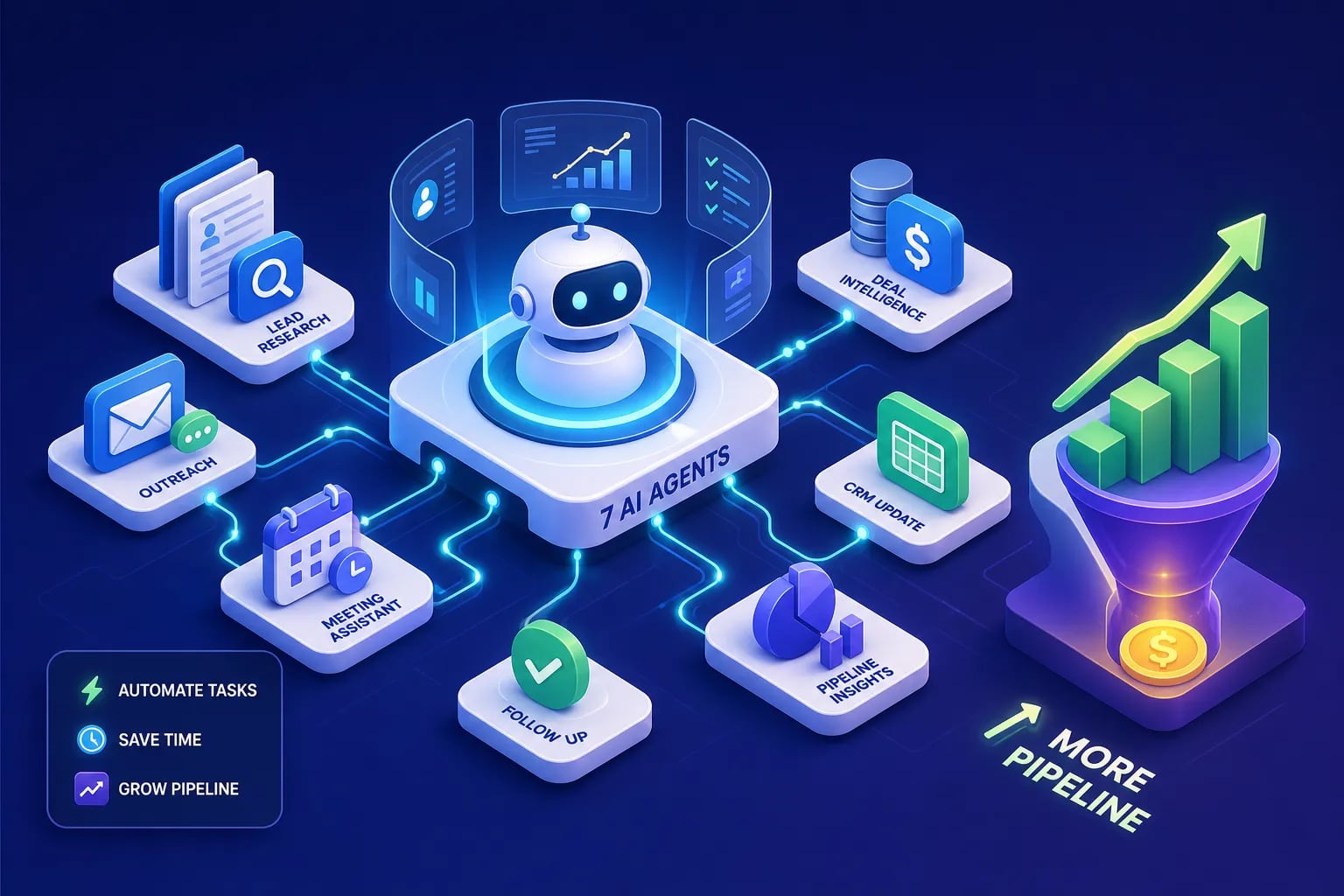
There is a meaningful gap opening between sales teams that use AI as a support tool and those that deploy AI agents capable of independent action. Copilots answer questions. Agents execute workflows. Many leading agents can automate significant parts of the sales process, researching prospects overnight, scoring deals in real time, triggering follow-up sequences, and flagging objection patterns mid-call, without daily manual input from a rep. This guide to 7 AI agents for sales teams cuts through the vendor noise so you can make a decision you can act on this week.
Many sales leaders in mid-sized B2B firms across India recognise that AI matters. What is less clear is which agent does what, which one fits your existing motion, and which one is worth the investment right now. This article addresses that directly. It is the same clarity we build into every AI Enabled Solutions workshop at Growth Aspire: identify your workflow gap, match it to the right agent category, and move.
By the end of this article, you will have a shortlist of two or three AI agents worth trialling, with enough context to start next week.
What makes an AI agent different from a regular sales tool
Most AI features embedded in CRMs offer suggestions. They highlight a deal at risk, recommend a next step, or draft a response when a rep asks for one. That is a copilot. A genuine AI agent operates differently: it completes multi-step tasks autonomously, researching a contact, drafting a personalised sequence, sending it, logging the reply, and updating the CRM record, without a rep manually initiating each step.
Consider the difference in prospecting. A rep manually working a list might process 20 accounts in a day. Vendors and published case studies report multiple-fold increases in qualified meetings when a prospecting agent runs the same motion overnight, applying buying signals and populating a prioritised outreach queue for the rep to review in the morning. The output is not just faster; it is fundamentally different in scale and consistency. This is where sales automation AI creates its clearest advantage.
Agents act, copilots advise
A copilot waits for a human to ask it something. An AI agent executes a workflow end-to-end based on triggers, goals, and data. Many teams are using copilots as their first step into AI, which is a reasonable starting point, but the ROI gap between the two is significant. Teams that shift from copilots to agents report 10, 20% sales ROI improvement and measurable pipeline lift within the first quarter, according to early adopter benchmarks from vendors including Gong and Salesloft.
The three things every agent needs to function
Before evaluating any agent, check three inputs: clean CRM data, defined workflow triggers, and the right integrations. Most implementations stall not because the agent is flawed but because the underlying data is messy. Address data readiness before you sign a contract. It is consistently the step teams underestimate, implementations frequently stall early if data quality issues are not remediated before go-live, and that delay costs more than the vendor contract.
Agents 1, 3: Building the pipeline before a rep ever picks up the phone
These three agents form the pipeline generation layer. They work upstream, before outreach begins, handling the research, qualification, and personalisation that SDRs typically spend hours on each week. If your pipeline volume is the primary problem, this is where you start. When evaluating 7 AI agents for sales teams, most B2B leaders find that at least one of these three addresses their most pressing gap.
1. Prospecting agent
An autonomous prospecting agent identifies target accounts, pulls contact data, applies buying signals, and launches personalised outreach sequences with minimal SDR input. Vendors like Artisan and 11x.ai operate in this category. Artisan’s public self-serve pricing starts at approximately $0, $250 per month on entry tiers, while enterprise contracts and older pricing sources report $1,500, $5,000 or more per month; confirm current plan details on Artisan’s pricing page before committing. 11x.ai sits firmly in the enterprise bracket, with annual contracts typically running $50,000 or more. Teams using fully autonomous prospecting agents report creating significant pipeline without proportional headcount growth, in some reported deployments, AI has sourced a substantial share of qualified meetings. Both platforms generally integrate with Salesforce and HubSpot; confirm with each vendor whether the agent writes data back to your CRM or reads from it only, as that distinction significantly affects long-term value.
2. Research and enrichment agent
Before your outreach lands, your prospect data needs depth: job title changes, tech stack, intent signals, recent funding announcements, news triggers. Enrichment agents such as Clay and Cognism handle this layer, functioning as a virtual sales assistant that sits between list building and sequencing. Clay operates on a credit and consumption model, starting around $149 per month and scaling with usage. Cognism focuses on compliant B2B data, particularly useful for Indian B2B teams targeting international accounts. Vendor case studies consistently link personalisation at scale to measurable reply-rate improvements, and this agent sits precisely at the point where a generic sequence becomes a relevant one. Without it, even a strong outreach sequence lands cold.
3. Lead qualification agent
Inbound leads do not qualify themselves. A qualification agent, one of the most practical AI lead qualification tools available today, scores leads based on ICP fit and engagement behaviour, routes them to the right rep, and sends alerts when a high-fit prospect takes action. Salesloft and HubSpot Breeze both handle this function, embedded within their broader platform pricing. The measurable impact is clear: reps spend time only on high-fit leads, which compresses the early stages of the sales cycle and reduces the cost of wasted discovery calls.
Agents 4, 5: Winning deals that are already in motion
Once a prospect has engaged and an opportunity is open, these two agents work mid-cycle: one improving pipeline visibility, the other providing real-time support in live conversations. This is the deal execution layer, and it is where complex B2B sales are won or lost.
4. Deal-scoring agent
A deal-scoring agent continuously analyses CRM activity, email engagement, meeting frequency, and stakeholder involvement to assign a health score to every active opportunity. This is fundamentally different from traditional lead scoring, which ranks prospects by fit. Deal-scoring agents assess trajectory. They look at whether touchpoints are accelerating or decelerating, whether the champion has gone quiet, and whether a deal is stuck in a stage that similar deals moved through more quickly. ZoomInfo Copilot and Gong’s pipeline intelligence are the clearest examples in this category. Both operate on enterprise custom pricing, integrating natively with Salesforce and Microsoft Dynamics. Teams using deal intelligence consistently report fewer forecast surprises and clearer pipeline visibility heading into a quarter-end review.
5. Objection-handling agent
Cresta is a leading real-time call support agent used by enterprise sales teams. It listens to live conversations, detects objection patterns, and surfaces relevant responses or case studies on the rep’s screen during the call itself. Deployment for a mid-sized sales team typically takes four to eight weeks, covering telephony integration, call routing setup, and team training. Pricing is enterprise custom, generally bundled with call intelligence platforms. For newer reps in complex B2B sales cycles, the practical benefit is immediate: they receive in-the-moment guidance rather than waiting for a post-call debrief that comes too late to change the outcome of a deal already in progress.
Agents 6, 7: Keeping momentum alive between meetings
The gap between a good first meeting and a closed deal is where most B2B opportunities quietly die. Follow-up is inconsistent, content is generic, and deals go silent while reps chase other priorities. These two agents address the momentum layer directly and are often the difference between a deal that closes and one that gets lost to inertia.
6. Follow-up agent
A follow-up agent triggers personalised follow-up sequences based on what happened in a meeting or call. It sends the right content, re-engages silent prospects, and nudges reps when a deal has gone quiet for too long. Outreach and Salesloft are the leading platforms in this category, both on enterprise custom pricing. The measurable impact is reduced deal slippage and faster next-step progression. One important requirement: this agent needs clean meeting outcome data fed from your CRM. If your reps are not logging call dispositions consistently, the agent’s triggers will not fire accurately.
7. Conversation intelligence agent
Gong is the benchmark in post-call conversational sales AI. Unlike Cresta, which operates in real time, Gong analyses recorded calls to surface coaching insights, flag risk signals in active deals, and track which talk tracks correlate with wins. Teams using conversation intelligence report 12, 18% win-rate improvement in 2026 benchmarks published by Gong, and the compounding effect on rep coaching quality is significant over a full quarter. Gong operates on enterprise custom pricing with no public tiers. For sales managers, this is the agent that makes coaching conversations specific rather than general, grounded in evidence from actual calls rather than memory or intuition.
How to shortlist the right agents and plan for deployment
Three filters apply before you commit to any agent. First, identify your workflow gap: is the problem prospecting volume, qualification accuracy, or follow-up consistency? Each maps to a different agent layer. Second, check your data readiness: is your CRM clean enough for an agent to work from? Third, confirm integration fit, does the agent connect to what you already use, and does it write back to your CRM or only read from it?
For pricing orientation: Apollo starts around $49 per month for lighter prospecting and data work; Clay starts around $149 per month; autonomous SDR-style agents like Artisan are reported at enterprise contract levels of $1,500, $5,000 or more per month depending on scope and tier. Implementation timelines range from a few days for managed no-code agents to three to six months for self-hosted or complex enterprise builds. As a starting point, and this reflects what we observe across pilot teams, most mid-sized B2B teams benefit from beginning with one pipeline-layer agent and one momentum-layer agent before expanding their stack.
Matching agents to where your pipeline actually breaks
Diagnosing the gap before evaluating vendors is the most important step. The category of agent matters more than the vendor within it. Use the following as a quick reference:
- Prospecting volume problem: Start with a prospecting or enrichment agent.
- Qualification accuracy problem: A lead qualification agent addresses the routing and scoring gap.
- Follow-up consistency problem: A follow-up or conversation intelligence agent keeps deals moving and improves coaching over time.
CRM integrations to confirm before you commit
The most common integrations across all seven agent types are Salesforce, HubSpot, and Microsoft Dynamics. Most agents connect via REST APIs or native connectors. The critical question to ask every vendor: does the agent write data back to your CRM, or does it only read? Read-only agents can support decisions; write-back agents update records, trigger workflows, and maintain data hygiene automatically. That distinction determines long-term ROI more than any feature comparison.
How Growth Aspire’s AI workshops help your team activate these agents
Knowing which 7 AI agents for sales teams exist is step one. Knowing which one fits your specific sales motion, how to evaluate vendors intelligently, and how to build an implementation plan without IT leading the charge, that is a different skill set entirely, and it is where most teams get stuck.
Growth Aspire’s AI Enabled Solutions for Revenue Teams workshop addresses exactly that gap. It is not a product demo or a tool tutorial. It is a structured process that helps mid-sized B2B sales teams across India match the right agent to their existing workflow, assess vendor fit, and build a 30-day activation plan they can execute immediately. Some participants have moved from general AI awareness to a live agent deployment in under eight weeks.
What the AI workshop covers
Participants leave with three concrete outputs: a prioritised agent shortlist based on their actual workflow gaps, an integration readiness checklist that flags data issues before they become implementation problems, and a 30-day activation plan mapped to their existing sales process. No generic advice and no ambiguity, a specific, executable plan for your team’s motion, built in the room.
The competitive advantage is available now, not later
These 7 AI agents for sales teams represent a present-day competitive advantage for B2B firms willing to move beyond dashboards and copilots. To bring it together: prospecting agents build pipeline with minimal manual input; enrichment agents deepen data before outreach; qualification agents filter and route inbound leads; deal-scoring agents assess pipeline health in real time; objection-handling agents support reps mid-call; follow-up agents keep deals moving between meetings; and conversation intelligence agents improve coaching quality post-call.
Pick the one workflow gap that costs you the most deals each quarter. Find the agent that addresses it. Run a focused 30-day trial with clean data and clear success metrics. If you want structured support rather than trial and error, Growth Aspire’s AI workshops give your team a clear path from shortlist to deployment, try a 30-day pilot with the framework we build in the room.