


Every head of sales at a mid-sized B2B firm knows the feeling: deal signals are piling up in your CRM, your reps are buried in admin, and your pipeline review still feels like digging through old records to piece together what actually happened last week. The tools are there. The data exists. But nobody is acting on it fast enough.
Agentic AI for sales changes that equation, and teams that deploy it thoughtfully are compressing their sales cycles without adding headcount or disrupting the reps who carry the number.
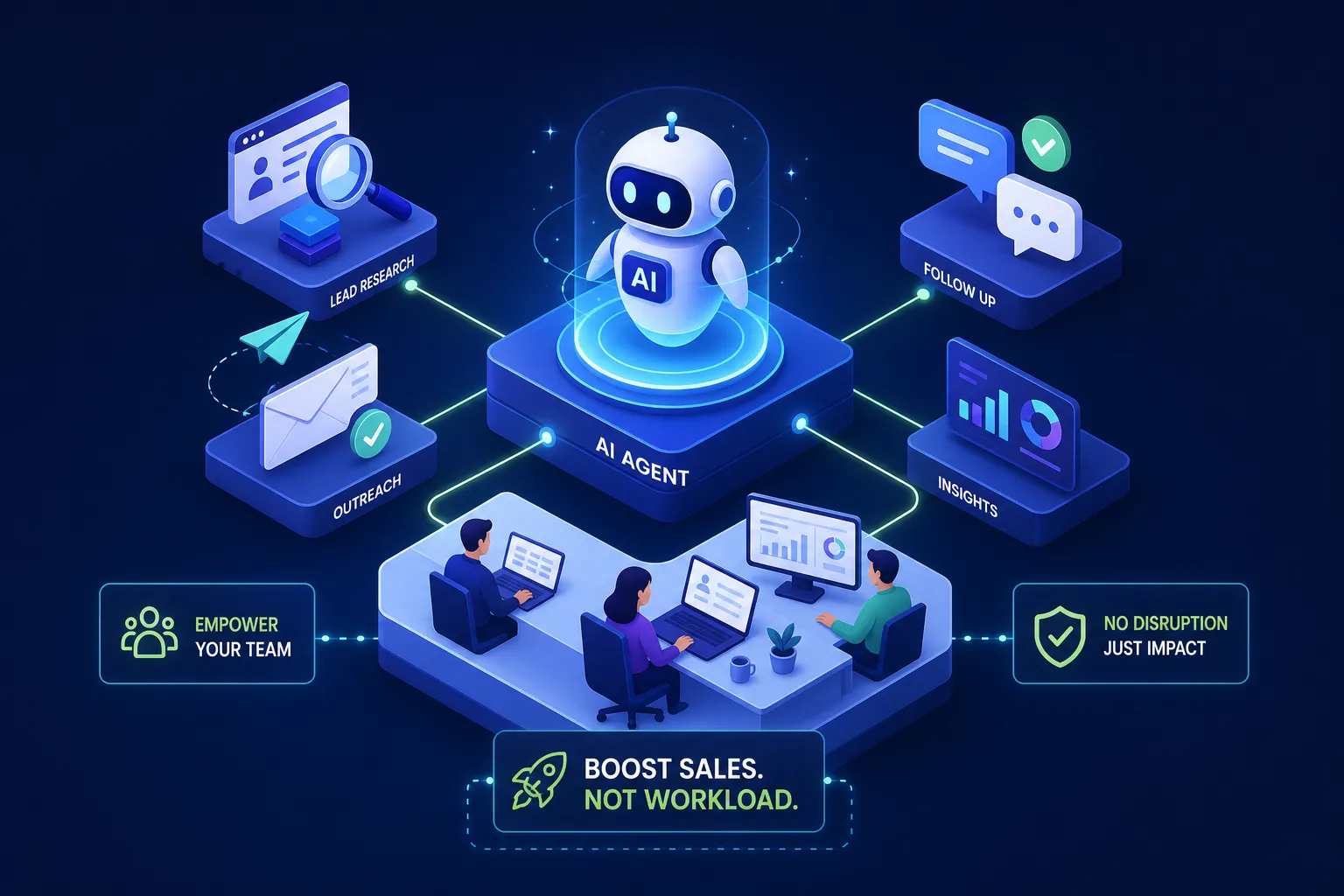
This is not another chatbot or a rule-triggered email sequence. Agentic AI is goal-centred, multi-step, and capable of acting with limited human supervision. The difference matters more than most people realise. Instead of waiting for a rep to click send, an autonomous AI agent spots a stalled deal, cross-references CRM history and recent account news, personalises a follow-up, and logs the outcome, all without a manual prompt.
McKinsey’s research on agentic sales deployments points to 2 to 3x higher conversion rates and tripled appointment-setting rates from teams that have adopted this approach. Revenue teams deploying agentic AI for sales are beginning to act on deal signals hours before those signals would have surfaced in a traditional review cycle.
By the end of this article, you will know exactly where to deploy autonomous sales assistants in your workflow, what results to expect, and how to do it without disrupting your team.
What makes agentic AI for sales different from regular sales automation
The three-tier distinction every sales leader needs to know
Most sales leaders are working with three types of AI simultaneously without realising it.
- Traditional sales automation executes fixed, rule-triggered workflows: send a follow-up email on day three if no reply is logged.
- Conversational AI handles language, it helps a rep draft that follow-up or answers a buyer’s question in chat, see examples like ChatGPT for B2B sales.
- Agentic AI does something qualitatively different. It pursues an outcome end-to-end, reasoning across multiple steps, using tools and data sources, and adapting when conditions change.
The stalled-deal scenario makes this concrete.
Traditional automation sends a canned message at a preset interval.
Conversational AI helps the rep write a better one.
An agentic system notices the stall without being prompted, cross-references the CRM history and recent account news, drafts a personalised sequence matched to the deal stage, selects the next best action, executes it, and updates the pipeline record.
The distinction is clean: automation executes rules, conversational AI handles language, agentic AI pursues outcomes.
Why “autonomous” doesn’t mean “unsupervised”
The word autonomous tends to make sales leaders nervous, especially when customer-facing communications are involved. That concern is valid, and the good news is that agentic AI is designed to operate within defined guardrails.
The agent pursues a sales outcome, booking a meeting, updating a deal stage, flagging a risk, but humans set the rules, approve sensitive actions, and review outcomes.
For mid-sized Indian B2B teams that are cautious about ceding control of enterprise relationships, this framing is essential. Autonomy within boundaries is the operating model, not autonomy without accountability.
The B2B sales workflows where autonomous agents deliver the most value
Prospecting and lead qualification at scale
The top of the funnel is where agent-based sales automation earns its place most clearly. The multi-step workflow here is entirely repeatable: identify high-fit leads from firmographic and behavioural signals, score them, personalise the outreach, follow up, and schedule the meeting, all without rep involvement until the prospect is qualified.
Sales teams using agentic AI for lead qualification consistently report reclaiming several hours per rep per week that were previously lost to manual research and sequencing, a finding supported by productivity benchmarks across agentic CRM deployments. Because the logic is data-rich and consistent, this is exactly the kind of workflow where autonomous AI agents perform reliably from day one.
Deal coaching nudges and pipeline risk detection
AI agents in sales workflows continuously monitor opportunity health in the background. They flag deals that have gone quiet, surface missing stakeholders in complex enterprise accounts, match the right playbook to the current deal stage, and push a next-best-action recommendation to the rep before the weekly pipeline review, not after it.
Growth Aspire’s AI-based sales solutions include a deal intelligence layer built specifically for revenue teams that need to act on these signals faster, without adding headcount or a new dashboard sitting outside the tools reps already use.
Follow-up automation and CRM hygiene
Call summaries, email thread extraction, automatic logging of action items and deal stage updates: this is the unglamorous work that agentic automation handles consistently. It is not merely about saving time, though the efficiency gains are immediate.
Clean, complete CRM data is the foundation for every coaching conversation, every territory planning decision, and every forecast that a sales leader presents to the board. When generative agents for sales handle this hygiene work automatically, forecast accuracy improves and pipeline reviews become forward-looking rather than forensic.
What the numbers actually say: results mid-sized B2B teams are reporting
The headline metrics worth tracking
McKinsey’s ‘Agents for Growth’ research on agentic sales deployments is worth examining directly: 2 to 3x higher conversion rates, tripled conversion-to-appointment rates, a 5 to 8% revenue increase, and up to a 30% reduction in cost-to-serve.
A 2023 Creatio study of agentic CRM deployments reported 61% faster lead response times. Deloitte’s benchmarks for AI-assisted lead scoring indicate a 20 to 30% uplift in conversion rates for mid-sized B2B teams, while Gartner’s analysis of sales cycle length suggests reductions of up to 30% where agentic automation is deployed across qualification and follow-up workflows.
These figures come from well-resourced deployments and set a realistic ceiling for your internal business case, they are not guaranteed outcomes from a first pilot. Use them to anchor the conversation with leadership, not to promise a specific return in month one. A well-scoped 30-day pilot against clear KPIs will tell you far more about what is achievable in your specific environment.
The KPIs to measure from week one
Early-stage pilots should be measured on indicators that build internal confidence before the bigger revenue numbers materialise.
Track five metrics from day one: time saved per rep per week (an immediate, visible proof point), CRM data completeness score, meeting-booked rate from AI-assisted sequences, deal velocity measured in days per stage, and forecast accuracy. These are the numbers that tell you whether the autonomous sales assistant is working correctly and earning trust with your sales team before you scale.
How to pilot agentic AI for sales without breaking your current workflow
The five-step deployment plan for mid-sized B2B teams
A structured pilot is the difference between a deployment that sticks and one that gets quietly abandoned after 60 days. Follow these steps in sequence:
- Pick one high-friction workflow, such as inbound lead qualification or post-demo follow-up, not your most complex process. Start where the logic is repeatable and the data already exists. Beginning with a contained, well-defined use case gives the pilot a fair chance to produce clean data.
- Audit your CRM data quality first. Agents are only as good as the data they act on. Duplicate records, stale ownership fields, and missing contact information will undermine results before the pilot even begins. A data audit is not optional, it is the first deliverable.
- Define the agent’s permitted scope. Decide which actions are fully autonomous and which require human approval. Pricing, discounts, and legal commitments must sit behind an approval gate. Outreach sequences, meeting scheduling, and standard CRM updates are common candidates for autonomous execution, though your governance framework should confirm this based on your customer relationship risk profile.
- Run a 30-day closed pilot with a small rep cohort and measure against the five KPIs from the previous section. Cohort size should reflect your sales cycle length and the statistical confidence you need; in most mid-sized B2B environments, three to five reps provides directional data without exposing the full pipeline to a new system.
- Review, retrain, and expand. Use the pilot data to identify where the agent performs well, where it needs refinement, and where the evidence supports making the case for the next workflow and a wider rollout to leadership.
What integration actually looks like in practice
Picture your rep opening Zoho on a Monday morning and seeing a prioritised list of at-risk deals with recommended next actions already queued, no separate app to log into, no new dashboard to learn.
That is what good AI sales orchestration looks like in practice. The agent connects to your CRM (Salesforce, HubSpot, or an equivalent), your email and calendar systems, and your call recording tool, reading from and writing to the same interfaces reps work in every day. This is a deliberate design choice that reduces the adoption friction that kills most new sales technology rollouts.
Governance and risk controls before you go live
The accountability framework your legal and ops teams will ask for
Four controls are non-negotiable before any agentic deployment goes live: audit logs for every outbound agent action, human approval gates for pricing and contract-level decisions, data minimisation so the agent accesses only what it needs to complete its task, and a clear escalation path when the system encounters a scenario outside its defined scope. For practical templates and checklist material, see IBM’s agentic AI governance playbook.
Indian companies also need to account for the Digital Personal Data Protection Act 2023 (DPDP Act). The Act requires clear purpose limitation, valid consent or a recognised legitimate use as the legal basis for processing, meaningful notice to data principals, and appropriate security safeguards.
Any agentic CRM deployment that processes customer or prospect data must be designed with these requirements built in from the start, not bolted on after deployment. Reviewing the DPDP Act text or a qualified legal summary before finalising your governance framework is strongly recommended, see a practical DPDP Act compliance guide.
The three questions to answer before your pilot goes live
These are not hypothetical governance questions. They are precisely what your legal, compliance, and operations leads will ask when you brief them on the pilot:
- Who is accountable when the agent makes a mistake in a customer communication, and what is the remediation process?
- What is the human review cadence for agent-generated outreach, and who conducts those reviews?
- How do you switch the agent off quickly if something goes wrong, and who has the authority to do so?
Having documented answers to all three before the pilot launches protects the project, builds internal confidence, and demonstrates to stakeholders that the deployment is being managed responsibly.
What to look for in an agentic AI partner for mid-sized sales teams
The capabilities that matter most (and what to ignore)
For a mid-sized B2B sales team, the capabilities that genuinely move the needle are: deep CRM integration that is native rather than bolted on, deal intelligence that surfaces signals in context rather than in a separate dashboard, a coaching layer that supports rep development, and a deployment model that does not require a lengthy IT project to get live.
Implementation timelines vary by complexity, but solutions designed for mid-sized teams should not demand the same runway as an enterprise platform rollout. Vendor claims built around phrases like “fully autonomous” or “zero human involvement” are risk factors disguised as features. The right partner builds autonomy with guardrails, not autonomy as a default.
Why Growth Aspire’s AI Agentic Solutions are built for this
Growth Aspire’s AI Agentic Solutions are designed for mid-sized revenue teams that need to act faster on deal signals without hiring additional headcount or replacing their current CRM setup. We have expertise built to help AI Agentic solutions across sales
The solutions sit on top of existing workflows, layer in deal intelligence and automated follow-up, and connect directly to Growth Aspire’s sales coaching programmes.
This matters because reps are not just getting automation, they are building the skills and judgement to work alongside it effectively. For Indian B2B teams navigating complex enterprise deals, this combination of agentic AI for sales and human-led coaching is the practical, scalable path to revenue growth that does not create dependency on a single technology platform.
Starting your agentic AI for sales deployment the right way
Deploy agentic AI for sales correctly and your reps reclaim the hours lost to admin, act on deal signals before they go cold, and carry more pipeline with the same headcount. The benchmark data from McKinsey, Deloitte, and Gartner all point in the same direction, the question is not whether the returns are real, but whether your deployment is structured to capture them.
The five-step pilot plan outlined above is the practical starting point: pick one high-friction workflow, fix your data quality, define the agent’s scope, run a 30-day closed pilot with a small cohort, and use the results to earn the mandate for wider rollout. Each step is achievable within your current operational structure without disrupting the wider team.
If you are ready to explore how autonomous agents can be layered into your existing revenue workflow, book a scoping call with the Growth Aspire team to map the solution against your current CRM setup and sales process. The goal is a deployment that is live quickly, governed properly, and built to scale.
You can visit explore more here and also require for a focused workshop on deploying agentic AI in B2B sales.