



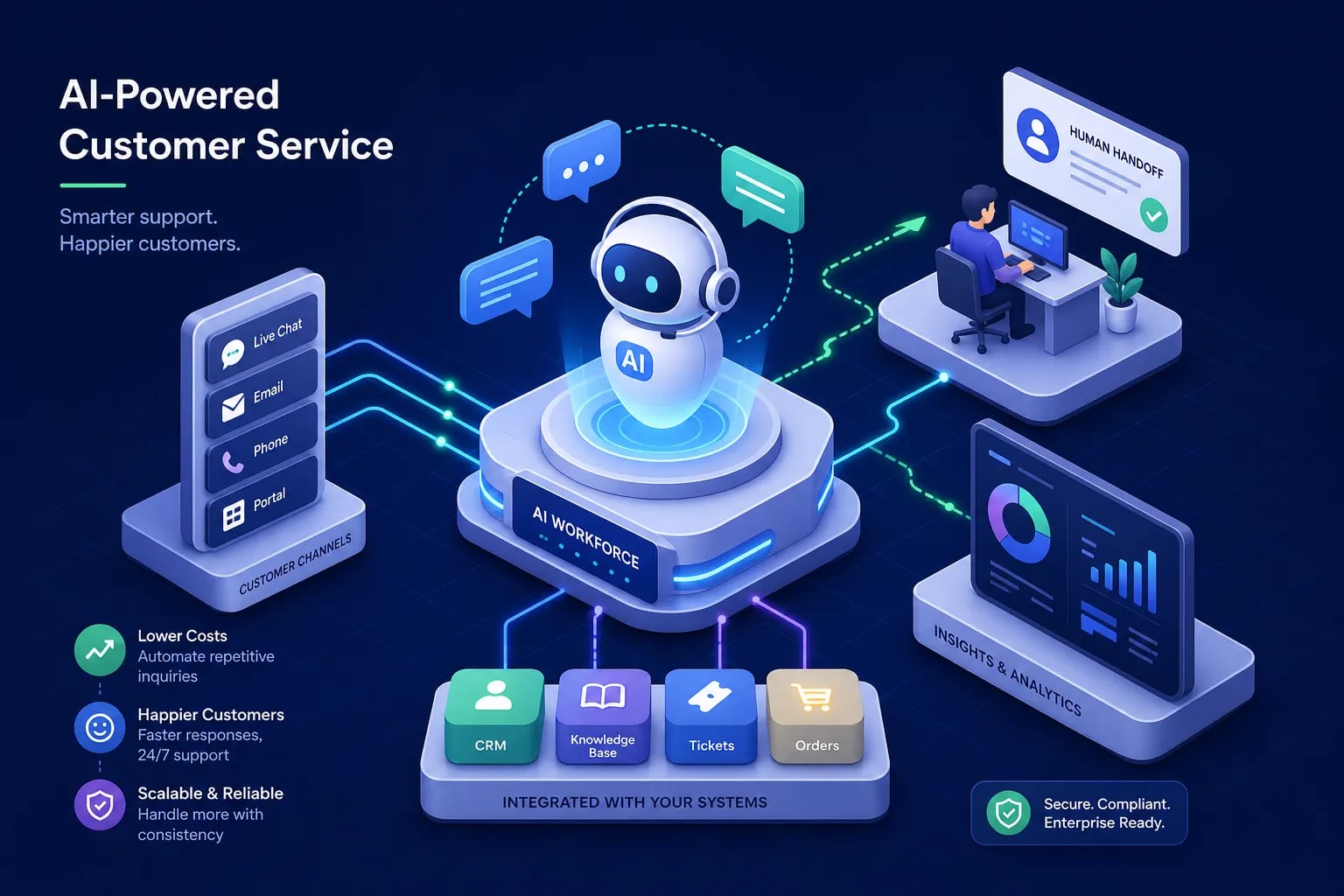
Many B2B service teams begin their AI journey with a single chatbot bolted onto their existing stack, one bot for the website, another for email triage, a third for live chat, each running independently with no shared context. The result is patchwork automation, missed revenue signals, and agents spending a significant portion of their day on work that a well-designed system could already be handling. This guide is written for customer success leaders, CX heads, and operations managers who want a clear-eyed view of what a coordinated AI workforce for customer service actually covers, which nine use cases move the needle in B2B environments, what realistic ROI looks like, and how to move from pilot to scale without creating compliance risk.
One important framing note before we get into the detail: the strongest retention outcomes consistently appear when organisations combine AI capability with structured account management skills. AI can surface a churn signal; only a trained account manager can act on it. Growth Aspire’s KAM workshops are built precisely for that pairing, equipping account managers with the structured skills to convert AI-generated signals into revenue protected. This article covers the AI side of the equation: use cases, benchmarks, a phased roadmap, and India-specific data considerations under the DPDP Act 2023.
What an AI workforce in customer service actually means
An AI workforce is not a chatbot. It is a coordinated set of AI agents and AI-assisted tools that handle different layers of your service operation simultaneously. At the front end, autonomous agents resolve routine enquiries without human involvement. Mid-conversation, agent assist tools surface knowledge, suggest responses, and summarise context for human agents in real time. In the background, workflow automation handles after-call work, ticket classification, and quality scoring. These five functional clusters, self-service, agent assist, workflow automation, quality and insight, and proactive support, together form the workforce layer that sits alongside your human team.
The human-AI collaboration model is clear in its division of labour: AI handles volume and speed; human agents handle complexity, emotion, and commercial relationships. The AI workforce reduces cognitive load on people so they can focus where they create the most value. This is a workforce design question, not just a technology purchase. Organisations that treat it as the latter tend to end up with disconnected tools and no measurable improvement in the metrics that matter.
Nine use cases that protect account health and revenue
Front-end automation: self-service bots, voice AI, and intelligent routing
Self-service bots handle FAQs, order status, password resets, and simple account tasks around the clock, cutting resolution times from hours to minutes. Voice AI and IVR automation understand spoken requests, resolve basic calls autonomously, and route customers faster than any menu-based system. Google Cloud benchmarks project AI agents handling 25, 40% of future call volumes, with annual savings projected at $1 billion for large deployments. Intelligent routing and triage sit underneath both: intent detection and priority queuing ensure every inbound interaction reaches the right queue rapidly, often reducing routing delays from minutes to seconds. These three use cases work together at the front of the customer journey to reduce inbound load while improving first-contact experience.
Agent assist, case summarisation, and post-call wrap-up
Live knowledge retrieval surfaces policy details, next-best actions, and relevant case history to agents while they are still on the call or in the chat. Auto-generated case summaries create concise handoff notes for escalations, saving time on one of the most labour-intensive parts of service work. Automated after-call work fills in notes, logs dispositions, and completes wrap-up tasks without the agent lifting a finger. These three use cases are the primary drivers of AHT reduction. Gartner frames agent assist as a high-value deployment because it speeds resolution and reduces agent effort simultaneously, producing measurable gains without adding headcount.
Sentiment analysis, QA scoring, and proactive renewal alerts
Real-time sentiment detection monitors conversations for frustration, hesitation, scope-reduction language, and competitor mentions, signals that indicate account risk before the customer explicitly voices dissatisfaction. Automated quality assurance scoring evaluates every interaction against preset criteria, giving supervisors a complete picture of service quality without manual sampling. Proactive renewal alerts are the most strategically important use case in B2B: they combine usage decline data, sentiment trends, ticket friction, and renewal proximity into an account health score that triggers a CRM task or CSM escalation weeks before the renewal window opens. This cluster converts reactive support into early account health management, the difference between protecting revenue and scrambling to save it at contract end.
ROI of an AI workforce for customer service
The numbers are clear enough to build a business case. AI automation reduces average handle time by 15, 30% in typical deployments, with optimised operations reaching approximately 37% (based on vendor benchmark reporting across enterprise deployments). For query volume, mature deployments contain 40, 70% of routine L1 enquiries autonomously. Agent assist drives the AHT gains; autonomous resolution drives the containment gains. Your starting call mix determines which metric you move first.
Four published case studies illustrate the range of outcomes. Klarna reduced resolution time from 11 minutes to under 2 minutes and cut repeat enquiries by 25%. Vodafone achieved a 70% reduction in cost-per-chat. Fairmoney deployed Freddy AI and reported 20% faster response times alongside a 15% improvement in customer satisfaction scores. An e-commerce deployment brought first response time down from 8.2 hours to 1.3 minutes, lifted CSAT from 3.6 to 4.3, and delivered a 52% reduction in contact costs. Based on these and similar deployment benchmarks, payback periods for mid-size enterprise implementations typically fall in the 6, 12 month range, with per-contact costs often dropping from the $8, $14 range for human-handled contacts to under $2 for AI-assisted or AI-resolved interactions.
Roadmap to build an AI workforce for customer service
Phase 1: assess, baseline, and choose your first use case
Start with one or two high-volume, low-complexity use cases. Post-call summarisation and FAQ containment are common starting points because they deliver fast, measurable results without touching sensitive account data. Define your success metrics before anything goes live: AHT, containment rate, first-contact resolution, QA scores. Capture the current baseline now, without it, you cannot demonstrate ROI credibly later. The readiness checklist covers data quality, CRM and telephony integrations, security and compliance requirements, and clear ownership assigned across operations, IT, QA, and enablement. Assessment and planning typically takes two to six weeks.
Phase 2: configure, pilot, and measure weekly
Design a controlled pilot: single channel, limited agent group, human fallback for sensitive actions, and clear escalation rules with guardrails in place. Run weekly measurement reviews covering routing accuracy, resolution quality, and agent feedback. Configuration and integration takes two to eight weeks; the pilot itself runs four to six weeks. Include agent and supervisor feedback early. Adoption issues discovered during the pilot are manageable; adoption issues discovered at scale are expensive. The minimum pilot squad for a mid-size operation covers six to eight roles: business owner, project lead, operations lead, IT integration resource, data analyst, and a QA and enablement lead (some roles may require two people depending on team structure).
Phase 3: expand gradually with governance in place
Phased expansion means increasing traffic by percentage or by queue, not switching everything over at once. Add adjacent use cases only after the first is stable and the numbers match your predefined targets. The governance layer matters: model documentation, ethics review, change management communication, and compliance checks should all be in place before you broaden the deployment. A realistic total timeline from pilot kickoff to broader production rollout is four to six months for a mid-size enterprise. Organisations that skip governance to move faster often face greater downstream costs than the time they saved.
Integration, data, and privacy essentials for Indian deployments
System integration and minimum-access principles
Map every data flow before go-live: what the AI agent can read, write, retrieve, store, and send to an external model or API. Limit tool permissions to the minimum required for the specific use case. A common and costly pitfall is granting the AI agent access to the full CRM when the use case only requires ticket history and contact details. Separate retrieval from action: let the AI suggest, require a human to approve for high-impact steps. Establish logging for prompts, outputs, and tool calls so you can investigate errors and privacy incidents. Define vendor and sub-processor obligations in contracts, covering security, breach notification, audit rights, and deletion support.
DPDP Act 2023 obligations every deployment must address
The Digital Personal Data Protection Act 2023 applies whenever your AI agent processes digital personal data of Indian customers. As the deploying organisation, you are the data fiduciary; accountability does not transfer to the vendor. Consent must be free, specific, informed, unconditional, and unambiguous. The consent notice must be given before or at the point of data collection, written in plain language, and must itemise the data being collected, the purpose of processing, and how data principals can withdraw consent or exercise access, correction, and erasure rights.
Three India-specific risks deserve particular attention. First, cross-border transfers occur whenever you use a model provider or cloud infrastructure hosted outside India; these transfers require contractual controls and compliance review. Second, using operational customer data to fine-tune or train a model requires a separate legal basis from the consent you obtained for service delivery; this distinction catches many teams off guard. Third, customer identifiers must be masked or pseudonymised before any data is sent to an external large language model. Organisations that qualify as Significant Data Fiduciaries face additional governance expectations, so confirm your classification early in the readiness assessment.
Why AI tools alone won’t protect your key accounts
An AI workforce for customer service does what it does exceptionally well: it detects patterns, flags risk, and surfaces alerts faster than any human team can manage manually. A proactive renewal alert system can identify an account showing declining usage, rising ticket friction, and negative sentiment across three stakeholders simultaneously, and trigger a CRM task within minutes. That kind of speed and coverage is genuinely valuable. But the alert is only as useful as what happens next.
AI cannot conduct a strategic renewal conversation. It cannot rebuild trust after a service failure, restructure a commercial relationship, or navigate the politics of a new decision-maker entering the account. The retention outcome depends entirely on what the human does with the signal. Organisations that pair AI-driven account health monitoring with structured key account management training consistently report stronger retention outcomes than those that deploy AI into a skills gap. Growth Aspire’s KAM programmes are designed for exactly this: helping account managers interpret account health data, prioritise high-risk accounts, and lead renewal conversations with commercial confidence. The AI surfaces the opportunity; the trained account manager converts it.
Bringing it together
An AI workforce for customer service is not a single tool; it is a coordinated layer of agents and assist capabilities that, when deployed correctly, reduces handle time, contains volume, improves CSAT, and converts reactive support into proactive account health management. The roadmap is well-defined: start with one use case, measure against a pre-deployment baseline, govern carefully, and expand only when the first deployment is stable. For Indian B2B organisations, add DPDP Act compliance to the readiness checklist before any live deployment begins, not after.
AI gives your team better data and faster alerts. The human conversation still determines whether the account stays or churns. Pair your AI workforce for customer service deployment with the account management capability your team needs to act on what the AI reveals. If your account managers are not yet equipped to lead high-stakes retention conversations, that gap is the place to start.
Explore Growth Aspire’s KAM training programmes and find out how structured account management skills turn AI-generated signals into revenue protected.