



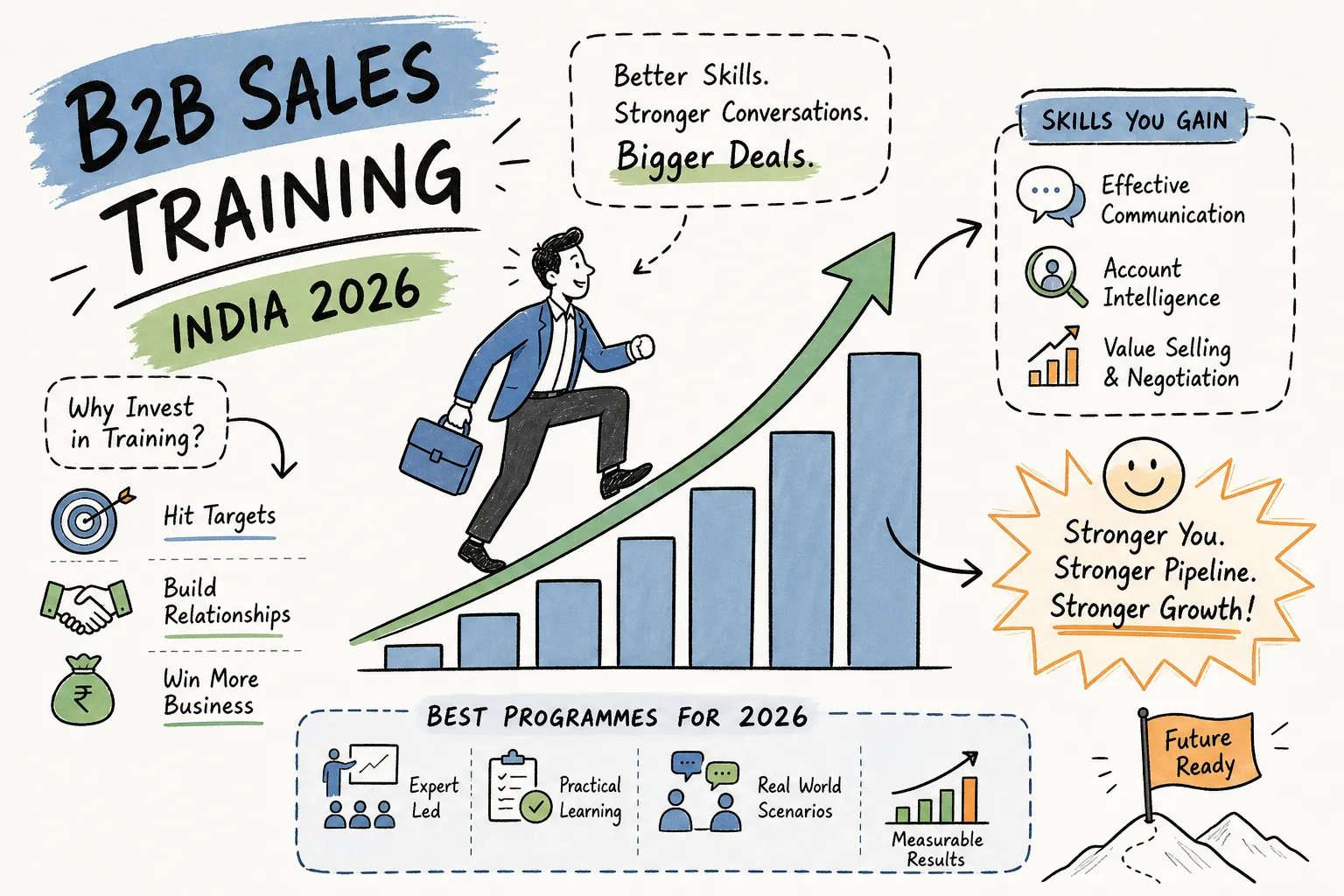
B2B sales training in India has reached an inflection point. Many companies send their sales teams to a workshop, see a short-term performance spike, and then watch results slide back to baseline. Sales leaders have started to accept this as the normal outcome of training. It is not. Consistent with forgetting-curve research (Ebbinghaus, 1885), without structured reinforcement, approximately 84% of training content is lost within 90 days, and that figure reflects a failure of delivery design, not a failure of the people in the room.
The question in 2026 is not whether structured enterprise sales training works; the evidence is clear that it does. Independently reported benchmarks suggest relative win-rate increases of around 18% for teams on structured programmes compared with those without, while training ROI figures, sourced from bodies such as the Sales Management Association and ATD, range from 150% to 500% in well-designed interventions. The real question is what separates a programme that actually moves revenue from one that fills a calendar and generates a feedback form. Providers like Growth Aspire have shifted that conversation from one-off events to science-backed performance interventions, and understanding what that distinction means in practice is exactly what this guide is built around.
By the end of this article, you will know what to look for in B2B sales training programmes, how delivery formats differ, what to expect to pay in the Indian market, and how to evaluate providers before committing a rupee of your training budget. You will also find guidance on sales enablement training and B2B sales certification to help you build a longer-term capability development plan.
What actually separates effective B2B sales training from a forgettable workshop
A common cause of poor training transfer is methodology mismatch and delivery that is disconnected from how adults actually learn complex skills. Effective programmes are built on a defined sales methodology. There are several methodology such as Challenger, SPIN Selling, Sandler, solution selling, or a proprietary framework, not assembled from generic slide decks.
The methodology gives reps a repeatable mental model for running deals; without one, reps default to individual habits, which makes it impossible to coach at scale or to diagnose where deals are breaking down. At GrowthAspire we bring in our experience of 25+ years along with the psychology of persuasion backed sales methodology to ensure that the sales teams are focused on customer first than product or solution.
The key aspects will be building the necessary mindset, process, skills, tools and real effort needed to achieve the outcomes business seeking. The key skills and tools involve leading with insights, reframing buyer thinking, pain discovery with leading questions, listening.. Presenting with end goal and negotiating for long term wins. Again the business and sales audit we conduct helps us identify the real gaps an structure the program.
For enterprise and complex B2B selling environments in India, the right choice depends on your deal type, cycle length, and buyer profile, and a strong provider will help you make that call rather than default to whatever framework they happen to know best.
For a concise explanation of the Challenger sales methodology and how it differs from other approaches, see this practitioner guide, and for a side-by-side comparison of Challenger versus Sandler.
Science-backed programmes integrate findings from behavioural science on deliberate practice (Ericsson et al.), spaced repetition, and cognitive load rather than building curricula around what worked for the trainer’s career. Growth Aspire’s methodology draws on these established learning principles rather than anecdotal selling advice, and their approach to ethical persuasion frames how insight-driven messaging is applied. This is precisely what mid-sized technology teams need when they are dealing with multi-stakeholder enterprise deals and cannot afford to learn through trial and error on live accounts.
The best programmes are also customised to the team’s industry, deal type, and current skill gaps. Mid-sized companies do not have the learning and development infrastructure of a large enterprise, but they are frequently competing for the same enterprise deals. A programme that ignores that reality and delivers a fixed, off-the-shelf curriculum is starting from the wrong place.
Core modules every strong B2B sales programme should cover
Think of this as a curriculum checklist. Before you sign anything, verify that the programme covers each of the following areas with meaningful depth rather than a surface-level slide.
Foundational selling skills
The foundational modules are non-negotiable: disciplined prospecting and lead qualification, discovery questioning frameworks that surface genuine business pain, and consultative solution selling that connects a buyer’s specific problem to a defined outcome. These form the backbone of any complex selling motion, and a programme that glosses over them is incomplete regardless of how polished the delivery looks.
Multi-stakeholder and key account management
B2B deals in mid-sized technology companies rarely involve a single decision-maker. Strong programmes cover multi-stakeholder selling, including how to navigate buying committees, adapt communication to different stakeholder personas, and build strategic account plans that drive expansion within existing accounts. Key account management (KAM) training is a meaningful differentiator for teams managing enterprise relationships where growth within the account is as important as the initial win.
Objection handling, negotiation, and close control
Objection handling, negotiation, and close control are the skills most reps lack confidence in, and they are where deals are most commonly lost. A strong programme teaches value-based negotiation that protects margin, disciplined objection responses that maintain deal momentum, and clear next-step discipline to advance the opportunity. AI-enabled role play and simulation practice are increasingly standard in top enterprise sales training in 2026, giving reps realistic rehearsal repetitions before they are in front of a live buyer.
Training delivery formats: which one suits your team
Instructor-led and blended learning
Instructor-led training, whether in-person or virtual, is the most common format for corporate B2B selling programmes and works well for building shared language and initial skill development across a team. Blended learning, combining live sessions with self-paced modules, produces better long-term retention than either format alone because it allows reps to apply and revisit concepts between sessions rather than absorbing everything in a single sitting.
For geographically dispersed teams across India, virtual instructor-led training has become a practical and effective default. For an industry overview of B2B sales training approaches and programme design, see this industry primer on B2B sales training.
Microlearning and AI-enabled simulation
Microlearning delivers focused skill practice in under 15 minutes and works best as a reinforcement tool after a core workshop, not as a replacement for it. AI-enabled simulations allow reps to rehearse discovery calls, objection responses, and negotiations in realistic scenarios with immediate feedback.
This format has moved from “nice to have” to a standard feature in serious enterprise sales training in 2026, and its primary value is giving reps a safe environment to fail and correct before they are managing a real deal.
Field coaching
Field coaching is the most powerful transfer mechanism for new skills. When a trainer or experienced manager observes live calls and deals and then provides structured feedback, skill transfer happens faster than through any other method. It is also the most resource-intensive format, which is why many providers bundle it into premium corporate packages.
For mid-sized teams, a programme that includes a post-training coaching cadence will almost always outperform one that ends when the workshop closes.
How to evaluate and shortlist B2B sales training providers
Before shortlisting any sales training provider, ask four questions directly: What methodology does your programme teach? How is content customised to our industry and deal type? What does post-training support look like? And can you show us outcome data from clients with a similar profile to ours?
A provider that cannot answer these clearly is telling you something important about their approach. You can also read a practical checklist on evaluating a sales training company to structure your vendor conversations and RFP.
Some providers publish specific impact metrics: improvements in quota attainment, reductions in sales cycle length, and increases in average deal size. These numbers matter, but so does the context behind them.
Look for providers whose claims are tied to a defined methodology and a post-training support structure, and ask whether the figures come from independent measurement or internal tracking. Growth Aspire, for example, reports measurable improvements in win rates and sales cycle length through their interactive workshop format and personalised post-training follow-up plans, ask them directly for the client context behind those numbers.
Watch for these red flags when comparing programmes. A provider that cannot articulate their methodology, offers no post-training reinforcement, or quotes a standard off-the-shelf curriculum without first asking about your team’s current performance gaps is unlikely to move the needle. Account executive training that focuses purely on product knowledge or pitch delivery rather than buyer-centric frameworks tends to underdeliver in complex B2B selling environments, regardless of how well-reviewed the facilitator is.
What B2B sales training in India typically costs
These ranges are aggregated market benchmarks and will vary by provider, level of customisation, and programme duration. Online and self-paced B2B sales courses typically range from ₹5,000 to ₹25,000 per participant, with some free entry-level options available on major learning platforms.
For example, platforms such as Coursera offer an online B2B sales course that teams can use for baseline skill development. Live virtual instructor-led training sits in the ₹15,000 to ₹75,000 per participant range for most mid-market programmes. In-person classroom workshops and premium enterprise sales training programmes can range from ₹25,000 to ₹1,50,000 or more per participant, particularly when they include assessment, B2B sales certification, and dedicated coaching hours.
Corporate B2B sales workshops for teams are almost always custom-quoted rather than listed at a fixed public price, with the final cost depending on team size, programme duration, delivery format, and whether ongoing coaching is included.
As a rough benchmark, a two-day in-person workshop for a team of 15 to 20 reps, including pre-training diagnostics and a 90-day follow-up plan, will typically sit in the ₹3 lakh to ₹8 lakh range depending on the provider’s depth of customisation.
Rather than evaluating training purely on per-participant cost, frame the investment against a projected improvement in win rate or deal size. If your team closes 20 deals a month at an average value of ₹5 lakh and a well-designed programme improves win rate by 20%, the revenue impact dwarfs the training cost within a single quarter. That is the business case to build internally before you go to procurement.
Making training stick: reinforcement, coaching, and ROI measurement
Without reinforcement, approximately 84% of training content is lost within 90 days, consistent with Ebbinghaus’s forgetting-curve research. The same principle applies directly to sales skills: without follow-up, coached deal reviews, and repeated deliberate practice, reps revert to their default behaviours regardless of how strong the initial workshop was. This makes the post-training coaching cadence arguably more important than the quality of the workshop itself.
A practical post-training reinforcement plan includes scheduled manager check-ins tied to specific skill areas, live call observation with structured feedback, access to microlearning modules that reinforce workshop content, and periodic deal reviews that apply the programme’s methodology to real opportunities in the pipeline.
Research on manager-led coaching (Sales Management Association) indicates that skill retention improves significantly, and may double in some studies, when managers actively coach the same methodology that reps are being trained on. Manager accountability checkpoints at day 30, 60, and 90 are therefore not optional extras.
GrowthAspire builds this directly into their delivery model through personalised follow-up plans and ongoing coaching support rather than leaving reinforcement entirely to the client.
Track win rate, average sales cycle length, average deal size, and quota attainment at the team level before and after the programme, with a measurement window of at least 90 days post-training. At the individual level, track call conversion rates, discovery-to-proposal ratios, and the frequency of specific behaviours the programme aimed to build, such as multi-threading in enterprise accounts or disciplined objection responses. These metrics tell you whether behaviour changed, not just whether people attended.
Choosing the right programme for your team in 2026
Effective B2B sales training comes down to five things: methodology rigour, curriculum depth, delivery format fit, post-training reinforcement, and measurable outcomes. For mid-sized Indian companies competing in complex B2B or enterprise deals, the right programme will combine a science-backed selling framework with interactive delivery and a coaching plan that keeps skills sharp well beyond the workshop itself. Any programme that cannot demonstrate all five is a partial solution at best.
For teams that want to move from a forgettable training event to a genuine performance intervention, Growth Aspire’s approach is worth a closer look. Their combination of a learning-science-grounded methodology, real-world interactive workshops, Deal Intelligence for pipeline management, and personalised follow-up coaching is designed specifically for mid-sized technology sales teams that need measurable results, not just a well-received training event. Ask them for client outcome data relevant to your deal type and team size before making any decision.
If your team is ready to move from average quota attainment to consistent top performance, get in touch with GrowthAspire to explore their 2026 B2B sales training programme options. A conversation about your team’s current gaps, deal profile, and growth targets is the right starting point, and it will tell you more than any course brochure will.