



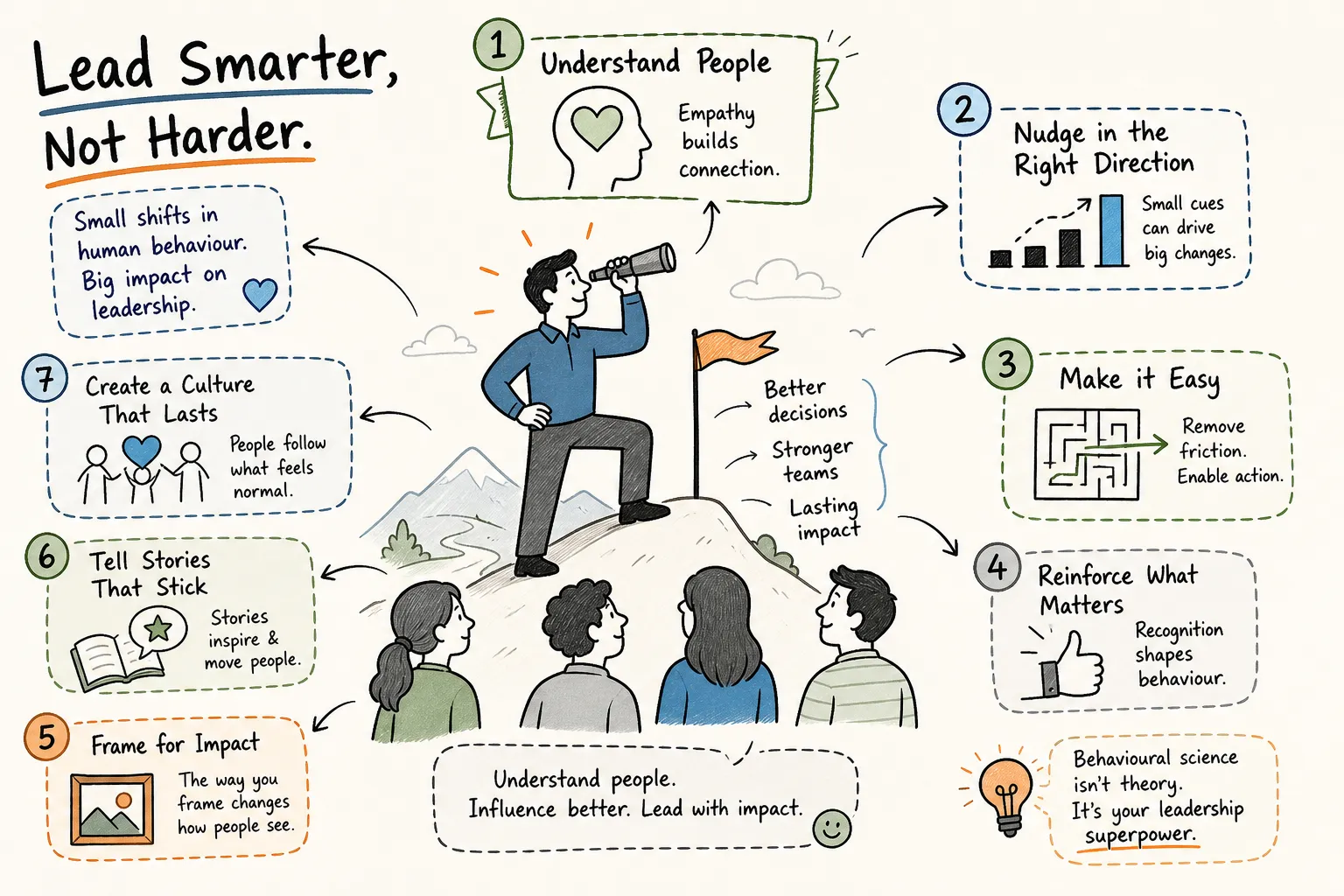
Meta Description: Behavioural science for leaders: 7 strategies to reduce bias, influence teams and sharpen decisions. Try one this week with Growth Aspire.
The most effective sales leaders in Indian B2B organisations are not necessarily the sharpest strategists in the room. They are the ones who understand how their own minds, and their teams’ minds, actually make decisions. This distinction sounds simple, but it has significant consequences for pipeline health, coaching quality, and win rates.
Leaders are trained to rely on data and logic. The problem is that human behaviour does not work that way. Decisions are shaped by cognitive shortcuts and deeply irrational patterns that operate well below conscious awareness. Behavioural science for leaders is the discipline that closes that gap, giving you a structured lens through which to understand, predict, and influence behaviour at every level of the sales organisation.
At Growth Aspire, this lens sits behind every workshop we run with sales and revenue teams across India. This article covers the core principles, four essential frameworks, three concrete interventions, and a simple measurement approach you can start applying this week.
Why cognitive biases are quietly undermining your leadership decisions
Leaders make dozens of consequential decisions every week: pipeline reviews, performance assessments, coaching conversations, deal stage updates. Most of those decisions are shaped by leadership decision biases they have never been trained to spot. In a B2B sales context, three biases cause the most damage.
The anchoring trap in deal reviews and sales forecasting
Anchoring occurs when the first number in a conversation becomes the invisible reference point for everything that follows. In a forecast call, if a salesperson opens with “I think this deal is worth about one crore,” that figure anchors the entire discussion, even if subsequent evidence suggests the true value is significantly lower. Leaders who anchor on last quarter’s win rate, or on the first figure a prospect mentions in a pricing negotiation, shape the outcome of that conversation without realising it. The fix is deliberate: withhold your opening estimate and ask the team to surface their data before any number is named.
Confirmation bias and its effect on team feedback
Confirmation bias causes leaders to seek out information that validates what they already believe about a salesperson’s performance or a deal’s probability. Consider a sales manager who has mentally written off a mid-market deal because of a weak discovery call. In subsequent reviews, that manager will unconsciously weight every piece of negative information and discount every positive signal, reinforcing a conclusion that was never properly tested. This bias is particularly costly in key account management, where a premature negative judgement on a relationship can cost the organisation a significant enterprise renewal.
The halo and horns effect in performance assessments
A single strong impression of a team member colours every subsequent evaluation. When an account manager closes a high-profile deal in Q1, their Q2 performance review will often look more favourable than it objectively should. The reverse is equally true. Leaders who allow one data point to define their entire picture of a salesperson are making distorted promotion and development decisions. Structured evaluation criteria, reviewed before the conversation rather than after, are the most reliable antidote.
Behavioural science for leaders: nudge tactics that steer teams without mandates
Once you can see bias operating in your own decisions, the next question is how to steer behaviour across the team without relying on top-down mandates. Behaviour science backed with Cialdini principles of persuasion provides the mechanism: small, deliberate design choices that make the desired behaviour the path of least resistance.
The Principles of Persuasion are more powerful than they appear. When Lyft tested behaviourally informed messaging with new drivers, opt-ins increased by 173 percent.
Google’s cafeteria nudge, placing healthier food at eye level and less visible options further back, shifted eating habits across thousands of employees. The principle scales.
What defaults and choice architecture mean in a sales context
Defaults are one of the most powerful tools a sales leader has. If CRM entry becomes a required step before a deal advances in the pipeline, the behaviour becomes embedded in the process rather than relying on individual discipline.
Defaulting calendar blocks for coaching conversations achieves the same result. Reducing the number of choices at each decision point also matters: the paradox of choice tells us that too many options create friction, and friction kills adherence. Simplify the path and more people will take it.
Using social proof and framing to shift team norms
Social proof works because people take cues from what their peers are already doing. Sharing anonymised win-rate data across the team, making top performers’ behaviours visible, and framing new habits as what the strongest account managers already do are all low-cost, high-impact interventions.
The messenger effect matters here too: the same message lands differently depending on who delivers it. Peer advocacy from a respected senior salesperson will consistently outperform a directive from management. Framing is equally important, describing a difficult pipeline conversation as a growth conversation rather than a gap conversation changes the emotional register before a word of substance is exchanged.
Four frameworks that give behavioural science structure
Principles without structure lead to haphazard application. These four frameworks provide a repeatable diagnostic and design process for any behaviour change challenge. They were selected because they are the most widely adopted in applied behavioural science for managers and have the strongest evidence base for practical leadership use.
COM-B
COM-B (Capability, Opportunity, Motivation, Behaviour) is the starting point for any diagnosis. When a salesperson is not following a new qualification process, the answer is never simply that they are not motivated. COM-B forces you to ask which of the three components is the actual barrier:
- Do they lack the skill (capability)?
- The time or tools (opportunity),?
- The belief that it matters (motivation)?
The intervention looks entirely different depending on the answer.
EAST
EAST (Easy, Attractive, Social, Timely) functions as a practical filter before rolling out any intervention. Run your proposed change through four quick questions. Is the new reporting step easy to complete?
Does the coaching conversation happen within 24 hours of a call, when the context is still fresh? If the answer to any of the four questions is no, redesign before you launch.
SCARF
SCARF (Status, Certainty, Autonomy, Relatedness, Fairness) explains why some leadership behaviours trigger defensiveness or disengagement in sales teams.
Public criticism activates the same neural pathways as physical pain. Ambiguous targets create a certainty threat that inhibits strategic thinking. Micromanagement signals a lack of trust. Leaders who design conversations through the SCARF lens create conditions where honest pipeline reviews are possible, and that is where the real coaching value lies.
MINDSPACE
MINDSPACE is a nine-factor checklist covering Messenger, Incentives, Norms, Defaults, Salience, Priming, Affect, Commitments, and Ego. Most change programmes address one or two of these drivers and then wonder why the behaviour does not shift. Running an initiative through all nine factors before launch forces a more comprehensive diagnostic than most teams ever attempt.
Three interventions you can start using this week
1. The “ask three before you tell” technique
Before offering a solution or directive in any deal review or coaching conversation, commit to asking three open questions first. This single habit reduces anchoring, surfaces information the team holds that you do not, and builds genuine ownership of the outcome. In a deal review, that might look like:
- “What blockers have you identified in the buying committee?” followed by
- “What does the champion’s internal position look like right now?” and then
- “What would need to be true for this deal to close this quarter?”
Only after the third answer should you offer a perspective. Use this quick checklist to track your adherence this week:
- Identify one recurring meeting where you typically speak first
- Write three open questions in advance
- Score yourself each evening: did you ask before you told?
- Track whether team input quality changed over five sessions
2. Immediate, specific positive reinforcement
The brain responds to feedback within seconds of a behaviour, not days later. Vague praise (“good call today”) tells the salesperson nothing useful. Specific, immediate reinforcement tells them exactly what to repeat.
“The way you handled that pricing objection by anchoring on value before discussing cost was exactly right” is actionable and memorable.
Match the form of recognition to individual preference: some people want public acknowledgement, others value autonomy or development time. The principle is consistent: be fast and be specific.
3. Micro-behaviours that build psychological safety
Micro-behaviours are small, deliberate actions that signal inclusion and respect. Nodding when a junior team member speaks in a review meeting, or stepping back to draw a quieter voice into a conversation, may look incidental. Asking for help as a deliberate act rather than a sign of weakness is equally powerful: the Ben Franklin Effect demonstrates that the helper’s brain rewires to feel greater connection with the person they assisted.
These are not soft-skills gestures. Practised consistently, micro-behaviours shift team culture faster than any policy document, because they operate at the level of daily social cues rather than quarterly communications.
How to measure whether your behavioural interventions are working
Activity metrics, training completion rates, session attendance, tell you very little about whether behaviour has actually changed. The metrics that matter are behavioural: pipeline update frequency, the quality of coaching conversations, deal progression rate between stages, and the consistency of qualification criteria applied across the team. These are the signals that confirm whether your behaviour change interventions at work are producing results or simply being tolerated.
Before scaling any intervention, run a low-cost pilot. Choose one team, one intervention, and a four-to-six-week window with a clear hypothesis. Structure a before-and-after comparison using both quantitative data and qualitative feedback. Behaviour change often shows up in conversation quality before it shows up in win rates, so qualitative signals matter as much as the numbers in the early stages.
Embedding behavioural science into your leadership practice for the long term
Isolated workshops produce short-term enthusiasm and long-term regression. Without spaced practice, real-time coaching, and an environment that reinforces new behaviours, even capable and motivated leaders revert to default patterns within weeks, a pattern well documented in memory and habit research since Ebbinghaus.
COM-B explains why: if the environment does not support the new behaviour, motivation alone is not enough to sustain it.
The most effective behavioural science training for executives does not treat the subject as a standalone topic. It embeds behavioural science into every session: how deals are reviewed, how coaching conversations are structured, how negotiation is practised under realistic conditions.
At Growth Aspire, our workshops for Indian B2B sales teams are designed precisely this way. The science is not the subject of the course; it is the architecture behind how the course works, from the way feedback is delivered to the way roleplay scenarios are sequenced to build psychological safety before introducing challenge.
Applying behavioural science for leaders: where to take this next
Behavioural science for leaders is not a soft-skills add-on. It is the most practical upgrade a sales leader can make to the way they think, communicate, and coach. The starting point is straightforward:
- Name your top two cognitive biases and write down where they show up most in your leadership week
- Choose one nudge to implement in your next team interaction
- Run a four-week pilot with one of the three interventions from the section above
The compounding effect of small behavioural changes across an entire sales team over twelve months is significant. A 5 percent improvement in coaching conversation quality, repeated weekly across ten salespeople, produces a materially different pipeline by the end of the year. Consistency outperforms intensity every time.
When you are ready to build this capability into your leadership team in a structured way, explore Growth Aspire’s behavioural science for leaders programme, and give your team the frameworks, practice, and follow-up coaching to make the change stick.