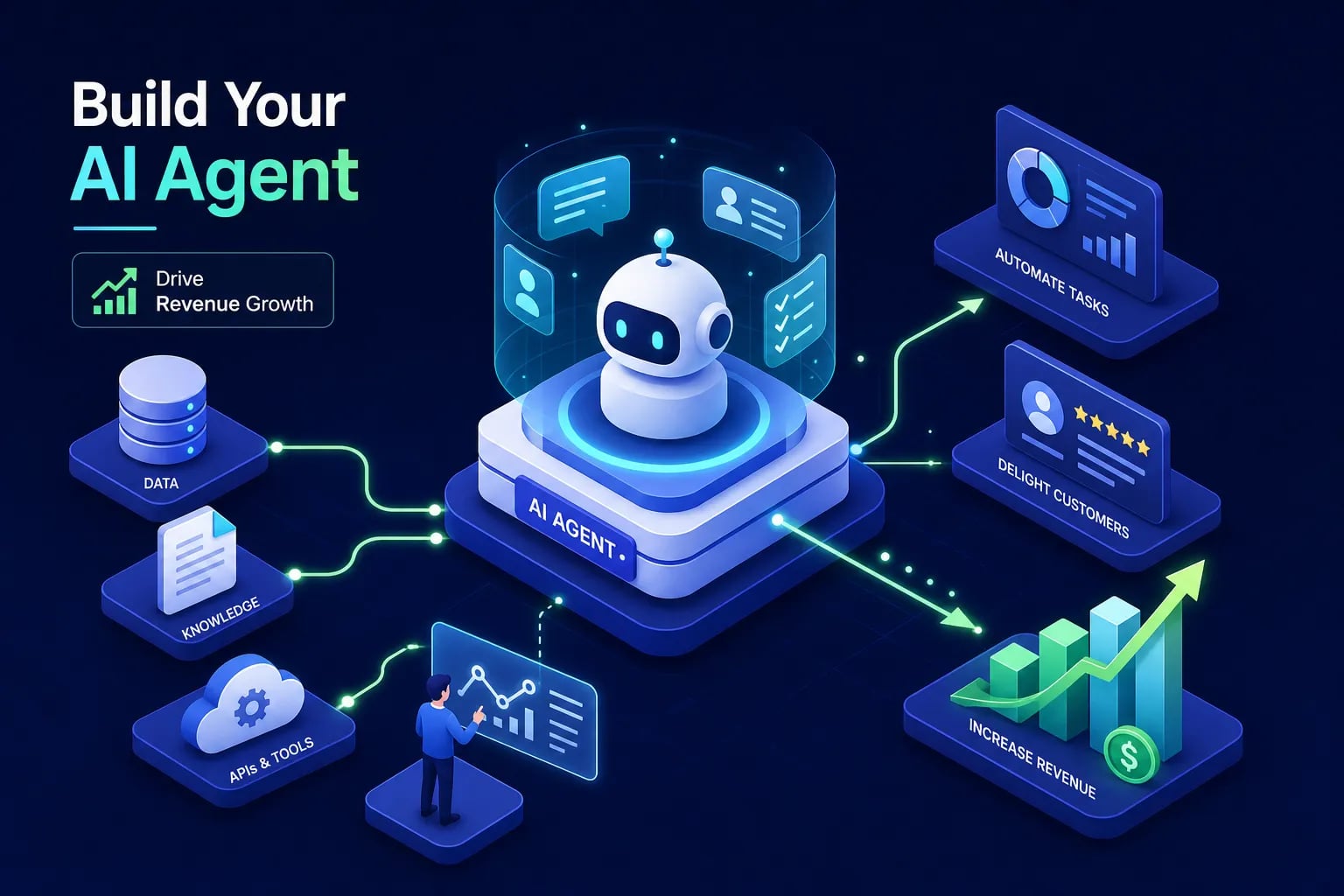
Building your first AI agent for revenue growth is now the central question for most revenue teams in India, not whether to deploy one, but where to start. Many revenue teams across the country are moving past the debate and into execution, and for good reason: getting the first deployment wrong wastes months of budget and erodes internal confidence in a technology that, when properly deployed, genuinely compresses sales cycles. The cost of a poor first attempt is not just financial. It is the lost credibility that makes the next initiative harder to fund and harder to sell internally.
The opportunity is real and measurable. AI sales agents handling lead scoring, follow-up automation, meeting preparation, and pipeline alerts are already freeing mid-sized B2B sales teams from the low-value work that consumes the majority of a rep’s week. Forrester-benchmarked data from 2026 shows AI lead-scoring deployments returning roughly 3x to 4x ROI within twelve months, with payback periods in the six-to-nine-month range for teams that execute the integration properly. (These figures are drawn from Forrester’s 2026 enterprise benchmark research; your actual returns will vary based on CRM data quality and integration depth.)
At Growth Aspire, we work closely with revenue teams at mid-sized technology companies across India, and the pattern is consistent: teams that build a focused, well-integrated first agent see measurable pipeline movement within six to eight weeks. What follows is a practical walkthrough covering use-case selection, tech stack choices, CRM integration, guardrails, and the KPIs that actually measure revenue impact, including an honest look at where AI agents reach their limits.
Choosing the right use case when building your first AI agent for revenue growth
Before writing a single line of code, write a single-sentence problem statement. A useful example: “This agent will score inbound leads from our website using HubSpot data and route high-fit prospects to a rep within five minutes.” Map the required data sources, outputs, and actions before selecting tools. This discipline prevents the common failure mode of building an agent that is technically functional but commercially irrelevant because no one specified what “good output” actually looks like, a risk that is especially acute for a first deployment.
Inbound lead qualification is consistently the highest-ROI entry point for a first AI sales agent, and the reason is straightforward: it captures buyer intent at its peak and eliminates the lag between a form submission and a rep’s first meaningful response. A prospect who downloads a pricing guide at 10 pm should not wait until the next morning’s stand-up to receive a prioritised call. An AI scoring agent reads firmographic data, website engagement signals, and behavioural patterns, assigns a priority score, and routes the lead to the right rep or nurture stream within minutes. The data inputs required include CRM records, website activity, marketing automation engagement data, and enrichment sources such as LinkedIn or Lusha.
Follow-up agents and meeting-prep agents represent the second tier of high-impact use cases. Follow-up agents trigger personalised outreach sequences based on deal stage, days since last contact, or trigger events such as a pricing page visit. Meeting-prep agents pull CRM history, recent news about the prospect’s company, and prior email threads to generate a structured briefing for the rep before a call. Both reduce manual preparation time while improving the quality of each conversation, which directly improves conversion rates.
Pipeline alert agents round out the priority list. These autonomous AI agents monitor deal velocity, flag stalled opportunities, and surface accounts showing churn signals before the quarter-end crunch. This use case does require clean CRM data and consistent stage hygiene, which functions as a useful forcing function for revenue operations teams who have been deprioritising data quality for too long.
The minimal tech stack to build and ship your agent MVP
Three frameworks are worth knowing for a revenue-focused agent. The OpenAI Agents SDK is the right starting point for straightforward tool-use workflows: it sets up quickly, has built-in tracing and guardrails, and works best when your agent mainly needs to call a few tools, draft outreach, or hand off between a small number of agents. LangGraph, a close alternative to LangChain agents for stateful workflows, becomes the better choice the moment your workflow requires conditional branching, retries, human approval steps, or multi-agent coordination. It models the agent as an explicit graph of states and transitions, which makes it more auditable and more controllable for production sales pipelines. n8n works well as a lightweight automation layer connecting external services, but it is not the right choice as the core reasoning engine for a production agent.
Frontend and backend
Next.js or a similar frontend paired with FastAPI or Node.js for the backend gives you a clean separation between the user-facing interface and the agent’s reasoning logic. Keep these as plain backend functions at first. Premature abstraction through heavy frameworks slows iteration and makes debugging significantly harder, particularly when you need to isolate why an agent routed a lead incorrectly.
Vector store and access control
PostgreSQL with pgvector handles retrieval without introducing a separate vector database before you genuinely need one. Clerk or Supabase Auth covers access control. Both are straightforward to configure early and painful to retrofit later.
Observability
Langfuse for prompt and trace observability, Sentry for application-level error tracking. Add both from the first week of development. Deferring observability is one of the most common and costly mistakes in AI agent deployment: without it, debugging a misfiring guardrail or a hallucinated output becomes a manual hunt through logs.
Deployment
Vercel or Railway keeps hosting simple and scalable for a first version. The smallest stack that works in production is almost always the right stack, resist the temptation to reach for heavier infrastructure before you have outgrown the lighter option.
Two additional mistakes slow first-agent projects significantly. Teams either reach for a heavy orchestration framework before they need it, which makes debugging painful, or they spin up a separate vector database before Postgres with pgvector has reached its limits. Skip both at this stage.
Step-by-step: connecting your AI agent to your revenue stack
The core agent loop is straightforward in concept. A user action or scheduled event triggers a request; the orchestrator calls the model; the model decides whether a tool is needed; the tool executes a backend function such as a CRM read, an email trigger, or a Slack alert; and the result is returned and logged. Agent orchestration at this stage should be kept lean, the more states and transitions you introduce before the basic loop is stable, the harder it becomes to diagnose failures cleanly.
The CRM integration is bidirectional. The agent reads lead, contact, account, and opportunity data via API, and writes back scores, stage updates, tasks, and notes so commercial teams can act on the output. Before going live, run a shadow test where the agent operates in parallel with the existing manual process for at least two weeks, long enough to generate a meaningful sample of scored leads against known outcomes. This surfaces data quality issues, validates the scoring logic, and builds rep confidence in the system. Audit logging is non-negotiable. It is also simpler to implement correctly from day one than to retrofit later. Log every prompt, retrieved context chunk, model output, tool call, and guardrail decision, with timestamps and user IDs attached.
Guardrails for building your first AI agent for revenue growth
A layered guardrail model is the only reliable approach to preventing hallucinations in client-facing outputs. Input filters block prompt injection and sensitive data before the model sees the request. Retrieval guardrails limit the agent to approved knowledge sources rather than allowing it to draw on the model’s parametric memory. Output checks block unsupported claims, validate structured formats, and enforce abstention when the retrieved evidence is insufficient to support a confident answer. For revenue-generating AI agents handling sales outreach specifically, every factual claim about pricing, product capabilities, or SLAs must be traceable to an approved source.
For companies in India handling customer data, a clear audit trail and role-based access control represent minimum expectations, particularly for agents that touch financial or personal information. Implement human-in-the-loop approval flows for high-risk actions: sending external emails at scale, creating CRM records automatically, or modifying deal stages without manual review all warrant a pause-and-confirm step before execution.
Measuring revenue impact: the KPIs that matter
Revenue attribution from an AI agent follows a clear data flow. Collect signals from analytics, CRM, and marketing automation. Normalise them into a shared schema. Resolve identity across systems so behavioural data connects to known contacts and accounts. Let the agent score or decide. Write actions back to the CRM and marketing automation platform. Measure outcomes in the analytics layer. Bidirectional sync is not optional: without writing agent decisions back to the CRM, there is no line to draw from signal to action to pipeline to revenue.
The KPIs worth tracking from the first week of deployment are:
- Lead-to-meeting conversion rate: does the qualification agent improve handoff quality from marketing to sales?
- Follow-up response time: does automation reduce the average lag between a trigger event and a rep’s first contact?
- Pipeline velocity: are deals moving through stages faster than the pre-agent baseline?
- Win rate on agent-scored leads versus unscored leads: the clearest measure of qualification accuracy.
- Agent-triggered meetings as a percentage of total meetings booked: tracks the agent’s direct contribution to pipeline creation.
Vanity metrics such as messages sent or leads touched tell you nothing about revenue impact. Every KPI you track should tie back to an outcome that moves a deal forward or protects an existing account. The North Star metric for evaluating your first agent is qualified pipeline added per rupee of AI spend.
The skill gap AI agents cannot automate
AI agents are excellent at identifying the right prospects, triggering the right touchpoints, and surfacing the right context before a call. The ceiling arrives the moment a qualified prospect sits across from a rep in a complex B2B conversation. At that point, the outcome depends entirely on the rep’s ability to ask incisive discovery questions, push back on objections without losing composure, and frame value in terms the specific buyer actually cares about, not a templated pitch. No agent scores, routes, or preps its way past a rep who cannot convert a high-quality conversation into a closed deal.
The failure pattern is predictable and common. A team deploys a lead-scoring agent, dramatically increases the volume of qualified meetings, and then watches win rates hold flat or decline. The agent delivered better opportunities. The reps were not equipped to convert them. The result is a more efficient pipeline that still underperforms, and leadership draws the wrong conclusion about what went wrong.
Growth Aspire’s revenue workshops are designed as the practical complement to an AI agent deployment. The agent surfaces the right opportunities at the right moment; the workshop equips reps with the consultative and value-based selling skills that convert those opportunities into closed revenue. The methodology is built specifically for mid-sized technology sales teams in India, with follow-up coaching to embed new behaviours after the training ends, not just a one-day session that fades within a fortnight. Based on what we observe across client engagements, teams that invest in upskilling alongside their AI deployment tend to see stronger win-rate improvements than teams that automate without addressing the human skill layer. The two investments reinforce each other.
Putting it together
The practical path is clear. Pick one high-ROI use case. Build a minimal but deployable MVP. Connect it bidirectionally to your CRM. Implement guardrails from the start. Then measure the metrics that tie back to pipeline and revenue. Avoid the temptation to solve five problems simultaneously with a first agent. A focused deployment that moves one meaningful metric in six weeks is more valuable than an ambitious deployment that takes six months and confuses its own outputs.
The process of building your first AI agent for revenue growth is a tractable six-to-eight-week project for most mid-sized revenue teams. The ceiling on its impact, however, is set by the selling skills of the people who receive its outputs. An agent that identifies the right prospect at the right time is only as valuable as the conversation the rep can hold once they are in the room.
If your team is ready to automate the pipeline and sharpen the skills that close it, get in touch with the Growth Aspire team to explore how our revenue workshops pair with your AI agent rollout. The combination is where the real performance gains live.