



Picture your last pipeline review. Every rep is confident. Every deal is “progressing well.” The numbers look solid. Then the quarter closes and you’re 30% short of target. Sound familiar? A deal intelligence platform is built precisely for this situation, it would have flagged the warning signs weeks before they became a quarterly miss. The problem isn’t your reps. The problem is the data they’re working from, or more precisely, the data you aren’t seeing.
Most B2B sales organisations operate on a risky assumption: that what reps report in the CRM accurately reflects what’s happening in their deals. Research on CRM data completeness consistently shows it rarely does. Reps are optimistic by nature, CRM fields get updated selectively, and by the time a stalled deal surfaces in a pipeline review, it’s already too late to recover it. This is the gap that sales deal intelligence tools are built to close.
This article explains what a deal intelligence platform is, how it processes and analyses your pipeline data, what outcomes organisations are actually measuring after deployment, and how to shortlist the right solution for your team size and sales process. If you’re a sales leader or RevOps professional evaluating this category for the first time, this is your starting point.
What a deal intelligence platform is (and what it isn’t)
How it differs from a CRM
A CRM records what your reps choose to log. That’s its fundamental limitation. A deal analytics platform analyses what is actually happening across calls, emails, meeting transcripts, and buyer interactions, then surfaces patterns that reps and managers would otherwise miss. The CRM is a filing cabinet. A deal intelligence tool is an analyst who reads everything in that cabinet and tells you what it means.
Sales leaders who treat their CRM dashboards as sufficient pipeline intelligence are working with a lagging picture. They see what was true last week when the rep last updated the record. They don’t see that the economic buyer has gone silent, that a competitor was mentioned twice on the last two calls, or that the deal has sat in proposal stage for three weeks beyond the team’s average cycle length. That’s the visibility gap these tools are designed to eliminate.
The problem it is built to solve
Industry observers and sales analysts commonly estimate that a significant share of B2B pipeline, often cited in the range of 30 to 40%, consists of phantom opportunities: deals that look active on paper but have stalled buyer engagement in practice. These are the deals reps talk up in reviews and then quietly push to the following quarter. Deal intelligence software identifies them through behavioural signals: stakeholder silence, declining email response rates, missed next steps, and stage durations that exceed historical norms. It catches these signals weeks before they become end-of-quarter surprises.
The core value proposition is straightforward. Instead of relying on rep sentiment and verbal status updates, sales leaders get a signal-based view of pipeline health. Which deals are genuinely progressing? Which ones are at risk right now, even if the rep doesn’t realise it yet? That shift from gut-feel to evidence is what makes this category so impactful.
Where deal scoring fits in
Deal scoring is the mechanism that converts raw activity data into a prioritised view of your pipeline. It feeds on signals: call sentiment, engagement velocity, multi-threading depth across the buying committee, days since last meaningful buyer reply, and whether the next step field has been updated. These inputs are weighted against your historical win and loss data to produce a numeric score for each opportunity.
A numeric score is far more actionable than a rep’s verbal status update because it’s objective and consistent. Two deals can both be described as “in negotiation” by their respective reps, but their scores might sit at 72 and 31. That difference tells a manager exactly where to focus coaching time and where to prepare contingency plans.
How a deal intelligence platform processes your sales data
The data sources it connects to
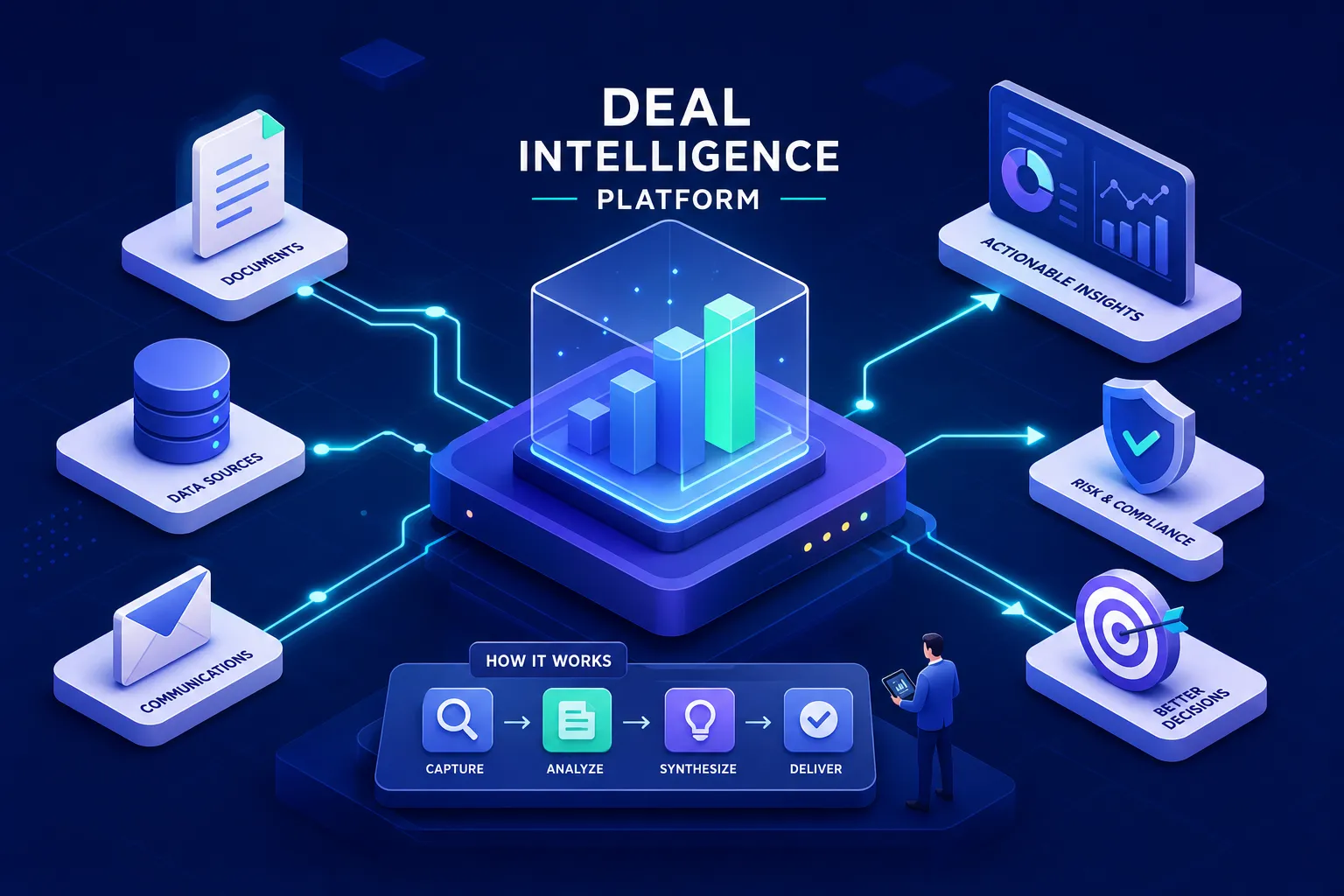
Leading deal intelligence tools pull from CRM systems (Salesforce and HubSpot being the most common), calendar and email activity, call recordings, meeting transcripts, and sales engagement platforms. Gmail, MS Teams, and Zoom integrations are supported by most platforms, though these communication tools are typically synced through the CRM layer rather than as standalone data feeds. The result is a unified signal layer that sits across all the places your sales conversations actually happen.
How AI converts raw activity into actionable insights
Once the data connections are live, the platform’s AI models look for patterns: which deals share characteristics with previous wins, where buyer engagement is dropping off, which stakeholders have gone silent, and how deal velocity compares to the historical average for opportunities at the same stage and size. This is what separates a genuine deal analytics platform from a simple activity tracker.
The distinction between leading and lagging indicators matters here. Most teams manage by lagging indicators: closed revenue, slippage at quarter end, win rates calculated after the fact. Deal intelligence shifts the focus to leading indicators, buyer reply rates, stakeholder involvement, engagement recency, that predict outcomes three to four weeks before they become visible in traditional pipeline reviews. Gong’s AI Deal Predictor, for example, analyses over 300 signals from CRM data, calls, and emails to generate its predictions. This signal-driven approach is also how broader revenue intelligence platforms are positioned, a deal intelligence platform can be understood as the deal-level execution layer within that wider revenue intelligence stack.
What integration and deployment actually look like
Realistic expectations matter when planning procurement timelines. HubSpot-native tools typically deploy in two to three weeks because the architecture is self-contained. Salesforce-based platforms run four to six weeks, assuming an existing Sales Cloud setup and a competent admin. Enterprise-grade platforms like Clari operate on an eight-to-twelve-week timeline because of the complex data mapping, custom forecasting models, and white-glove setup requirements involved.
For a team of 10 to 30 reps, a phased rollout is the recommended approach: start with activity capture, progress to pipeline intelligence, and layer in guided selling recommendations once data quality is established. This reduces adoption risk and accelerates time-to-value significantly.
The outcomes sales teams are reporting after deployment
Forecast accuracy and pipeline visibility gains
Published vendor outcome data and analyst benchmarks point to meaningful gains at deployment. Organisations using AI-driven forecasting have reported accuracy improvements of 25 to 30 percentage points, moving from approximately 65% accuracy to over 90% within the first year. Deal slippage falls by 25 to 40% because risks are surfaced three or more weeks earlier than manual pipeline reviews typically catch them. Sales managers reclaim eight to twelve hours per week previously consumed by manual pipeline review cycles.
These gains stem from a specific shift: replacing roll-up forecasting, which is heavily influenced by rep optimism, with bottom-up AI forecasting that analyses leading indicators and compares current deals against historical win patterns. The AI doesn’t carry a quota, which means its read of the pipeline is considerably more objective than a rep’s self-assessment, a point supported by research linking AI forecasting to the accuracy lifts cited above.
Win rate and sales cycle improvements
Win rates improve an average of 15 to 25% after deployment, with competitive win rates rising by up to 45% in select enterprise deployments documented by vendors such as Gong. Sales cycles shorten by approximately 35% when AI-driven velocity optimisation replaces reactive deal management. The mechanism behind these numbers is important: the platform doesn’t just flag problems, it prescribes the next best action for each deal based on what has historically worked for similar opportunities. That prescription is what drives behavioural change on the sales floor, not just awareness of the problem.
How Growth Aspire’s Deal Intelligence helps mid-sized B2B teams close faster
Built for mid-market complexity, not enterprise overhead
Enterprise platforms carry real implementation weight. Clari, for instance, typically requires an eight-to-twelve-week implementation with substantial data mapping and white-glove setup; Gong’s deployments commonly run six to eight weeks at comparable investment levels, with annual pricing for enterprise contracts running to several hundred thousand dollars. For a mid-sized B2B sales team operating in a fast-moving Indian market, that overhead is a genuine obstacle to getting started. Growth Aspire’s Deal Intelligence offering is designed for teams at this scale, delivering pipeline visibility, deal risk detection, and AI deal insights without the operational complexity that characterises enterprise deployments.
The Indian B2B sales environment has distinct characteristics worth accounting for: longer relationship-building cycles, multi-stakeholder buying committees, and a mix of local and global competitive dynamics. A deal intelligence solution configured for these realities, and validated through pilots in the Indian market, is worth testing explicitly against a globally oriented platform to see which delivers more relevant signals for your sales motion.
What pipeline management looks like in practice
Consider a concrete scenario. A sales manager at a mid-sized technology firm opens their pipeline on Monday morning. Instead of reading through CRM notes logged inconsistently by each rep, Growth Aspire’s platform surfaces the three deals showing declining buyer engagement, flags two that have sat at the proposal stage beyond the team’s typical cycle window, and recommends specific next actions for each. The coaching conversation that week is built on evidence, not anecdote.
This is the practical shift Growth Aspire’s Deal Intelligence is designed to support. Sales managers stop spending their best energy chasing pipeline updates and start spending it on conversations that actually move deals forward. If your team is ready to move beyond manual pipeline hygiene, explore Growth Aspire’s Deal Intelligence offering and see how it fits your sales process.
What to evaluate before selecting a deal intelligence platform
Must-have features for sales leaders and RevOps teams
Any platform worth evaluating should cover the following baseline capabilities:
- Deal scoring and risk detection
- Automated pipeline hygiene checks
- Forecast modelling driven by bottom-up AI signals
- CRM bi-directional sync
- Conversation intelligence integration
- Manager dashboards with rep-level drill-down
These are the baseline requirements. Anything below this threshold is a reporting tool, not a genuine deal intelligence platform, regardless of how it’s marketed.
Pricing models and what mid-market teams typically pay
For SMB and mid-market teams, full-intelligence platforms typically run between $50 and $150 per user per month, with annual commitments in the $12,000 to $30,000 range for teams of 10 to 20 reps, figures broadly consistent with published vendor pricing in this segment. Enterprise deployments with custom forecasting models start at $60,000 annually and scale considerably from there. One frequently overlooked cost: implementation fees for complex enterprise platforms can add 30 to 60% to the first-year total. Build that into your business case from the start.
Compliance and data security for Indian procurement teams
Indian sales organisations evaluating deal intelligence software must assess vendors against the Digital Personal Data Protection (DPDP) Act, which specifies how personal data is collected, stored, and processed. Sales conversation recordings and CRM contact data fall within the Act’s definition of digital personal data if they identify an individual.
Ask every vendor on your shortlist these three questions before progressing:
- Does the platform offer India data residency?
- Is a DPDP-compliant Data Processing Agreement available?
- Are SOC 2 Type II and ISO 27001 certifications in scope for the specific modules you are procuring?
For AI-native platforms, one additional requirement is non-negotiable: confirm explicitly, in writing, that your sales conversation data is not used to train the vendor’s models. Purpose limitation is a core obligation under the DPDP Act, and any vendor unwilling to contractually commit to this should be removed from your shortlist immediately.
How to shortlist and get started
Narrowing to two or four platforms worth trialling
Start with your CRM infrastructure. If your team runs on Salesforce, platforms with deep native Salesforce integration, such as Outreach or Salesforce Einstein, will deploy faster and with less data mapping overhead. Note that enterprise Salesforce-integrated platforms like Clari, while deeply connected, still carry substantial setup requirements even after mapping is resolved. If you are on HubSpot, the integration timeline compresses to two to three weeks with native tools. For mid-sized B2B teams in India who want measurable outcomes without enterprise-scale complexity and cost, a purpose-built offering like Growth Aspire’s Deal Intelligence belongs on this shortlist alongside whichever enterprise platform you’re evaluating for comparison.
Running a pilot and measuring early ROI
A credible pilot typically runs for 60 to 90 days against a defined pipeline segment, commonly 20 to 30 active opportunities across three to five reps, based on vendor guidance and practitioner experience with platform evaluations. Before the pilot begins, establish three baseline metrics: current forecast accuracy percentage, average deal slippage rate, and average sales cycle length. These three numbers form your measurement framework.
At 90 days, the data tells you what you need to know. As a practical rule of thumb, if forecast accuracy has not shown meaningful improvement, consider 10 percentage points as a directional threshold, investigate data integration completeness and model configuration before proceeding. If the integration is clean and the model is correctly configured but results are flat, that is itself a signal worth acting on. A pilot that surfaces these issues early saves you from embedding a broken process across your entire sales team.
The decision in front of you
A deal intelligence platform closes the gap between what reps report and what is actually happening in your pipeline. The best solutions combine AI deal insights, real-time risk detection, and automated forecasting to give sales leaders a clear view of which deals will close and which need intervention, weeks before a miss becomes a quarterly problem. That is a fundamentally different way of running a sales team, and the outcome data supports it.
The shortlisting framework is straightforward: match the platform to your CRM infrastructure, evaluate pricing against your team size and budget, verify the compliance posture against Indian data regulations, and run a 90-day pilot against clear baseline metrics established before kick-off. For mid-sized B2B sales teams who want pipeline predictability without enterprise-scale complexity, Growth Aspire’s Deal Intelligence is built for this use case.
Ready to see how it works for your team? Contact Growth Aspire to learn more about our Deal Intelligence offering and find out what your pipeline is actually telling you.