



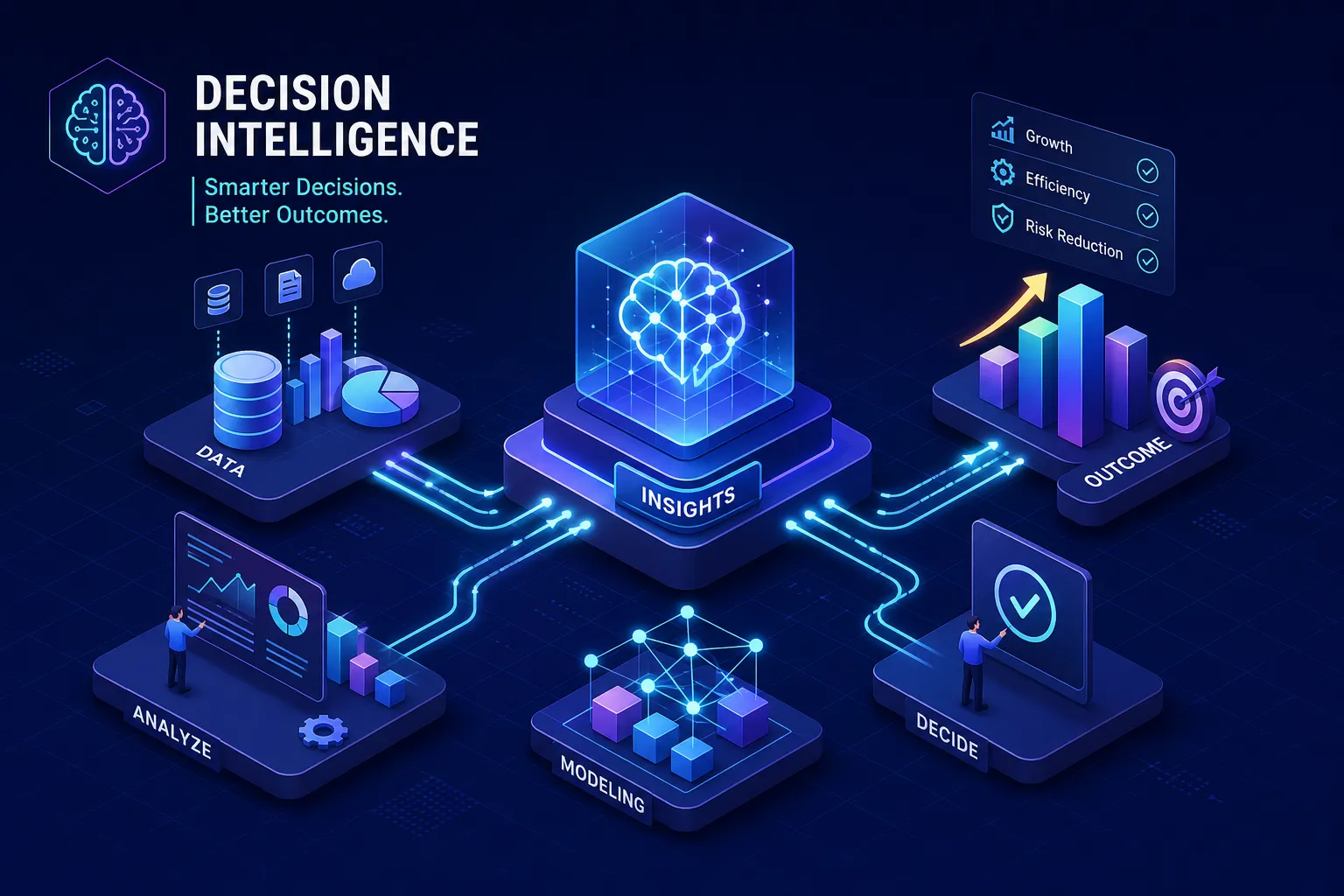
Most business teams are not short on data. For example sales team have CRM dashboards, pipeline reports, weekly review decks, and activity metrics going back years. Marketing teams have even more metrics, customer support teams have the call logs, CSAT scores, complaints, etc. Every business team you name have the data.
And yet, when any business issues surfaces such as deal stalls or a renewal is three weeks out, the call on what to do next still comes down to whoever is loudest in the meeting room. That is not a data problem. That is a decision problem, and it is precisely the gap that decision intelligence for business is built to close.
Decision intelligence (DI) takes the data your organisation already has, applies structured logic to it, and produces a clear action, not just another chart to interpret. For B2B sales teams managing complex pipelines, this shift from insight to execution is the difference between measurable win-rate improvement and another quarter of wondering why the numbers did not move.
This article defines decision intelligence in plain terms, contrasts it with the tools your team already uses, shows where it delivers the most measurable value in a B2B sales pipeline, and gives you a concrete starting point. Growth Aspire’s Deal Intelligence platform sits at the centre of that starting point, and by the end you will understand why.
What decision intelligence actually means for your sales team
Most organisations have already moved past pure gut instinct. They have CRM data, quarterly reviews, and dashboards that track everything from deal-stage progression to rep activity. The problem is that insight without a structured mechanism to act on it creates a bottleneck at the point of decision. Decisions still depend on who is in the room, what they remember from last quarter, and how much time they have before the next meeting.
DI addresses that bottleneck by treating decisions as something that can be modelled, automated, and improved over time. The core process involves five steps:
- A triggering event occurs, a deal stalls, a prospect goes cold, a contract renewal approaches.
- The system ingests relevant data from available sources.
- A decision model evaluates options against historical patterns and business rules.
- An action is executed or recommended.
- The outcome is recorded to improve the next decision.
This closed loop is what separates a decisioning system from a standard reporting tool. The report tells you what happened; the loop tells you what to do and gets sharper every time it cycles through observed outcomes.
Not every decision gets fully automated, and that is by design. Decision intelligence operates on a spectrum. At one end, the system augments human judgement by surfacing AI-driven recommendations alongside the reasons for them. At the other end, it handles routine operational calls entirely on its own within defined guardrails.
For a sales team, this typically means the platform flags which accounts need immediate attention and surfaces the evidence behind that call, while the rep retains full control over how to engage. This human-in-the-loop structure is what keeps the system trustworthy and governable as it scales.
How decision intelligence differs from business intelligence, and why it matters
Business intelligence is retrospective. It answers “what happened last quarter?” and “why did our win rate drop?” These are useful questions, but they require a human to translate the answer into an action. Prescriptive analytics goes one step further by calculating what the optimal action is given a set of constraints.
Decision intelligence, through decision science and decision optimisation principles, goes further still: it engineers the entire decision flow, applies that logic consistently at scale, monitors outcomes, and uses the results to improve future decisions.
The key difference is not the data, and it is not the algorithm. It is that DI treats the decision itself as the unit of value, not the report. In a BI-led organisation, data is the asset: teams argue over dashboard definitions and data ownership. In a DI-led organisation, decisions are the asset.
They are modelled, versioned, tested, and improved like software. A head of sales who understands this stops asking “can we build a better dashboard?” and starts asking “can we build a better deal-scoring model and make it self-improving?” That reframe changes the entire conversation about what AI-driven decision making can do for a revenue function, and it is where automated decisioning begins to move from concept to competitive edge.
In a B2B sales pipeline specifically, the practical distinction is sharp. BI tells you that a particular deal stage has a significant drop-off rate. DI tells you which specific deals are at risk of stalling right now, why they are at risk based on engagement signals and historical patterns, and what action to take before the opportunity is lost. One produces a slide for the next QBR; the other changes what a rep does tomorrow morning.
Where decision intelligence for business delivers measurable value in B2B sales pipelines
For a B2B sales team managing dozens of open opportunities simultaneously, the highest-leverage application of decision intelligence for business is deal prioritisation. Instead of relying on a rep’s instinct about which opportunity is worth pursuing this week, a decision model scores each deal against historical win patterns, engagement signals, deal size, and stage-progression velocity.
Reps stop spreading effort across a large pipeline and start concentrating it on the deals with the highest close likelihood. The downstream effect on pipeline velocity is direct and measurable.
Published industry research supports the scale of that impact. Financial services firms that have deployed DI platforms report a 20, 40% improvement in decision accuracy and a 50, 70% reduction in decision latency, according to analyst studies tracking enterprise DI adoption.
In retail, autonomous decision intelligence applied to retention campaigns has produced ROI multiples that would be implausible from reporting tools alone, one widely cited campaign-level example reached 42x. For B2B sales specifically, the evidence points to gains across three dimensions:
- Win-rate improvement when reps are guided consistently toward better-fit opportunities, some mid-sized SaaS deployments have recorded uplifts in the 15, 20% range
- Shorter sales cycles driven by earlier identification of stalled deals and faster re-engagement
- Improved forecast accuracy as deal-health models replace subjective stage-based probability estimates
Results depend on data quality and adoption, both of which the pilot section below addresses directly. The directional evidence is consistent: organisations that implement deal-level decisioning outperform those that stop at insight generation.
Mid-sized technology firms in India are well-positioned to benefit from this shift. These teams typically operate with lean sales headcount managing complex enterprise deals where a single misallocated rep’s time is genuinely costly. Decision intelligence, delivered through a purpose-built platform rather than a custom data science build, gives these teams access to capabilities that were previously available only to large enterprises with dedicated analytics functions.
Growth Aspire’s Deal Intelligence: decision intelligence for business built for revenue teams
Growth Aspire’s Deal Intelligence platform applies DI principles directly to mid-sized B2B sales teams. It is designed to ingest pipeline data from your existing CRM, apply scoring models informed by behavioural and deal-stage signals, and surface prioritised recommendations for where reps should focus their time.
The goal is not to replace the sales manager’s judgement but to amplify it, by making the decision logic explicit, consistent, and reviewable across every deal in the pipeline, rather than leaving it implicit in whoever happens to chair the pipeline call.
Pipeline reviews stop being status updates and become strategic conversations. When every deal carries a model-generated priority score with supporting evidence, the team is not debating which deal deserves attention this week. They are deciding how to execute on a shared, data-backed view of the pipeline, a material shift in how that time is spent.
Enterprise DI platforms carry implementation complexity and price structures that mid-sized teams cannot justify, and often do not need. Deal Intelligence is designed to work within existing CRM infrastructure and to deliver value in weeks rather than quarters, making it suited to teams managing anywhere from dozens to hundreds of active opportunities at any given time. It provides the decisioning layer that sits between raw CRM data and the weekly pipeline call, turning that call from reactive to proactive.
How to know if your organisation is ready
Decision intelligence delivers the most value when three conditions are in place. Your pipeline data needs to be reasonably clean: deals should move through defined stages, and CRM fields should be consistently populated.
Your sales process needs to be consistent enough that historical win patterns are meaningful, if every rep runs a different process, a model trained on that data will produce noisy outputs. And your leadership team needs genuine appetite to act on model recommendations rather than override them reflexively.
If your team’s CRM data is incomplete, deals change stage without defined criteria, or reps routinely ignore scoring outputs, the bottleneck is process, not intelligence. Fix the process first, then layer the decisioning system on top. No platform resolves a broken workflow; it amplifies whatever is already there.
A DI initiative does not require a data science team, but it does require named owners. You need a business outcome owner (the head of sales), a data quality owner who monitors and improves CRM input hygiene, and a feedback loop owner responsible for verifying that the system continues to update on observed deal outcomes rather than running on stale assumptions.
Governance does not need to be complex, but accountability needs to be explicit from day one. Without named owners, pilots stall at the dashboard stage and the loop never closes.
How to pilot decision intelligence for business without overcomplicating it
The goal of a pilot is not a perfect system. The goal is a working feedback loop. With that framing, a practical six-week structure looks like this:
Week 1, Define and align
Identify the single decision you are automating or augmenting (for most sales teams, this is deal prioritisation scoring), align on your success criteria, and identify the data sources the model needs to ingest.
Weeks 2 to 3, Integrate and validate
Integrate the platform, run scoring models on live pipeline data, and validate outputs against rep and manager judgement. Look for alignment on high-priority deals and investigate any significant gaps between model scores and experienced intuition.
Week 4, Begin the loop
Start acting on recommendations for a defined subset of deals and track what happens. This is where decision optimisation becomes observable: action, outcome, learning, repeated.
Weeks 5 to 6, Review and decide
Review business KPIs including pipeline velocity, win-rate trend, and forecast accuracy variance. Review operational indicators including data pipeline reliability and model output consistency.
At the business level, you are asking: are reps spending more time on the right deals? Is cycle time shortening? Is forecast accuracy improving? At the operational level, you are asking whether the data pipeline is reliable, whether model outputs are consistent, and whether reps are actually using the recommendations. If business KPIs are not moving after six weeks, the cause is almost always data quality or adoption, not the platform itself. Both are fixable with the right coaching structure in place, and that is precisely where Growth Aspire’s training capability sits alongside the Deal Intelligence product.
Set a clear review cadence: weekly check-ins on adoption and leading indicators, a formal six-week review on business outcomes. If the numbers are not moving, iterate for two more weeks before deciding whether to pause and reassess. Most pilots that fail do so because the team never closes the loop between model output and observed deal outcomes. Keep that loop tight from week one.
The decision you are actually making
Decision intelligence for business is not a new category of software to stack on top of everything else. It is a different way of thinking about decisions themselves: as assets that can be modelled, tested, and systematically improved rather than outcomes left to whoever is in the room that day.
For sales leaders managing complex B2B pipelines in India’s mid-sized technology sector, the opportunity is concrete. Shorter cycles, higher win rates, and a pipeline review process that moves from gut-feel debate to structured, model-guided prioritisation are within reach with a well-scoped pilot and the right platform. The organisations that move first on this will not do so because they have the most data. They will do so because they treat their decisions as something worth improving deliberately.
Growth Aspire’s Deal Intelligence platform gives mid-sized B2B sales teams a practical, measurable entry point into decision intelligence for business, without the implementation burden of an enterprise build. If you are ready to move from pipeline reporting to pipeline decisioning, Growth Aspire’s team can map Deal Intelligence directly to your pipeline in a scoping call. The starting point is one well-defined decision, and that conversation is where most pilots begin.