



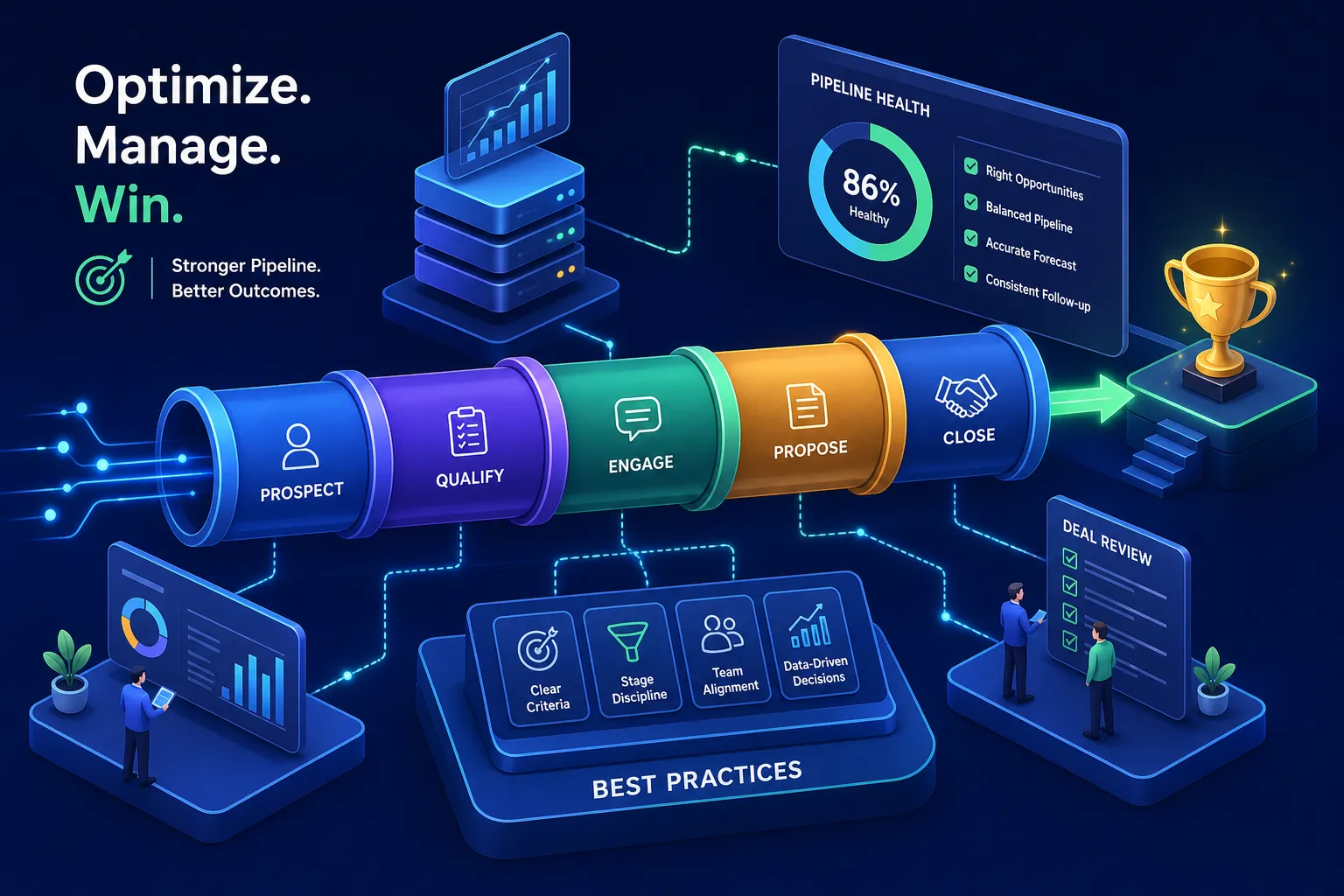
Enterprise pipeline management is the discipline that separates B2B sales teams who predict their quarters from those who are perpetually surprised by them. Every sales leader in a mid-sized B2B company knows the feeling: the pipeline looks healthy on paper, the CRM shows deals across every stage, and the team is busy. Then the quarter closes and the revenue simply is not there. The shortfall was not from a lack of effort.
It came from the absence of a structured system that gives leaders real visibility into deal health, not just deal volume. A full CRM and a managed pipeline are two very different things, and confusing them is one of the most expensive mistakes a B2B sales organisation makes.
Four disciplines separate high-performing B2B sales teams from those that live quarter to quarter in a constant state of surprise: precise stage definitions anchored to buyer behaviour, deal health scoring that gives everyone a shared language for quality, coverage ratios calculated by stage rather than total value, and inspection cadences that produce action rather than status updates. Together, these four disciplines form the operating system of a predictable revenue engine.
This is exactly the gap that Growth Aspire works with mid-sized B2B teams to close, and it is the foundation on which our Deal Intelligence for Pipeline Management was built.
Why most B2B pipelines give false confidence
A CRM records deals. An enterprise pipeline management discipline governs the process around those deals. Without defined criteria for movement between stages and clear signals of deal health, the data in your CRM reflects the optimism of the rep who entered it, not the actual status of the opportunity. Pipeline inflation is rarely deliberate; it is structural. When there are no rules about what qualifies a deal to advance, every deal advances.
In B2B sales cycles that span six to eighteen months, small slippages compound quickly. A deal that stalls at stage three in month two does not always look broken until month eight. By then, closing it in the current quarter is near impossible. The absence of structured pipeline inspection creates a culture of surprises rather than a culture of foresight, and surprises at quarter-end are always expensive.
Many sales leaders respond to a revenue miss by prioritising pipeline quantity over inspection. The more effective lever is improving the quality and rigour of existing pipeline. Working with mid-sized B2B teams across industries, we consistently see deals stall in middle stages not because of vendor issues but because of internal buyer-side problems: unclear decision ownership, no compelling business case, or no access to the economic buyer. More pipeline does not fix those problems. Structure and discipline do.
Enterprise pipeline management: defining pipeline stages that map to how buyers actually decide
Most pipeline stages are seller-centric. “Proposal sent” and “demo completed” describe what the rep did, not where the buyer is in their decision process. Effective stage definitions for complex B2B cycles are anchored to verifiable buyer actions: a mutual evaluation plan agreed upon, a commercial conversation initiated with finance, a technical sign-off obtained. This distinction matters enormously for forecast accuracy. If a deal advances because a rep sent a proposal rather than because a buyer reviewed it with key stakeholders, the pipeline is reporting seller activity, not buyer intent.
For cycles involving multiple stakeholders and procurement processes, five to seven stages is the practical range. Fewer stages obscure where deals are actually stalling; more stages create administrative overhead that reps resist and managers cannot interpret quickly. The right structure for a long-cycle enterprise B2B deal typically spans seven stages: prospecting; qualification; needs discovery and champion development; solution validation; proposal and negotiation; procurement and legal review; and closing. Each stage represents a genuine shift in the buyer’s position, not a seller milestone.
Each stage must carry explicit exit criteria, the conditions a deal must satisfy before it progresses. Without exit criteria, reps advance deals on instinct rather than evidence. Strong exit criteria at the qualification stage might require that the economic buyer has been identified and the budget confirmed. At the solution validation stage, they might require that key stakeholders attended the demonstration and a pilot scope has been agreed. These are verifiable customer actions, and they make the pipeline inspectable rather than merely interpretable.
Deal health scoring and enterprise pipeline management: knowing which deals need your attention this week
Deal health is not just about close date and deal size. Four signals consistently predict outcomes in long B2B cycles: engagement recency, stakeholder breadth, stage velocity, and competitive presence.
Engagement recency
When did the buyer last take a meaningful action, not just open an email, but attend a meeting, share a document, or introduce a new contact? Recency of genuine buyer activity is one of the most reliable early indicators of deal momentum or stall.
Stakeholder breadth
Are you talking to one contact or are you genuinely multi-threaded across the buying committee? Single-threaded deals are fragile by definition. If your champion leaves, is promoted, or loses internal influence, a deal with no secondary contacts can collapse overnight.
Stage velocity
A deal moving more slowly than your historical average for that stage is signalling resistance before the rep has named it. Velocity against baseline is often a cleaner signal than any qualitative status update a rep can provide.
Competitive presence
Has a competitor been explicitly named by the buyer? The presence of a named competitor changes the risk profile of a deal materially, even if the rep believes the relationship is strong.
A deal health score does not need to be algorithmically complex to be useful. Rated red, amber, or green, a weighted model using these four signals gives managers and reps a shared language for deal quality.
A practical weighting structure for long-cycle B2B might assign 45% to engagement signals, 30% to sales activity and stage velocity, 15% to CRM completeness (stakeholder documentation, decision map), and 10% to deal risk indicators such as single-threaded engagement or an absent economic buyer. The specific weights matter less than the consistency of applying them.
When every deal carries a health score, pipeline reviews stop being status updates and become coaching conversations. A red-scored deal with a high deal value becomes the immediate focus of the manager’s attention. The question shifts from “so where is this one up to?” to “what has the buyer done since our last conversation and what is the single next commitment we have from them?” That is a fundamentally different quality of conversation, and it produces fundamentally different outcomes.
Coverage ratios: the pipeline maths that protect your quarter
A coverage ratio is the value of open pipeline divided by the revenue target for a given period. For straightforward transactional sales with short cycles, a 3x ratio is often cited as sufficient. For long-cycle enterprise B2B with win rates in the 20 to 33 percent range, the right coverage ratio typically sits between 4x and 5x. If your win rate is 25%, the mathematical minimum is 4x pipeline to hit your number. Given the slippage and shrinkage that characterises complex cycles, a buffer of 0.5x to 1x on top of that is prudent.
Looking at total pipeline value is misleading if most of it is sitting in early stages. Stage-weighted coverage applies different multipliers depending on how far each deal has progressed. A deal in stage six of seven contributes far more to this quarter’s attainment probability than a deal in stage two, yet both appear in the total pipeline number at face value. A simple stage-weighted model assigns higher conversion probability to later-stage deals and discounts early-stage pipeline accordingly, producing a more honest picture of where attainment genuinely stands.
A pipeline can show 5x total coverage and still miss the quarter badly. Three patterns should trigger an alert regardless of the headline number. Skewed deal age is the first: if the average age of deals in your pipeline significantly exceeds your historical cycle length, those deals are likely stalled rather than progressing.
Deal concentration is the second: if three or four large opportunities represent the majority of your coverage number, a single loss creates a significant gap. Roll-forward deals are the third, the same opportunities appearing in pipeline review after pipeline review with close dates pushed rather than genuine progression. That signals a hygiene problem, not a coverage problem.
Inspection cadences that turn enterprise pipeline management into forward momentum
Different inspection rhythms serve different purposes, and conflating them is a common mistake. Weekly inspection focuses narrowly on deal movement, next actions, and risk identification, examining which deals advanced, which stalled, and whether committed deals have verifiable evidence behind them.
Monthly inspection examines stage conversion rates, coverage by territory, deal health trends, and forecast accuracy. Quarterly inspection steps back from individual deals entirely to evaluate whether the pipeline structure itself is fit for the complexity of the sales cycle.
Most pipeline reviews fail because they ask the wrong questions. “What is the status of this deal?” invites a monologue from the rep that rarely surfaces what actually matters. The questions that drive forward momentum are outcome-focused:
- What has the buyer done since the last conversation?
- What is the next specific commitment secured from them?
- Who else in the buying organisation needs to be brought into the process?
- What is the risk that changes the close date? Is the economic buyer engaged?
Six to eight sharp questions like these, asked consistently, change the quality of every pipeline review.
A pipeline review that does not conclude with specific, assigned actions is largely wasted time. The post-review protocol is simple: for every deal discussed, there should be a named deal owner, a specific action, a deadline, and a next check-in date. This is the difference between pipeline management as an activity and pipeline management as a discipline. The first produces data. The second produces revenue.
How Growth Aspire’s Deal Intelligence gives sales leaders real-time pipeline control
Deal Intelligence for Pipeline Management was built for the scenario this article has described: mid-sized B2B sales teams running complex cycles where deals can stall invisibly for weeks before the problem surfaces in a pipeline call. The platform is designed to give sales leaders a live view of deal health, stage progression, and coverage ratios without waiting for the end-of-week report, so that at-risk deals are surfaced before they miss, not after the quarter has closed.
Rather than managing stage definitions in a CRM, health scores in a spreadsheet, and coverage calculations in a separate report, Deal Intelligence consolidates all four disciplines into one consistent operating view. Sales leaders can see which deals are stalling, which reps need coaching support, and where coverage is thin, updated continuously rather than at the close of a reporting cycle. The reduction in time spent gathering pipeline data means more time spent acting on it.
The value of real-time visibility is not faster reporting; it is faster intervention. When a sales leader can see that a high-value deal has had no buyer engagement for three weeks, they can act in week three rather than discovering the problem in week eight. This is what shifts a team’s culture from reactive pipeline management to proactive pipeline leadership. Alongside the tool, Growth Aspire’s workshops are designed to embed these four disciplines as behavioural habits, so the change in how teams inspect and manage pipeline is sustained well beyond the initial implementation.
Pipeline discipline as a competitive advantage
The four disciplines covered in this article, stage definitions anchored to buyer behaviour, deal health scoring that gives teams a shared language, coverage ratios calculated by stage rather than total value, and inspection cadences that produce action rather than discussion, are not complex in isolation. They become powerful when applied consistently and reinforced through structured coaching. Mid-sized B2B sales teams can build these practices incrementally, starting with precise stage definitions and exit criteria, and adding the scoring and coverage layers as the process matures.
Enterprise pipeline management is not a technology problem solved by adding more fields to a CRM. It is a structural and behavioural discipline. The teams that master it stop being surprised at quarter-end and start being able to predict, protect, and consistently grow their revenue. That predictability is a genuine competitive advantage in complex B2B markets where most competitors are still operating on optimism rather than evidence. For guidance on evaluating the market solutions available, see a roundup of the best sales pipeline management software.
For sales leaders who want to implement these practices with the support of structured training and the real-time visibility of Deal Intelligence for Pipeline Management, Growth Aspire is where that shift begins. Explore our pipeline management programme and take the next step towards pipeline predictability.