



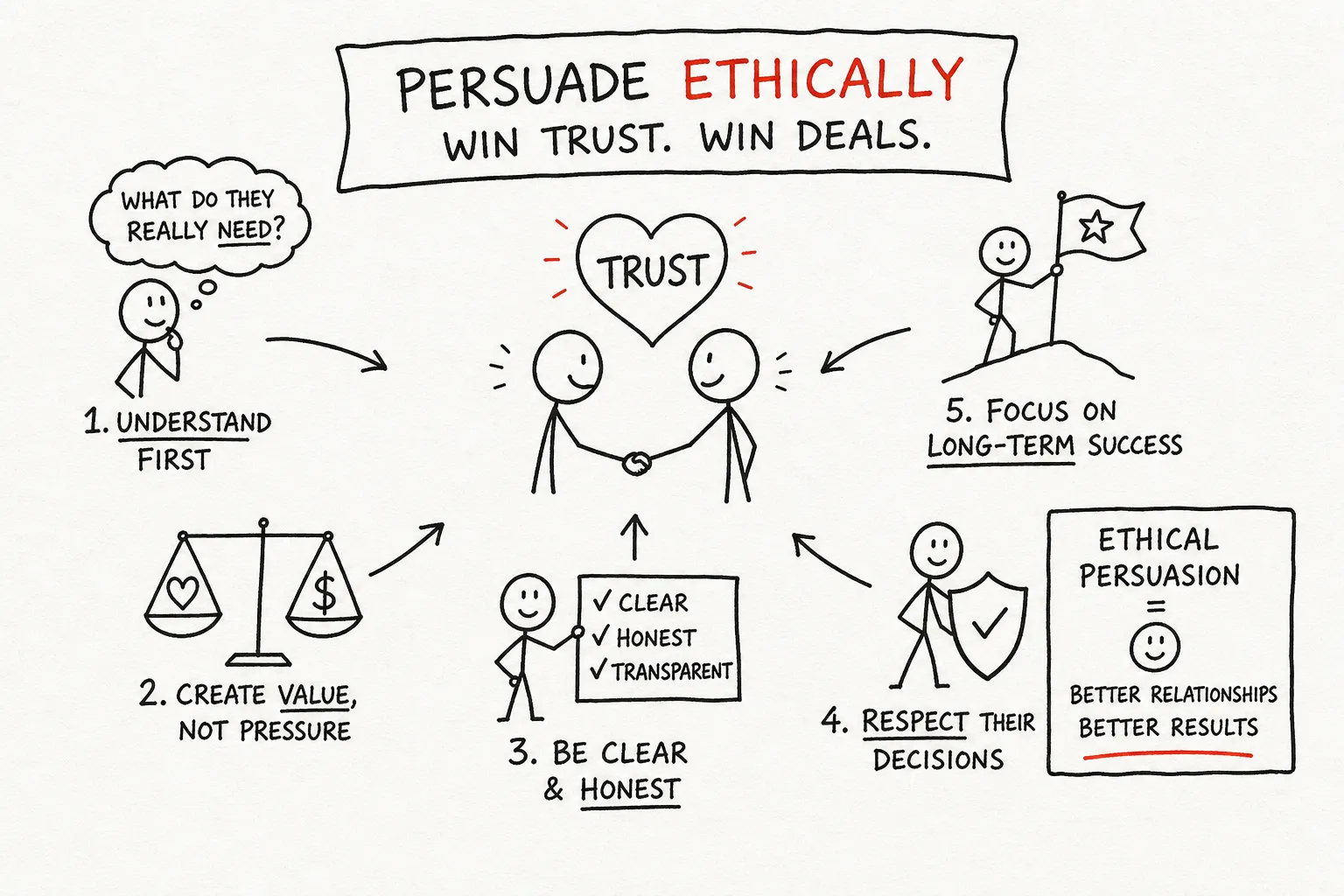
Here is an uncomfortable truth about ethical persuasion in long, complex sales cycles: the line between influence and manipulation gets crossed regularly. Most B2B sales professionals already know this but rarely say it aloud. Not always with bad intent, often, it is deal pressure, quarter-end targets, and competitive anxiety that push salespeople toward tactics they would not defend if asked to explain them plainly.
The stakes are higher than most people realise. Enterprise buyers sit on procurement committees, share notes internally, cross-reference your claims, and carry relationships with your company for years. A single manipulative tactic does not just threaten the current deal. It erodes the relationship capital that drives renewals, referrals, and expansion revenue. In B2B, trust is the longest asset on your balance sheet, and it depreciates fast when buyers sense they are being steered rather than helped.
This article covers the framework for ethical persuasion that every B2B sales professional needs: where manipulation ends and ethical influence begins, how Cialdini’s framework applies with its guardrails intact, a seven-point checklist you can use before any proposal or closing conversation, and what it actually takes to make these principles stick under pressure.
Why ethical persuasion is the real competitive edge in enterprise sales
Enterprise sales are not transactional. A single deal can involve multiple stakeholders, multi-stage procurement reviews, legal sign-offs, and a vendor relationship that outlasts the individual advocates who drove the purchase. In that context, the commercial case for principled persuasion is not a soft argument. It is a performance argument.
Studies on coercive and deceptive influence tactics, including work by social psychologists examining compliance and long-term relationship quality, consistently point to the same pattern: short-term compliance often comes at the cost of the trust and cooperation that sustain long-term commercial relationships. A buyer who felt pressured into a decision carries that experience into every renewal conversation. A buyer who felt genuinely helped arrives at those conversations as a partner.
Many practitioners report that sophisticated buyers at mid-sized and large Indian technology and services firms are increasingly attuned to high-pressure or misleading tactics. They have seen them before. A salesperson who influences through genuine understanding rather than manufactured urgency is remembered and referred. Responsible persuasion is both an ethical preference and a commercial advantage, the two are not in tension. Industry accounts consistently suggest that the sales professionals who win complex deals are the ones buyers trust enough to bring into conversations early, before the formal process begins.
Where manipulation ends and ethical influence begins
The distinction is not about whether you are trying to influence someone. Every sales conversation is an influence attempt. The question is how the influence works and what it does to the buyer’s ability to think clearly and choose freely.
Ethical influence expands the buyer’s understanding and preserves their freedom to decide. Manipulation narrows it. A useful test: if a tactic works primarily by obscuring information, creating artificial urgency, or exploiting fear or insecurity, it is manipulation regardless of how it is framed in your playbook.
Baker and Martinson’s TARES framework, developed within ethical communication theory, offers a practitioner-friendly lens: ask whether your communication is Truthful, Authentic, Respectful, Equitable, and Socially Responsible. If it fails any of those five tests, it warrants a second look before it goes out.
The most common manipulation patterns in B2B sales include false scarcity (“this pricing expires Friday” when it does not), fear-mongering about competitor risk, social pressure created through phrases like “your competitors have already moved on this,” and inflated case study claims that cannot survive scrutiny. Each of these backfires in enterprise contexts for the same reason: buyers discuss claims internally, verify figures, and lose confidence the moment they detect deception.
In B2B, the damage from a single misleading claim can compound across future conversations with that account.
Cialdini’s influence principles and ethical persuasion
Cialdini’s seven principles of influence are among the most cited frameworks in professional selling, and for good reason, they describe how human decision-making actually works. The problem arises when the principles are treated as techniques to exploit rather than mechanisms to understand. Each principle has a legitimate application and an unethical version. The difference lies entirely in intent and truthfulness.
Here is how each principle applies in B2B with its ethical constraints built in:
- Reciprocity: Share a genuinely useful insight or resource before pitching, not a token gift engineered to create obligation.
- Commitment and consistency: Help prospects articulate their own priorities during discovery so their later decisions align with what they said mattered to them.
- Social proof: Cite real, verifiable customer results that are relevant to the prospect’s specific industry and context, not generic testimonials.
- Liking: Build authentic rapport grounded in shared professional challenges, not flattery designed to lower defences.
- Authority: Demonstrate genuine expertise through the quality of your questions and insights, not inflated credentials or borrowed case studies.
- Scarcity: Reference real capacity constraints or implementation timelines when they exist, not invented deadlines.
- Unity: Align your proposal with shared goals, industry context, or operating realities that genuinely connect both organisations, not manufactured “we” language.
The unity principle deserves particular attention in enterprise contexts. Cialdini introduced it as a seventh principle, distinct from liking. Unity is about shared identity: “we are on the same team, working toward the same outcome.”
In practice, this means shifting the conversation from seller-versus-buyer to co-solving a shared problem. Phrases like “our rollout together” or “what both our teams need this to deliver” activate a collaborative mindset.
The constraint is that it must be genuine. Fabricated common ground is detectable and corrosive to trust. For a practical discussion of how unity functions in persuasion, see the analysis of Cialdini’s unity principle.
How to bring ethical persuasion into enterprise deal conversations
Ethical influence does not begin at the pitch. It begins in discovery. Questions that help a prospect articulate their own pain, priorities, and success criteria are a form of consent-based influence: you are helping them think more clearly, not steering them toward a predetermined answer.
A well-structured discovery conversation rarely needs pressure tactics because the buyer arrives at the need themselves. The close becomes a natural conclusion rather than a forced outcome.
When it comes to authority and social proof, the rule is specificity. Use attributable results from clients whose context resembles the prospect’s. Avoid extrapolating one client’s exceptional outcome to every conversation. Enterprise buying committees include finance leads, procurement specialists, and technical evaluators who will verify your claims. Accuracy serves both purposes, ethical and strategic. The moment a buyer catches an inflated figure, your credibility in that account takes a hit that is difficult to recover from.
Position your expertise through the quality of what you bring to the conversation, not through titles or metrics. The questions you ask, the frameworks you offer, and the nuance you demonstrate in understanding their specific situation are what build genuine authority. Buyers remember the salesperson who asked the question that reframed how they thought about the problem, a far more durable form of moral persuasion than a name-dropped client logo.
A 7-point checklist to evaluate any persuasive tactic before you use it
Before any proposal, follow-up message, or closing conversation goes out, run it through this checklist. It takes two minutes and will catch the majority of tactics that drift into manipulation under pressure. The goal is to make ethical persuasion and consent-based influence a habit, not a bureaucratic step.
- Are all claims accurate, complete, and not misleading by omission?
- Does this communication avoid hiding facts that would change the buyer’s decision?
- Is the intent of the influence transparent to the buyer?
- Does it leave the buyer free to decide without coercion or artificial pressure?
- Does it avoid exploiting fear, urgency, or vulnerability?
- Are the supporting reasons and evidence proportionate, credible, and specific?
- Does it aim at a genuine benefit for the buyer, not just the seller’s quota?
Apply this to the final draft of proposals, to follow-up sequences, and to the framing of closing conversations. If a message fails even one of these questions, revise it before it goes out. The checklist is not about slowing down your sales process. It is about ensuring that the influence you exercise builds the relationship rather than quietly damages it.
From principles to practice: what it takes to make ethical persuasion stick
Most B2B sales professionals already know that manipulation is wrong. The knowledge gap is not the problem. The problem is that deal pressure, quota targets, and competitive anxiety push people toward shortcuts in the moment, when knowing better is not enough to change behaviour.
Principled persuasion becomes reliable only when it is practised repeatedly in realistic scenarios, not just understood intellectually. What changes behaviour is scenario-based practice, real-time feedback, and deliberate repetition of ethical influence techniques in situations that mirror actual enterprise deal conversations.
Reading about Cialdini’s principles does not prepare someone to apply them accurately in a live procurement conversation with a sceptical CFO. Only practice closes that gap.
One structured way to close this gap is Ethical Persuasion, Growth Aspire, a paid programme built specifically for B2B sales teams in mid-sized technology and services firms. The programme covers Cialdini’s principles with their ethical constraints intact, manipulation recognition, consent-based discovery frameworks, and the checklist above, all practised through interactive, real-world deal scenarios rather than delivered through slides alone.
If your team is ready to move from knowing these principles to applying them consistently across every deal conversation, explore how the workshop can support that shift.
The foundation, not the constraint
Ethical persuasion is not a limitation on good selling. It is the foundation of it in enterprise B2B. The principles work precisely because they respect the buyer’s ability to think clearly and choose freely, and that respect is what builds the trust that drives complex, multi-stakeholder deals across long sales cycles.
Research on persuasion ethics and trust in commercial relationships suggests that sales teams who embed influence without manipulation into their everyday conversations are better positioned to preserve strong account relationships and contribute to improved commercial outcomes over time. Buyers move faster with vendors they trust.
They expand relationships with partners who have been consistently straight with them. They refer colleagues to salespeople who helped them think, not to salespeople who pressured them into decisions. For readers seeking deeper academic perspectives, see this peer-reviewed research on persuasion and ethics.
Start with the checklist in your next deal conversation. Apply it to the proposal you are drafting this week. And if you want to make ethical marketing and sales a team-wide capability rather than an individual habit, explore how structured, scenario-based training can build principled persuasion into the way your entire sales organisation operates, for more resources and related articles, visit Ethical Persuasion Archives, Growth Aspire and consider the extended reading on Ethical Persuasion page two, Growth Aspire.
For a concise primer on the broader concept you are working with, see the overview on ethical persuasion.