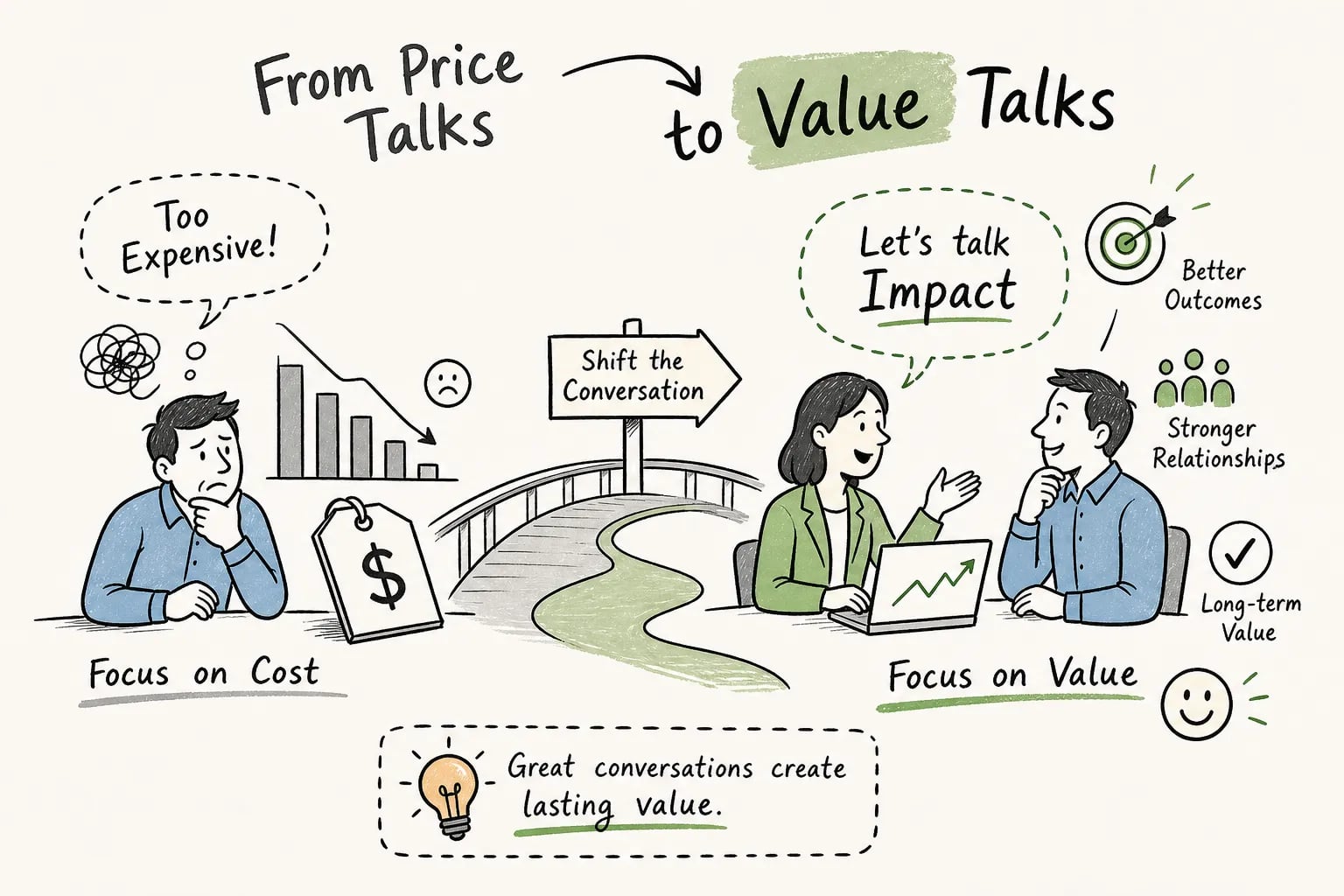
Most B2B sales teams don’t lose deals because they’re expensive. They lose because they never made the value clear enough. According to Gartner’s B2B buyer research, a significant majority of buyers are willing to pay a premium for demonstrable value, yet more than half of sales teams report shrinking margins despite growing sales volume. The price was never really the problem. The conversation that led there was.
At Growth Aspire’s consultative selling workshops, the same pattern surfaces in nearly every roleplay. Reps navigate through discovery, build some rapport, and then advance to the pricing slide before they’ve established a single unit of economic proof. The buyer has no reference point other than the fee itself. From that moment, every conversation becomes a negotiation about the number rather than a discussion about the outcome. Understanding how to shift from price to value conversations is what separates teams that protect margin from those that discount their way to a closed deal.
This article gives you a repeatable framework to change that sequence. It covers discovery questions that surface real business problems, ROI storytelling that survives finance team scrutiny, scripts for handling objections without discounting, and the metrics that tell you whether the shift is actually working.
Why B2B conversations default to price
Buyers don’t walk into conversations obsessed with price. They become price-focused when sellers fail to establish a measurable difference between their offering and the alternatives. The root cause is almost always a positioning gap, not a product gap.
The positioning gap that invites price comparison
Generic language is the first offender. When sellers describe their work as “implementation,” “consulting,” or “managed services,” they use the same words competitors use. Procurement teams, faced with identical descriptions, have only one rational way to sort the options: by price. Bain’s research found that even in commodity categories, 88% of buyers would pay at least 2.5% more to avoid switching suppliers. The monetisable differences exist; sellers simply fail to surface them through their positioning.
The second offender is premature price disclosure. When a rep shares pricing before establishing a value baseline, that number becomes the anchor for every comparison that follows. McKinsey’s analysis shows that a 1% improvement in realised price yields an 8.7% lift in operating profit, assuming volume holds. The inverse is equally true: unnecessary discounting destroys profit at a rate that volume gains rarely repair.
How to shift from price to value conversations, discovery questions
The shift from price to value conversations begins in discovery, not in the proposal. If your discovery doesn’t surface the economic consequence of the problem, your proposal will always feel expensive because there’s no cost-of-inaction figure to measure it against.
SPIN questions that uncover the cost of the problem
The SPIN sequence (Situation, Problem, Implication, and Need-Payoff) gives reps a structured path from fact-gathering to economic impact. Most reps rush through Implication questions, which is precisely where the financial weight of the problem gets quantified. Prepare before the call so you’re not wasting Situation questions on information available in the prospect’s annual report or LinkedIn page. Then use these sharper questions to build economic proof:
- Implication: “What does that delay cost in labour, revenue, or capacity?” / “What happens if this continues for another two quarters?” / “Does this create customer, compliance, or forecast risk?”
- Need-Payoff: “If that bottleneck disappeared, what would the team do with the recovered capacity?” / “What would a 20% improvement mean for your quarterly target?”
Insight-led questions that reframe the buyer’s diagnosis
The Challenger approach works differently. Rather than opening with a company overview, you lead with a commercially relevant hypothesis. The goal is to show the buyer something about their situation they haven’t fully accounted for, creating useful tension that makes the economic consequence visible before price is ever mentioned. Try questions like: “Many companies treat this as a staffing problem, but the larger cost often comes from poor prioritisation. How are you currently diagnosing it?” or “What has prevented previous initiatives from producing the expected result?” The key distinction: challenge the assumptions, not the buyer personally. The insight must be evidence-based and relevant.
Building the ROI story economic buyers actually believe
Once discovery surfaces the problem and its cost, reps need to translate that into a business case that survives internal scrutiny. The mistake most reps make is presenting ROI as a vendor claim. Economic buyers reject claims they didn’t help build.
Anchoring value before any number enters the conversation
The first concrete number in a conversation becomes the reference point for everything that follows. If that number is your price, every subsequent discussion is measured against it. If that number is the cost of inaction, drawn from the buyer’s own estimates, the investment looks entirely different. Consider a scenario relevant to many mid-sized SaaS or technology firms in India: a buyer estimates a churn problem costs ₹20 lakh per quarter. A solution priced at ₹8 lakh is no longer “expensive”; it’s a 2.5x return. The anchor has shifted completely.
How to shift from price to value conversations, ROI scripts
The basic value equation is: Annual Value = (Improvement × Economic Value Per Unit) minus Implementation Cost. If a mid-sized technology firm is losing 1,000 hours of sales rep time annually to manual data entry, and each hour is valued at ₹1,500, the recoverable value is ₹15 lakh before implementation costs are considered. The model is straightforward; the critical step is validating the assumptions with the buyer. Finance teams reject ROI calculations they weren’t part of building. Present the model collaboratively, not as a fait accompli.
Connecting outcomes to the economic buyer’s priorities
Value conversations stall when they stop at the user level. The economic buyer cares about revenue, cost, risk, or strategic exposure. These outcome-focused conversations require you to reframe the same result in executive language: “How would this affect your cost-per-acquisition this year?” or “Which strategic goal is most exposed if this problem continues?” or “What would the board ask if this initiative doesn’t produce measurable results within two quarters?” These questions move the conversation up the organisation and anchor value where budget decisions are actually made.
Scripts for handling price objections without discounting
Knowing the framework and executing it under pressure from a procurement manager demanding a price sheet are two different skills. These scripts give reps language that works in real conversations.
When the buyer says “you’re too expensive”
The sequence is: acknowledge, clarify, isolate, reframe. Start with “Compared with what, another provider, your current process, or the budget you had in mind?” This clarifying question does significant work. It reveals whether the objection is about competitive price, budget constraints, or unclear ROI. After clarifying, isolate: “Aside from the investment, is there anything else that would prevent you from moving forward?” Then reframe using the buyer’s own numbers: “You mentioned this costs you roughly ₹15 lakh per quarter. If this reduces that by even 20%, the investment covers itself in the first year. Would your finance team agree that’s a reasonable threshold?”
Avoid these responses entirely: “We’re actually very affordable,” “You get what you pay for,” or any version of immediate discounting before understanding what the objection actually is. Each of these signals that the price conversation has already won.
When they ask you to “just send the pricing”
Two responses work well here. First: “Absolutely. To avoid sending a number without context, what should the investment be expected to improve, revenue, costs, capacity, or risk?” Second, if they still want the number: “I’ll send the pricing along with the assumptions and expected outcomes, so it’s easy to assess internally.” The goal is to ensure the number is never evaluated in isolation. A price without a value context is always expensive.
When they say “we don’t have budget”
Distinguish between two very different situations: there is genuinely no budget for this initiative, or the expected return isn’t compelling enough to reallocate existing budget. The question that draws that distinction: “Is there no budget for this, or is the expected return not yet strong enough to justify reallocation?” If it’s the latter, the conversation returns to the ROI model. If it’s genuinely a budget timing issue, a phased-scope alternative adjusts the structure before touching the price, which preserves the value proposition while addressing the constraint.
KPIs that tell you if value conversations are actually working
You can’t improve what you don’t measure. Tracking the right metrics also makes it significantly easier to sell the methodology internally to a head of sales who wants evidence before committing to a training investment.
The four metrics that reveal pricing discipline
- Win rate: Closed-won divided by all closed opportunities. Define the denominator consistently and stick to it.
- Average deal size: Report as the median alongside the mean, because a few large deals distort the average and obscure what’s actually happening across the pipeline.
- Discount rate: List price minus booked price as a percentage. This single metric reveals more about pricing discipline than almost anything else.
- Sales cycle length: Report as the median and the 75th percentile, not just the mean, which can be pulled by outliers.
Programmes that embed value-focused conversations consistently report 5, 15% higher win rates and 5, 25% larger average deal values across comparable pipelines.
How to track and report progress honestly
Run a weekly review of stage conversion rates and deal slippage alongside a monthly review of win rate, average deal size, and discount rate. The most common reporting mistake is tracking activity metrics, calls made, emails sent, meetings booked, rather than quality metrics. Activity without quality is just noise. Segment results by rep, deal size, and competitive intensity so the data reveals precisely where value conversations break down. A rep with a high win rate on small deals and a low win rate on enterprise opportunities needs a very different intervention than a rep with consistent discounting across all deal sizes.
How reps build this skill so it holds under pressure
Reading this framework will not help a rep when a procurement manager is demanding a price sheet and the conversation has been running for forty minutes. The gap between knowing a technique and executing it reliably under pressure is real, and it’s the gap that most sales training programmes fail to close.
Why roleplay builds muscle memory faster than frameworks alone
Under pressure, the brain reverts to habitual patterns. A framework read once does not replace a habitual response; deliberate, structured practice does. Ericsson’s research on skill acquisition makes the mechanism clear: improvement requires a specific, defined skill target, repeated attempts with immediate corrective feedback, and progressive challenge. For objection handling, that means isolating specific behaviours in sequence:
- Asking a clarifying question before responding
- Isolating the objection precisely
- Reframing using the buyer’s own numbers
Practise each behaviour separately before combining them. Reps who work through objection handling in realistic simulated scenarios before live calls execute those techniques significantly more reliably when the moment arrives on an actual deal.
Embedding value conversations through structured practice
Growth Aspire’s consultative selling workshops are built specifically around this gap. The live roleplay scenarios simulate complex B2B deals where price objections surface mid-conversation, giving reps a structured environment to practise discovery questions, ROI anchoring, and objection reframes before they have real revenue at stake. The workshops are designed for mid-sized technology sales teams in India operating in multi-stakeholder deals, where value needs to land persuasively at both the user level and the economic buyer level. Sales leaders who want to map these workshops to their specific deal environment can contact the Growth Aspire team directly.
Putting it all together
Knowing how to shift from price to value conversations follows a clear sequence: diagnose why price conversations are happening in the first place, use SPIN and Challenger discovery to surface the economic cost of the problem, build the ROI story using the buyer’s own assumptions, handle objections with the acknowledge-clarify-isolate-reframe sequence, and measure the impact through win rate, average deal size, and discount rate. That sequence is repeatable. It works across deal sizes, industries, and buyer profiles.
This is not a one-time mindset change. It’s a skill that requires structured practice and consistent measurement before it holds under the kind of pressure that real deals generate. The data on value-based selling is unambiguous: win rates improve, deal sizes grow, and margins recover when reps can make the economic case before a price is ever mentioned.
Start with one objection from this article. Script your own response using the acknowledge-clarify-isolate-reframe sequence. Test it on your next call. Executing how to shift from price to value conversations isn’t about reading the framework most carefully, it’s about practising enough for it to hold when it matters.