



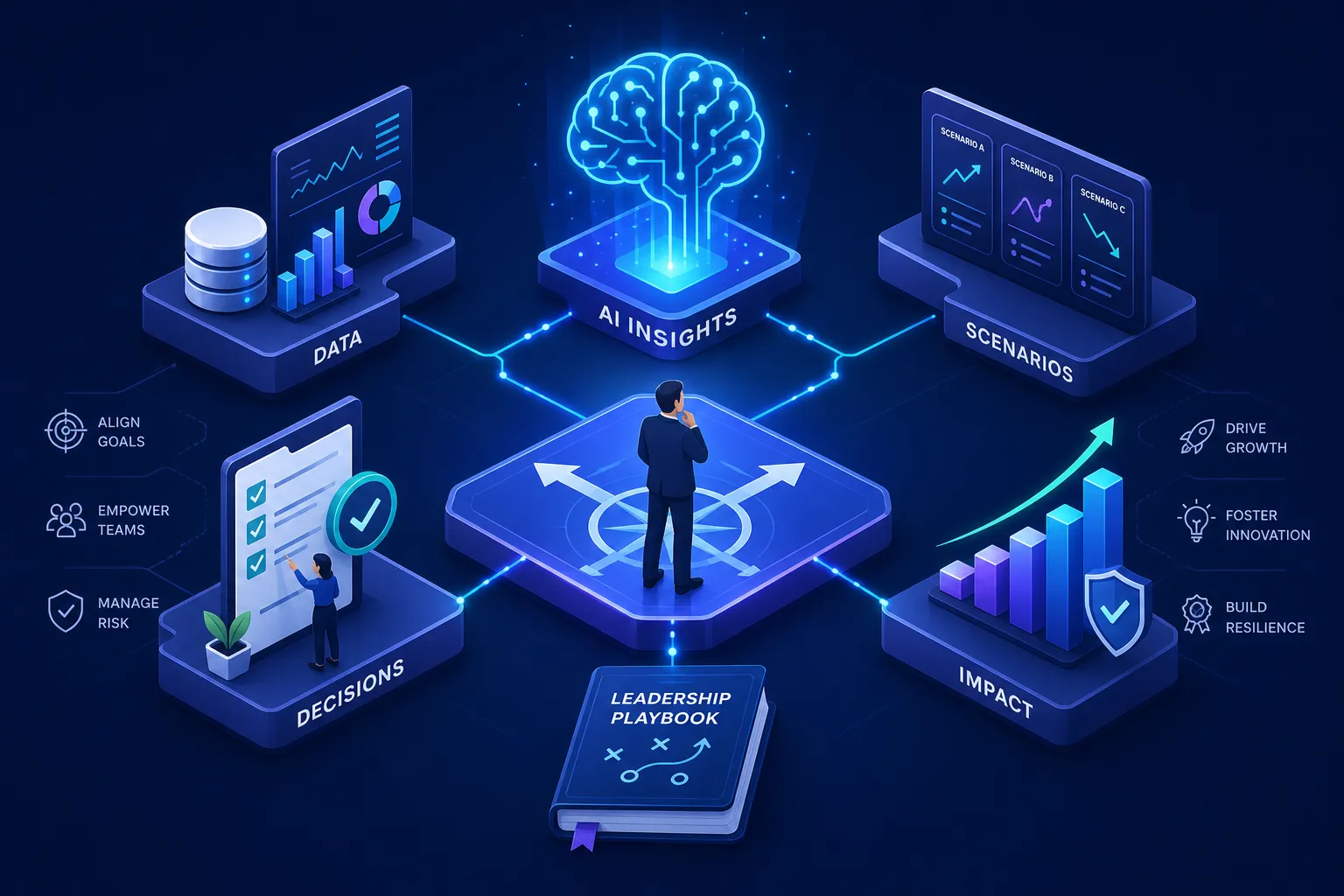
Leadership decision-making in the AI era is evolving faster than most governance frameworks can keep pace with. According to the Capgemini Research Institute’s 2026 survey of 500 CXOs, more than half are already using AI to support or inform strategic decisions, and AI use among senior leaders is projected to double within three years. That is a significant structural shift in how organisations arrive at consequential choices. Yet most are running without a clear framework for how humans and machines actually share decision authority, which creates a predictable failure mode: leaders either over-rely on AI outputs or dismiss them entirely. Both are expensive mistakes.
At Growth Aspire, this tension surfaces repeatedly in conversations with heads of sales and senior revenue leaders across India. The challenge isn’t access to AI tools. It’s knowing how to lead with them responsibly while keeping human judgement in the right place, and how to build governance habits before something goes wrong. This playbook covers all four essentials: how decision ownership is shifting, a framework you can apply immediately, the capability investments worth making now, and a governance checklist to pilot AI-assisted decisions safely.
What actually changes about decision ownership
AI restructures the process, not the accountability
The most important clarification any senior leader needs right now is this: AI does not transfer decision rights from humans to machines. What changes is the structure of the decision process itself. AI handles high-volume pattern recognition, scenario modelling, and data aggregation. Humans retain final authority and, critically, accountability for the outcome.
JPMorgan Chase‘s COIN system illustrates this precisely. The system processes the equivalent of 360,000 staff hours of contract review annually, compressing weeks of work into seconds. Human sign-off remains mandatory on all contract interpretations. Legal and strategic accountability stayed entirely with people. The AI restructured the workflow; it did not absorb the responsibility that comes with it.
Decision modes every leader should recognise
Not all AI collaboration looks the same, and treating it as uniform is where many leaders go wrong. Three distinct modes define how humans and AI share the decision process. In AI-assisted mode, the system surfaces data and the leader decides. In AI-augmented mode, the AI enhances the decision process and the leader co-creates the outcome. In AI-autonomous mode, the system decides on routine, pre-defined tasks while the leader oversees the process.
Most leadership decisions sit firmly in the first two modes. The mistake many senior leaders make is applying autonomous-mode thinking to decisions that require augmented-mode rigour: assuming the AI will handle it when what the situation actually demands is active human interpretation. Knowing which mode a given decision belongs to is the first step toward structuring it well.
The cognitive bias problem in leadership decision-making in the AI era
Why even experienced leaders make predictable errors
Cognitive biases are not signs of poor leadership. They are structural features of how the human brain processes information under pressure. Anchoring bias causes leaders to over-weight the first data point they receive. Confirmation bias leads them to seek evidence that validates their existing instinct. Availability bias drives decisions based on recent events rather than representative long-term patterns. None of these are intelligence failures; they are predictable outputs of human cognition under time and complexity constraints.
The consequences are measurable. McKinsey’s 2024 research found that only 20% of executives believe their organisations excel at decision-making, and poor decision quality costs Fortune 500 firms an estimated USD 250 million annually in wasted effort. For mid-sized technology companies in India competing in complex B2B sales environments, the absolute cost may be lower, but the proportional drag on pipeline velocity and win rates is likely just as damaging.
Where AI changes the calculus
AI consistently surfaces data that contradicts a leader’s initial instinct, forcing a structured pause before committing to a direction. It can more consistently run stress-tests on assumptions without ego investment in the outcome, something that is easier to build into an algorithm than to sustain within a team of experienced, opinionated professionals. This is not a criticism of your people; it is simply an acknowledgement of where the structural advantage lies.
The risk of the opposite failure is equally real. Ethical concerns about AI taking a larger role in decision-making have been raised precisely because over-reliance on AI outputs, particularly when the underlying data is poor or the model was not trained on relevant contexts, produces false confidence rather than better decisions. As the saying goes, it becomes a case of “garbage in, confident output out,” one of the most common and costly failure modes in AI-assisted decisions. The antidote is not distrust of AI; it is the disciplined habit of questioning model inputs with the same rigour you apply to model outputs. AI reduces bias most effectively when the leader stays an active, critical participant in the process rather than a passive recipient of recommendations.
A practical framework for leadership decision-making in the AI era
The four-step decision loop
The Market Logic collaborative loop offers a clean, practical structure for AI-assisted decision-making that senior leaders can apply immediately. The four steps work as follows. First, AI surfaces patterns and signals from live data. Second, the leader interprets findings and sets priorities, applying domain knowledge and stakeholder context that no model possesses. Third, AI stress-tests the direction, running scenarios and flagging contradictions. Fourth, the leader refines, decides, and defines action.
Consider a head of sales using AI-generated pipeline intelligence before a quarterly strategy meeting. The AI surfaces deal velocity patterns, win-rate trends by segment, and flags accounts showing disengagement signals. The sales leader interprets those findings through the lens of relationship context and market conditions the model cannot see. The AI then stress-tests a proposed territory reallocation against historical conversion data. The leader refines the recommendation and commits to an action plan. Each step contributes what the other cannot replicate alone.
Knowing when to override the model
Well-designed AI systems signal low confidence when their output should be treated cautiously, a principle explored in the “learning to defer” literature on human-AI decision systems. Leaders need a matching habit of recognising when human override is not just acceptable but required. Two clear triggers define this. The first: when the decision involves values, relationships, or stakeholder trust that no model can quantify. The second: when the AI’s training data does not reflect the current context, a frequent issue in fast-changing Indian B2B markets where historical patterns may not anticipate new competitive dynamics.
Override is not AI failure. It is the framework functioning as intended. The goal of human-AI collaboration is not to let the machine decide; it is to let the machine improve the quality of information you bring to a decision that remains yours to own.
The capability investments worth making now
Data literacy and model fluency as a leadership baseline
Technical proficiency is not the goal here. Interpretive literacy is. Senior leaders need to read AI outputs critically, understand what the model was trained on, and identify data quality gaps before acting on a recommendation. The core skills are practical: data visualisation fluency, an understanding of confidence intervals, and the consistent habit of asking “what would make this output wrong?” before treating it as a reliable input.
This is a narrower skill set than it sounds, and it is learnable. Most experienced sales leaders already apply structured scepticism to pipeline forecasts from their teams; applying the same discipline to AI-generated pipeline intelligence is a direct extension of a capability they already have.
Critical thinking within a data-rich environment
Decision science research, including work on pre-mortems and hypothesis-first analysis, consistently shows that leaders who form a view on expected results before viewing AI-generated data make better decisions than those who approach output without a prior hypothesis. This pre-commitment habit reduces anchoring bias and forces genuine engagement with the data rather than pattern-matching to confirm instinct. It is a trainable skill, not an innate one, and it improves measurably with structured practice.
Treating AI outputs as starting points rather than answers is the practical expression of this skill. The leaders who do this consistently make better calls. The leaders who treat the model’s output as the answer tend to inherit the model’s blind spots along with its recommendations.
Building this capability systematically, not by accident
One-time workshops rarely embed new behaviours under pressure. What the learning science literature consistently supports is immersive, facilitated programmes that combine simulation, peer exchange, and a sustained coaching cadence. Reading about AI governance does not build the habit of applying it under pressure; practising it in a structured environment does. Data-driven leadership, in other words, requires more than data, it requires deliberate repetition under realistic conditions.
Growth Aspire’s AI-enabled leadership development programme is designed for exactly this context. It equips senior sales leaders with decision frameworks, data literacy habits, and the governance mindset needed to lead confidently when AI is in the room. The programme uses scenario-based learning drawn from real sales and revenue contexts, with coaching built into the follow-up to embed new behaviours rather than leaving them to chance.
Drafting your AI governance starter checklist
The four governance essentials to define before you start
Before piloting any AI-assisted decision process, a leader needs clear answers to four questions. These translate directly into a checklist your team can use before any high-stakes AI-informed decision is acted upon, and sequencing them in this order matters, because each one creates the condition the next depends on.
- Accountability: Who owns the final decision and accepts accountability if the outcome is wrong? This must be a named individual, not a team or a tool.
- Explainability: Can the AI output be explained in plain language to a non-technical stakeholder? If it cannot, it should not inform a high-stakes decision without further scrutiny.
- Override protocol: What is the documented trigger for a human to override or pause the AI recommendation? This should be written down before the decision process begins, not improvised during it.
- Data quality gate: Has the input data been audited for completeness, recency, and representativeness? A model fed poor data produces confident-sounding output regardless, and that false confidence is one of the costliest failure modes in AI-informed decisions.
How to pilot without overcommitting
Start with low-stakes, reversible decisions: territory allocation scenarios, pipeline segmentation, meeting prioritisation. These are decisions where the cost of an error is bounded and the learning value is high. As a practical starting point, run the four-step collaboration loop on one real decision in the next 30 days. Document what the AI surfaced, what you changed after human review, and what the outcome was.
That single documented cycle teaches more than weeks of reading about AI governance. It builds institutional memory about how your team interacts with AI outputs, where your data quality gaps are, and which types of decisions benefit most from AI augmentation in your specific sales context. Scale from there, not before.
The disciplined leader wins in the AI era
Leadership decision-making in the AI era does not favour the leaders with the most sophisticated tools. It favours those who know exactly where human judgement must stay in the loop, what capabilities their teams need to develop, and how to govern AI use before something goes wrong. A clear decision framework, deliberate capability investment, and governance discipline, that combination is what turns AI from a liability into a reliable performance multiplier.
If you lead a sales organisation in India and you are still working out where to start, the practical answer is to build the framework before you scale the tools. Scaling tools without a decision framework produces speed without direction, which is worse than moving slowly. Growth Aspire’s AI leadership development programme gives senior sales leaders the structured environment to practise exactly this, with coaching support and a focus on outcomes you can track against your pipeline and win-rate data.
The AI era does not reward the fastest adopters. It rewards the most disciplined ones. Start with one decision, one loop, and one governance checklist, the compounding value follows from there.