


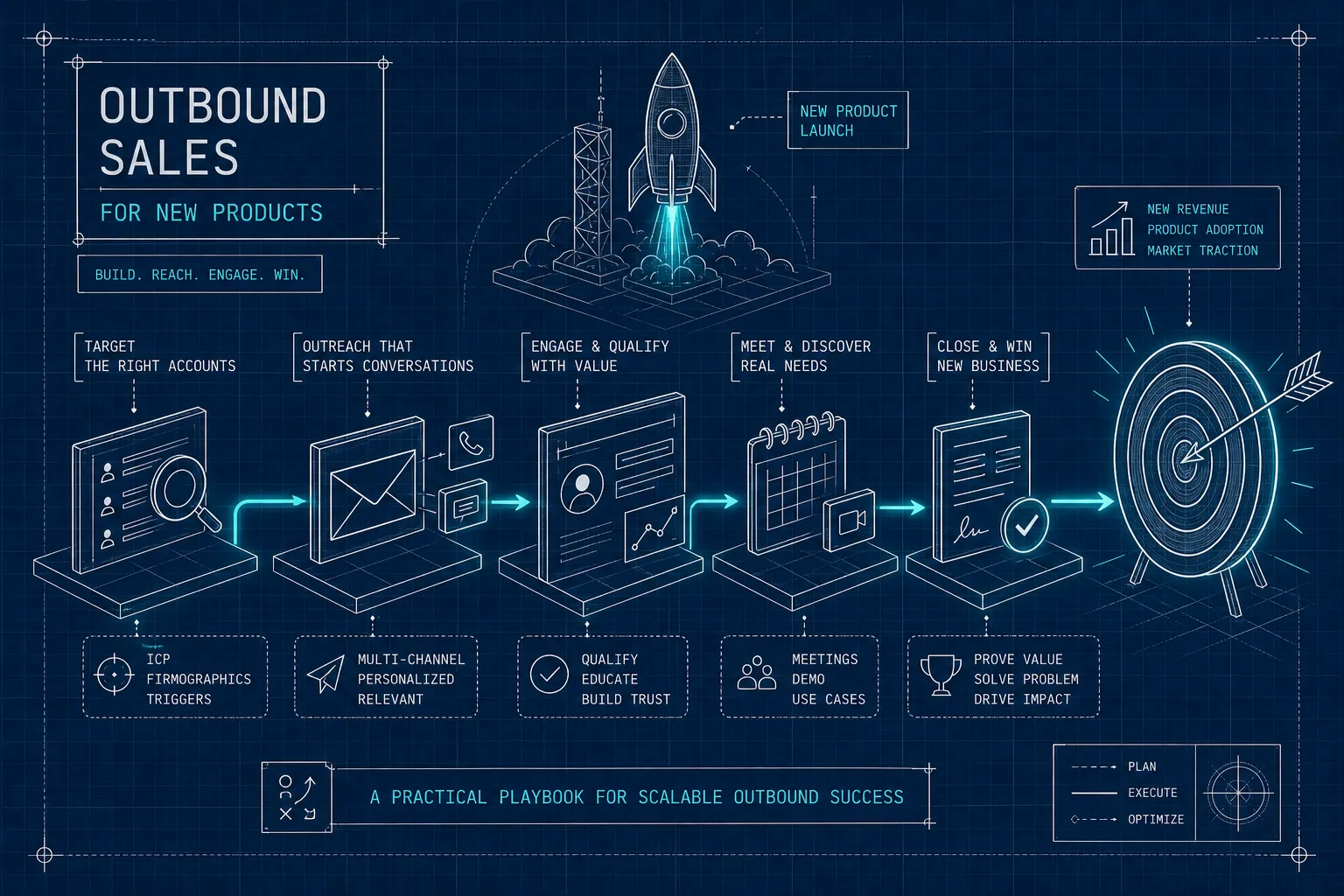
Outbound sales for new products fail most often not because the product is weak, but because teams prioritise volume before building structure. Cold emails land in inboxes and vanish without a trace. First meetings never materialise. The launch window closes before the pipeline has warmed up enough to show a single qualified opportunity.
Outbound for a new product is fundamentally different from outbound for an established offer. Your prospect has never heard of what you are selling. The market has not formed a buying habit around your category yet. That means the sequencing, the messaging, and the objection handling all need to be tighter from day one, not improvised under launch pressure.
Mid-sized sales teams that build structured outbound capability before launch consistently cut their time-to-first-meeting compared to those who improvise. This playbook covers the go-to-market outbound strategy that makes the difference: from ICP definition to cold sequence structure to the metrics that tell you when to scale and when to fix.
Define your ICP before you write a single email
One of the biggest reasons cold outreach for product launches under-performs is inadequate ICP definition. When everyone looks like a potential buyer, the messaging becomes generic, the list grows bloated, and the reply rate tanks. Tight ICP definition is not a planning exercise; it is a revenue decision that shapes everything downstream.
Start from evidence, not gut feel
For a new product, you are often working with a hypothesis ICP rather than one drawn from years of historical data. The recommended approach is to identify accounts with the fastest expected fit: a high-value use case, urgency around the problem your product solves, and the organisational maturity to act on a recommendation. Start tight, validate with a small pilot batch, then expand. Casting wide from day one guarantees mediocre results across a list you cannot recover later.
The India-specific ICP signals that actually matter
In the Indian B2B context, generic firmographic data is rarely enough to drive outbound prospecting for new products. The signals that predict buying behaviour include city cluster (Bengaluru, Gurugram, Mumbai, Pune are commonly cited clusters for mid-market SaaS outbound), growth stage (Series A or B SaaS, or scaling mid-market), tech stack maturity, hiring velocity in relevant roles, and procurement style. As an illustrative example, a concrete ICP statement might read: “Series B SaaS companies, 50 to 200 employees, ₹10 to 40 Cr ARR, using Zoho or Salesforce CRM, headquartered in Bengaluru or Gurugram, actively hiring sales development or business development roles.” Validate these numeric bands against your own best-customer data before adopting them wholesale, the specificity is the point, not the exact figures.
Build a prioritised prospect list, not just a big one
A large, unfiltered list is not an asset. It is a liability that drains SDR time, inflates bounce rates, and dilutes the personalisation that drives replies. Industry benchmark data links tighter account prioritisation directly to improved reply rates, the difference between a 1% and a 5%+ reply rate in first-customer acquisition outbound often comes down to how well accounts are selected before a single email is sent.
Account tiering: the Tier 1, 2, and 3 model
Tier 1 accounts combine the highest ICP fit score with a strong buying trigger. Recent funding, active hiring of SDRs, new market expansion, compliance changes, or a leadership hire in the relevant function are all strong Tier 1 signals. Tier 2 accounts have solid fit but weaker urgency signals; they receive semi-personalised sequences rather than fully custom outreach. Tier 3 accounts match partial ICP criteria and belong in a nurture sequence, not your immediate outbound sprint. Alongside these tiers, maintain a negative ICP list to disqualify accounts early and protect your team’s bandwidth from low-probability pursuits.
Tools that make list building reliable
For Indian mid-market outbound, a lean four-tool stack covers the essentials without creating operational complexity. LinkedIn Sales Navigator handles targeted list building by role, location, and company stage. Apollo provides verified contact data and enrichment, with decent coverage of Indian companies. Klenty or Smartlead manages sequencing and email deliverability. HubSpot keeps pipeline tracking manageable. The goal of the stack is accurate, enriched contacts at scale; the tools are just the mechanism to get there.
Sequence your outbound sales for new products across channels and touchpoints
The sequence is the operational heart of outbound selling for product launches. The number of touches, the channels selected, the order, and the messaging at each step, these decisions determine whether your motion books meetings or generates silence.
The multi-touch structure that books first meetings
Industry benchmark data shows that four-to-seven-step sequences generate reply rates of around 8%, compared to roughly 4% for single-touch outreach. For a new product with little brand recognition, most practitioners recommend building towards eight to twelve touches, with newer products typically needing the upper end of that range. A workable starting sequence runs: Day 1 cold email, Day 3 LinkedIn connection request with a contextual note, Day 5 follow-up email adding new information (not a re-send), Day 8 phone call referencing earlier touchpoints, Day 10 LinkedIn message with a relevant insight, Day 12 final-value email, Day 14 break-up email. Run this with 30 to 50 accounts first, review the data after two weeks, and validate before scaling to the full list.
Subject lines, openers, and follow-up templates that get replies
The patterns that consistently outperform in SDR playbooks for launches are short subject lines (one to four words), trigger-based openers that show immediate relevance, and follow-ups that introduce new information rather than simply bumping the thread. Three templates you can adapt immediately:
- Subject: Quick question, “Saw you’re expanding into [city/market]. We built [product] specifically for teams handling [specific challenge] at this stage.”
- Subject: [Company] + [Your Company], “Noticed you’re hiring SDRs in Bengaluru. Teams scaling outbound this way usually run into [specific problem]. Thought this might be worth 15 minutes.”
- Subject: Should I stop reaching out?, “Not sure if [problem] is on your radar right now. If it is, I can send a three-bullet overview of how we handle it. If not, I’ll close the loop here.”
Handle early objections before they kill the meeting
Early-stage objections in cold outreach are not the same as late-stage objections in a live negotiation. When a prospect replies with “not the right time” or “we already have something,” most SDRs either fold immediately or push too hard. Both responses lose the meeting that was within reach.
Why early objections are often buying signals in disguise
A reply, even a negative one, signals engagement. The prospect read the email, processed the offer, and formed an opinion. That already puts them well ahead of the majority of your list who never responded at all. The objection is not a door closing; it is an opening to ask one more calibrated question and keep the conversation alive.
Reframes that move the conversation forward
Four objection patterns account for the majority of pushback in cold outreach for new products. Each one has a reframe that earns the next step rather than triggering a dead end:
- “Not the right time”: Reframe to future fit and offer a lower-commitment next step. “Understood. When would a better window be? I can send a brief overview so the context is there when you’re ready.”
- “We already have a solution”: Reframe to an outcome gap rather than a tool comparison. “That makes sense. Most teams we speak with have something in place. The question we usually explore is whether the current solution is delivering the outcomes you expected.”
- “No budget right now”: Reframe to the cost of the current problem. “Fair enough. It’s worth a quick look at what staying with the current situation is actually costing you before we close the loop.”
- “Send me an email”: Treat this as a channel stall, not a final decision. Ask what would actually be useful, then follow up with a short, specific message tied to that exact point.
The goal of every reframe is not to win the argument. It is to earn the first meeting.
Measure the metrics that tell you if your outbound is working
A playbook without measurement is just activity. Every outbound lead generation motion for a new product must track a small set of metrics from week one. Without them, you scale what is broken and miss what is working until the launch window is already behind you.
The conversion benchmarks to set expectations correctly
For broad ICP targeting, a cold email reply rate of 1 to 3% is typical. With tight ICP definition and trigger-based personalisation, 3 to 7% is achievable. Hitting 10% or above signals excellent list-to-message fit, a clear indicator to scale quickly. Reply-to-meeting conversion should sit at 15 to 30%, with stronger numbers on high-intent, signal-triggered campaigns. These ranges reflect 2026 B2B cold outreach benchmarks and apply broadly across Indian mid-market outbound.
When to iterate and when to scale
Run the pilot with 30 to 50 accounts and review reply rate, positive reply rate, and meetings booked after two weeks. If reply rate sits below 1%, the problem is either ICP definition or the message itself, fix that before scaling. If it crosses 3%, expand volume and preserve the sequence structure that is producing the results. Early-stage outbound requires fast iteration cycles, not patience. The teams that scale a broken sequence burn through their best-fit accounts before the message is right, and those accounts do not come back around easily.
Build outbound muscle that compounds beyond the launch
A product launch is a moment. Outbound capability is a sustained competitive advantage. The teams that treat outbound selling for product launches as a one-off sprint often lose momentum within weeks because the motion was never systematised, and they find themselves rebuilding from scratch the next time a new product or territory comes up.
Why improvised outbound fails mid-sized teams
A pattern that emerges repeatedly across mid-sized technology sales teams is predictable: outreach is inconsistent, messaging is untested, and there is no coaching cadence reinforcing what works after the initial push. The result is a team that generates a burst of activity around launch week and then watches pipeline velocity stall as momentum fades and the original energy dissipates without a repeatable structure to sustain that momentum.
How structured training shortens early-stage sales cycle time
Growth Aspire’s sales training programmes are designed specifically for mid-sized teams that need to build repeatable outbound capability fast. The workshops cover ICP definition, outreach sequencing, and objection handling frameworks, the same pillars this playbook covers, delivered in interactive formats that make the skills stick. The structured coaching cadence that follows every programme is aimed at helping teams embed new behaviours and reduce early-stage sales cycle time. For teams serious about first-customer acquisition outbound and outbound lead generation for startups scaling into new markets, the training compounds across every launch, every new territory, and every new product cycle.
Outbound sales for new products: the playbook is the starting point, not the finish line
A successful outbound sales motion for a new product is not built on volume or luck. It is built on a tight ICP, a structured multi-touch sequence, tested messaging, disciplined measurement, and the willingness to iterate fast when the data points to a fix. The teams that book first meetings fastest are the ones that treat outbound as a repeatable system rather than a one-off sprint.
Mid-sized sales teams wanting to build this capability with expert support can start with Growth Aspire’s training programmes, built around exactly this kind of structured, go-to-market approach to outbound. If your team is preparing for a product launch or wants to run more repeatable outbound at scale, connect with Growth Aspire to explore a workshop designed for your context and your market.
Frequently asked questions about outbound sales for new products
How many touches should an outbound sequence include for a new product launch?
For outbound sales for new products with limited brand recognition, most practitioners recommend eight to twelve touches spread across two to three weeks. Newer products with no market familiarity typically need the upper end of that range to generate consistent reply rates.
What reply rate should I expect from cold outreach during a product launch?
With broad ICP targeting, a 1 to 3% reply rate is typical. Tight ICP definition combined with trigger-based personalisation can push that to 3 to 7%. Anything above 10% signals strong list-to-message fit and is a clear prompt to scale the sequence.
When should a mid-sized sales team invest in outbound training before a launch?
Ideally, before the ICP is finalised, not after the first sequence has already run. Structured training ensures the team is aligned on targeting criteria, messaging frameworks, and objection handling from the outset, which shortens the iteration cycle and protects the best-fit accounts from poorly tested outreach.