



If you are a sales leader, head of revenue, or RevOps professional trying to understand how AI Powered revenue intelligence platforms work and whether your team should invest in one, this article is written for you.
The commercial definition, stated plainly: revenue intelligence is what happens when AI is applied to your pipeline data to tell you which deals are at risk, which are likely to close, and what your team should do next. It is not a reporting upgrade.
It is a shift from managing a pipeline reactively to leading one with informed, data-backed decisions. At GrowthAspire, we work with mid-sized B2B companies across India on exactly this intersection of data and sales skill, and the distinction matters more than most teams realise. We internally call this as Deal Intelligence. More on that later
What revenue intelligence means for B2B sales teams
The working definition
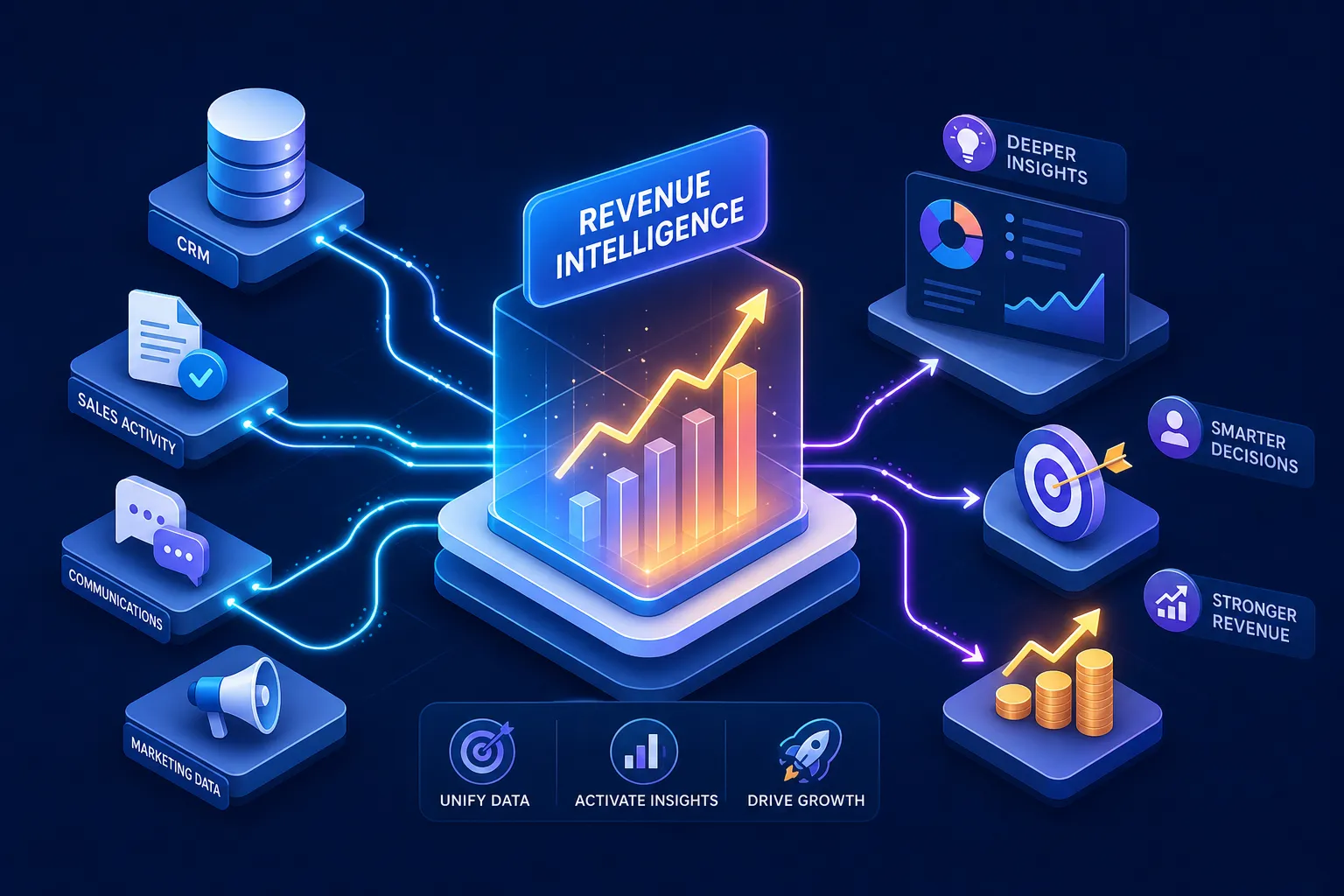
For a sales or RevOps audience, revenue intelligence is the practice of capturing signals across your CRM, emails, calls, and meetings, then applying AI to explain what is happening in your pipeline, predict what is likely to close, and recommend what to do next.
The distinction from traditional reporting is not subtle: reports tell you what happened, while revenue intelligence tells you what to do about what is about to happen.
Major revenue intelligence platforms like Gong, Clari, and People.ai have each built their products around this core definition, though their emphases differ.
Gong leads on conversation analysis. Clari leads on forecast accuracy and pipeline rollups. People.ai focuses on CRM hygiene and automated activity capture.
The underlying logic is the same across all three: capture more signal, interpret it with AI, surface decisions rather than data. For readers comparing vendor capabilities side-by-side, see an industry comparison of the best revenue intelligence platforms.
Where the data actually comes from
These platforms pull from several sources simultaneously: CRM opportunity records, email and calendar activity captured automatically without rep input, call transcripts and recordings, buyer engagement signals such as document views and meeting attendance, and external intent signals like web visits, hiring patterns, and funding events.
External intent sources are a growing input to modern revenue stacks and are catalogued in several tool round-ups for revenue teams, including lists of revenue intelligence tools.
The power lies in unification. Signals that previously existed in five separate tools now feed a single AI layer that can surface complex cross-deal patterns more quickly than manual analysis, particularly across a team of 30 or 50 sellers running different deal conversations simultaneously. That speed of pattern recognition is what separates revenue analytics from a standard sales report.
Why revenue intelligence platforms go further than CRM reporting
What CRM reporting actually gives you
A CRM report is a rearview mirror. It reflects what your reps entered, which is often incomplete, delayed, or optimistic. The system shows you opportunity stage and deal value; it does not show you that buyer engagement dropped 40% in the last two weeks, or that no additional stakeholder has been added to a complex enterprise deal that clearly involves a procurement committee. The result is forecast variance that consistently surprises sales leaders at quarter-end, a structural problem, not a people problem.
Industry analysis consistently places the proportion of forecasted deals that slip or die in organisations relying solely on CRM-stage forecasting at between 50 and 60%. That is not a reflection of poor selling; it is a reflection of a forecasting method that was never designed to handle the complexity of modern B2B buying cycles.
The shift from data entry to deal intelligence
Revenue intelligence software flips the model. Instead of asking reps to log activity, the platform captures activity automatically and interprets it.
The output is not a dashboard; it is a decision.
Which deals need attention today?
Which forecast categories are understated?
Where is momentum stalling, and why?
This shift directly compresses deal velocity. Reps stop wasting cycles on deals that are already lost and redirect energy where the signals indicate genuine opportunity. Organisations implementing these platforms have documented around 45% improvements in forecast accuracy and sales cycles running 15 to 30% faster, based on vendor-reported case studies from platforms including Gong and Clari.
A Forrester Total Economic Impact study commissioned by Gong reported a 481% ROI over three years, with $12.1 million in benefits against $2 million in costs. These are not incremental gains; they are structural improvements to how revenue is managed. For examples of enterprise-grade solutions, review vendor product pages such as Salesforce Revenue Intelligence.
Why mid-sized B2B companies in India are adopting revenue intelligence now
The pipeline visibility problem that has become urgent
The common situation in mid-sized Indian B2B technology firms looks like this: a fast-growing sales team, increasingly complex enterprise deals involving five to ten stakeholders, distributed sellers working remotely across cities, and a CRM that is inconsistently updated because nobody made it easy or mandatory.
As deal cycles lengthen and buying committees grow, the gap between what is in the CRM and what is actually happening in the deal widens to the point where it becomes dangerous for forecasting and resource planning.
Revenue intelligence directly solves this visibility gap. Adoption among Indian tech and SaaS firms has accelerated significantly through 2025 and into 2026 as leadership teams have grown frustrated with quarterly forecast misses that consistently trace back to the same root cause: the data they were trusting was not accurate, and the warnings were not early enough.
What companies are actually reporting after implementation
The numbers from documented implementations are worth stating directly. Beyond the Forrester study on Gong, vendor-reported outcomes have included forecast variance improving from the ±35% range to around ±12%, win rate gains in the region of 10 to 13 percentage points, and pipeline velocity increases of approximately 25% within a year of platform adoption.
These figures vary by organisation and should be validated against your own baseline, but the direction of movement is consistent across published case studies.
At mid-market scale in India, even a conservative 15% improvement in win rate on a 50-person sales team with an average deal size of ₹30 lakhs creates material, measurable revenue impact within two to three quarters. The arithmetic is straightforward: more deals closing from the same pipeline, compounded across four quarters, changes the revenue trajectory meaningfully.
The adoption argument is not about technology sophistication; it is about competitive necessity.
Buyers in the Indian B2B market are more informed than they were three years ago, deal cycles are longer, and buying committees are larger. Teams that operate on gut feel and manual CRM updates are consistently losing ground to teams that operate on signal. Based on current adoption trends and analyst projections for RevOps intelligence spending through 2027, that competitive gap is more likely to widen than close.
Revenue intelligence platforms: key features to evaluate
The capabilities that drive actual pipeline outcomes
Not all revenue intelligence software delivers equal value, and the feature set you prioritise should match your team’s specific gaps. Four capabilities consistently determine whether a platform creates real impact or becomes expensive shelf-ware.
- Pipeline forecasting with explainability: Look for AI models trained on historical win/loss patterns, not just CRM stage weighting. Ask vendors specifically how their platform handles deals with missing activity data, because that is where most mid-market CRMs fall apart.
- Deal risk scoring with reasoning: A risk score is only useful if it tells you why the deal is at risk. Platforms that surface “deal health: red” without explaining the signal fail this test. You need the reasoning to coach the rep or change the approach.
- Automated activity capture: If reps must manually log the data the platform analyses, the intelligence is only as good as their logging discipline. For most teams, that means it is not very good. Automation is not optional; it is the foundation of data trust.
- Conversation analysis: For teams running complex consultative sales, call and meeting analysis surfaces coaching opportunities and buyer sentiment that pure CRM data misses entirely. This is particularly valuable in Indian B2B contexts where relationship dynamics and indirect communication patterns carry significant deal signal.
What to avoid when shortlisting vendors
Avoid platforms that require heavy IT integration before delivering any insight. Some vendors can surface meaningful signals within weeks depending on integration complexity; if a platform requires quarters of setup before producing usable data, treat that as a red flag. Watch for vendor lock-in with your CRM, as the platform should read from and write back to your existing stack rather than replacing it.
On cost, enterprise platforms like Gong and Clari command approximately $1,300 to $3,000 per user per year as of mid-2026 (verify current pricing directly with vendors, as these figures change). Mid-market alternatives like Avoma offer conversation intelligence at significantly lower price points, which makes them worth evaluating seriously for Indian mid-sized teams working within budget constraints.
Why revenue intelligence alone is not enough
The gap platforms cannot close on their own
Revenue intelligence shows you what is happening in your deals: a key stakeholder has not engaged in three weeks, the price conversation happened too early, the champion has gone quiet, the buying committee has added a procurement contact who has not received a single communication. That visibility is genuinely valuable. But the platform cannot change rep behaviour on its own.
A platform that flags deal risk to a rep who does not know how to re-engage a stalling champion is delivering insight without impact. The insight is only as valuable as the skill of the person acting on it. This is where the compounding gain comes from: data that identifies where to improve, combined with structured training that builds the specific skill to close that gap.
How structured system creates the compounding effect
GrowthAspire takes this one step forward. We help companies develop custom deal Intelligence platform that demands not just low investment compared to ready platforms but also more customized for your business
With our expertise of working across 22+ industries, 185 business of mid-sized B2B sales teams across India, we can create exactly this combination platform + capabality.
We use pipeline and deal data to identify where deals most commonly stall for a specific team, then design targeted workshop interventions and coaching cadences around those precise gaps.
Our 90Day Deal Pilot Coaching is designed to help you build deal intelligence
We bring in not just deal pipeline, but bring 7 new intelligence to help deals close. And also equip the teams with right tools and skills. For example if deal intelligence data shows, for example, that the majority of stalls cluster at the commercial negotiation stage, that is where focus goes. If conversation analysis reveals that discovery calls are ending without clear next steps, that is the skill gap the coaching programme addresses.
The compounding effect comes from alignment between signal and skill. Platform data becomes more actionable as rep behaviour improves, and rep behaviour sharpens as the data reveals new patterns each quarter.
GrowthAspire’s deal intelligence is based on simple principle that company the intelligence exists with organization, but sellers lack that access at right time.
By developing right stage gate checklists, AI infra, Coaching and connected apps we can get the data surfaces to target deal pipeline closures clearly, rather than just using CRM or buying expensive software or running generic sales training disconnected from live pipeline reality.
That is the difference between a technology investment and a genuine performance transformation.
Revenue Intelligence – (Clari, Gong and others)
↑
(Executive View)
Deal Intelligence – GrowthAspire Offering
↑
(Sales Execution Layer)
CRM. – (Many such as Hubspot, SalesForce, Zoho, Odoo, Pipedrive and others)
↑
(Record Keeping)
The clear picture for B2B sales leaders in India
For sales leaders, the core argument is this: revenue intelligence is not a reporting upgrade. It is a structural shift from reacting to a pipeline to leading one, with signal-based decisions made early enough to change outcomes. But for many businesses that have smaller sales teams and complex sales of large deal size and long sales cycle this can be too much to invest.
The mid-sized B2B teams in India that will pull ahead over the next 18 to 24 months are those combining platform-level deal intelligence with structured skill development, not teams that invest in one without the other.
If your team is investing in a revenue intelligence platform and you want to ensure your sellers can act on what it surfaces, explore how GrowthAspire’s Deal Intelligence 90Days Program are built precisely for that outcome. The future of B2B sales in India is built on deal intelligence, not just the software, but the human capability to use it well.