Meta description: Revisiting key account management using AI, explore proven use cases, governance principles, KPIs and a 90-day adoption roadmap to grow and retain strategic B2B accounts. Learn more.
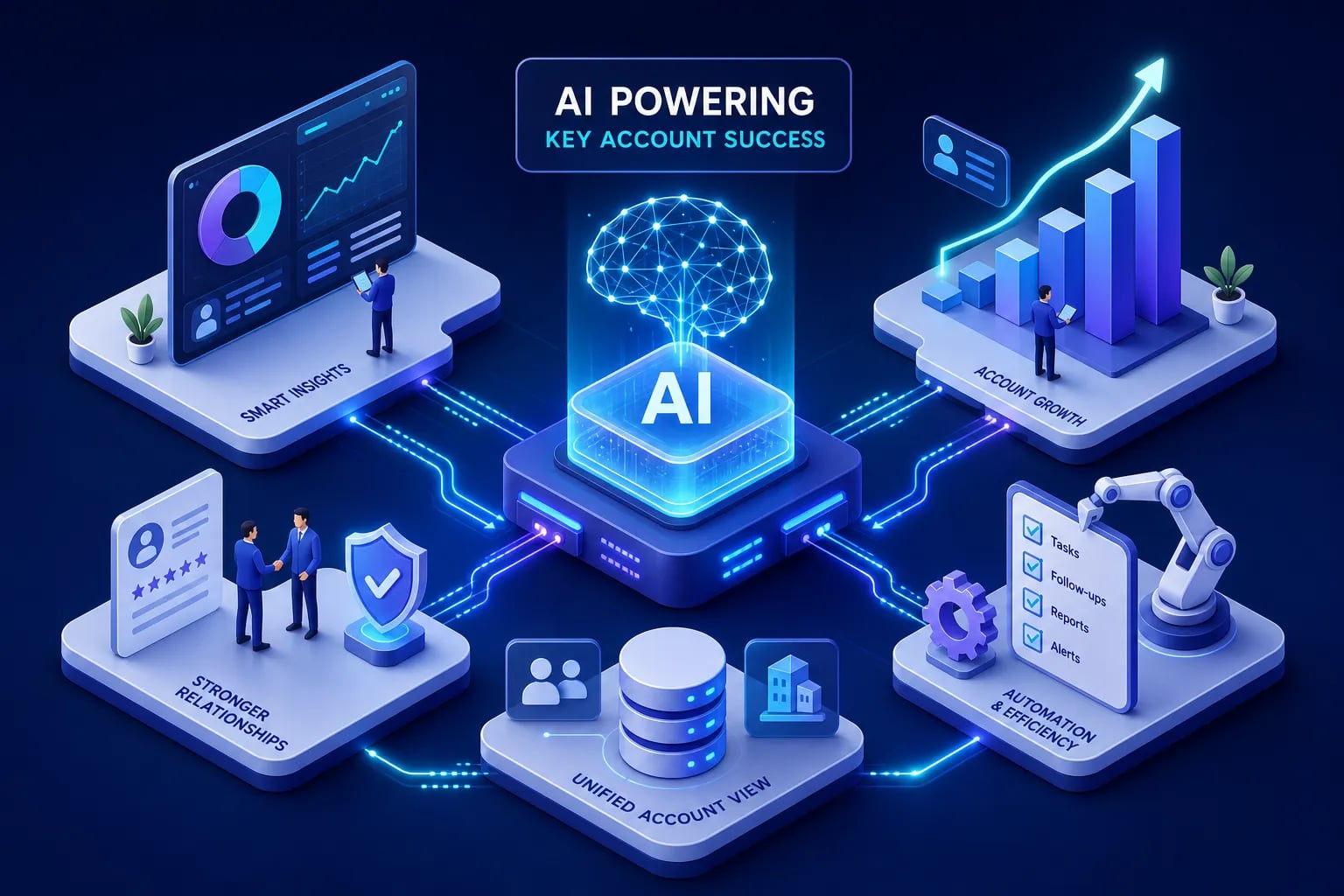
Account managers who built their careers on relationship instinct, quarterly check-ins, and a sharp memory for customer preferences are now competing against teams armed with live churn signals, AI-generated account health scores, and QBR decks that practically write themselves. The game has shifted structurally, not gradually, and revisiting key account management using AI has become one of the most consequential decisions a commercial leader can make in 2026.
The uncomfortable reality is that most KAM teams adopting AI are layering sophisticated tools on top of shallow account strategies and inconsistent processes. AI amplifies what is already there: a team with strong strategic account planning skills becomes measurably more effective; a team without that foundation ends up with expensive dashboards nobody trusts and alerts nobody acts on. The technology does not fix the fundamentals; it exposes them.
This article covers the AI use cases that are genuinely moving the needle in key account management, the tool categories worth understanding, the governance model your enterprise accounts expect, and the skills and KPIs that determine whether AI investment pays off. At Growth Aspire, we have spent over a decade working with KAM teams across India’s mid-sized technology sector. The gap between AI adoption and AI effectiveness is the single most consistent pattern we observe across those engagements, and it is the problem this article is designed to help you close.
Revisiting key account management using AI: the use cases that are actually changing how account teams work
Not every AI application in KAM deserves your attention. The ones worth prioritising are those that directly affect retention, expansion revenue, and the quality of engagement with strategic accounts. Lower-priority applications, generic content generation, automated email sequences with no account context, and dashboard visualisation for its own sake, consume budget without moving the commercial needle. AI-driven key account management only delivers when the use cases are chosen for their proximity to revenue decisions.
Churn prediction and automated account health scoring
AI now monitors usage patterns, support ticket volume, stakeholder engagement frequency, and contract signals simultaneously to generate a live health score for each account. This replaces the quarterly gut-check with a continuous early-warning system running in the background while your team focuses elsewhere.
The practical difference is significant: an account scoring red well ahead of renewal gives the team enough runway to intervene with a value-focused executive conversation, restructure the engagement, or address adoption gaps before they become renewal objections. In practice, composite scoring models consistently outperform single-signal approaches because no individual metric captures the full picture of an account’s commercial health.
Whitespace identification and expansion intelligence
AI analyses an account’s current product footprint alongside firmographic data and historical win patterns to surface untapped cross-sell and upsell opportunities the account manager may never have identified manually. Contrast this with the old approach: account managers reviewing spreadsheets, waiting for a buyer to initiate the conversation, or relying on memory of what was discussed in the last QBR.
AI-driven whitespace analysis shifts the account team from reactive order-taking to proactive expansion conversations, a fundamentally different posture in a strategic relationship. Indian B2B teams using this approach have reported pipeline generation lifts of up to 40% alongside a 22% reduction in average deal cycle length, based on outcomes tracked across mid-sized technology sector engagements.
Relationship mapping and stakeholder intelligence
Losing a champion without knowing it is one of the most common causes of unexpected churn in enterprise accounts. AI tools now keep org charts current in near real-time, flagging changes in decision-makers, champion departures, and new budget holders by pulling data from CRM activity, email patterns, and third-party sources.
The result is a living stakeholder map rather than a static diagram updated quarterly by an account manager who may not have spoken to the account in six weeks. When a new CFO joins a strategic account and your team knows within days rather than months, the relationship conversation happens on your terms, not theirs.
AI for account planning: the tools B2B account teams are using
Understanding the tool landscape is not about picking a winner. It is about knowing which category solves which problem, so you invest in the right capability at the right time.
Purpose-built KAM platforms
Platforms like DemandFarm are designed specifically for enterprise key account management. Their core capabilities include structured account plans, whitespace analysis, relationship maps, and QBR management.
DemandFarm, for instance, offers one-click in-app QBRs that pull live CRM data, AI-generated account summaries, opportunity risk analysis, and automated progress tracking against strategic account objectives.
Altify approaches the same problem from an account-planning and opportunity management angle, with relationship mapping and structured sales methodology built in. These tools work best when the account team already operates from a clear methodology. Without that foundation, the platform becomes an expensive dashboard that surfaces insights nobody knows how to act on.
At the same time many of these tools include many features that most team may not require. On the other hand,
Broader account intelligence and CRM-native tools
Platforms like Salesforce, HubSpot, 6sense, Demandbase, and ZoomInfo are not KAM-specific, but they provide predictive scoring, buying-stage signals, and account prioritisation that feed directly into account planning workflows. The common mistake teams make is selecting a tool before agreeing on what signals matter and why.
Data overload is not the same as actionable intelligence, and too many KAM teams confuse the two. Before any tool deployment, the more important conversation is: what decisions do we need to make faster, and what signals would actually change those decisions?
Why AI tools deliver weak results without a structured KAM foundation
This is the argument that most AI vendors do not make, but the pattern is consistent: AI surfaces signals, and it takes trained strategic judgment to act on them.
The gap between AI insight and account action
An AI tool flags that an account’s health score has dropped sharply over the past six weeks. The alert lands in the account manager’s dashboard. Now what? If the account manager does not know how to structure a value-focused executive conversation, map buying committee dynamics, or build a mutual success plan that reconnects the customer to their original business case, the alert becomes noise.
The tool identified the risk; the human still has to resolve it. Across the KAM teams we have worked with, this gap appears repeatedly: teams automate before they have a clear account strategy, and the result is faster delivery of outputs that nobody trusts or uses.
How structured KAM training makes AI effective
Organisations that see measurable lift from AI-assisted KAM are, almost without exception, those that invest in structured KAM training frameworks before or alongside tool deployment. This is the pattern Growth Aspire’s KAM training programmes are built around.
We equip account managers with strategic account planning skills, stakeholder engagement frameworks, and deal intelligence thinking so that AI outputs translate into decisions and actions rather than dashboard activity. Our approach integrates AI-enabled revenue methodologies alongside human skill development, which means teams are not choosing between tools and training, they are building both in parallel, which is the only model that produces durable commercial results.
The skill gaps most teams need to close are data literacy, AI output interpretation, strategic account planning, and executive communication. These capabilities are learnable, but they require structured practice across multiple engagements, not a one-day awareness session. That is why GrowthAspire’s programmes are designed around live account application rather than classroom theory. We help you build the AI agentic solutions for your KAM.
Strategic account management with AI: governance, data controls, and customer trust
AI adoption in key accounts introduces risks that most KAM teams are genuinely underprepared for. A governance failure with a strategic account is not just a data incident; it is a relationship incident, and in enterprise sales, relationship incidents are career-defining moments.
Data controls and privacy-by-design principles
Three controls are non-negotiable in any AI-assisted KAM environment.
First, least-privilege data access: AI models, integrations, and third-party services should access only the minimum customer data required for the specific use case, nothing more.
Second, data provenance documentation: your team should be able to explain what customer data was used, for what purpose, and how it was processed, in plain language if a customer asks.
Third, vendor controls for any third-party AI service that touches account data, this means contractual data processing agreements, audit rights, and clear data retention limits.
In the Indian context, these controls must align with the Digital Personal Data Protection Act, which establishes requirements for lawful basis, consent management, and customer rights including access, correction, and erasure.
Enterprise key accounts expect discretion, and the practical rule is straightforward: the more AI influences pricing, renewal risk classification, or relationship actions, the stricter your approval and human-review requirements should be.
Human oversight, explainability, and transparency with customers
High-impact KAM decisions should always have a named human owner who can review and override AI recommendations. Renewal risk classification, expansion prioritisation, pricing inputs, and executive escalations are not decisions to automate without a human checkpoint.
Account managers also need to understand why the AI flagged something, not just that it did. An account manager who cannot explain the reasoning behind a recommendation cannot have a credible conversation with a senior customer stakeholder about what it means for their business.
When AI materially influences outreach, prioritisation, or recommendations, be prepared to explain your process honestly if the customer asks. Customers increasingly expect that transparency, and the teams that deliver it build deeper trust than those who treat AI as a black box.
The skills, roles, and KPIs that AI-enabled customer success requires
Operationalising AI in KAM is an organisational change, not a software purchase. The people side and the measurement side are inseparable.
The skills and roles KAM teams need to develop
The traditional relationship-keeping KAM is evolving into an orchestrator role: someone who owns the account narrative, consumes AI insights, coordinates a cross-functional pod, and closes the loop on execution.
Teams that accelerate this transition most quickly tend to hire hybrid commercial-analytical profiles and invest in RevOps capacity to bridge the gap between data output and account action. If your account managers cannot read a dashboard critically, challenge a low-confidence AI recommendation, or translate an account health signal into a board-level conversation with the customer, the tools will not deliver their promised value.
The KPIs and dashboards that show real AI impact
Track AI impact across five layers: adoption depth, operational efficiency, output quality, commercial impact, and customer health. Adoption depth tells you whether the tool is being used consistently across the team.
Efficiency metrics, task cycle time and time-to-value, show operational gains. Output quality metrics, including first-pass yield and override rate, reveal whether AI recommendations are reliable enough to act on without manual review.
Commercial impact covers expansion revenue, win rate, renewal rate, and sales cycle length. Customer health tracks churn rate alongside NPS or CSAT. The most credible way to prove AI impact is the cohort comparison dashboard, which compares AI-enabled accounts against non-AI accounts over two to three quarters.
This isolates AI’s contribution from seasonal variation and account mix differences. Executive portfolio dashboards should focus on three outcomes: growth, retention, and productivity lift. Everything else is supporting evidence.
Revisiting key account management using AI: building the combination that wins strategic accounts
AI is a force multiplier in key account management, but only for teams that have the strategic foundation to act on what it reveals. The signal-to-action gap is real; it is measurable, and it is the primary reason well-funded AI initiatives underdeliver in mid-sized B2B organisations.
A practical KAM AI playbook for the first 90 days: in month one, audit two or three AI use cases against your current account planning process and set baseline KPIs before touching any tool. In month two, run a structured pilot with your top five accounts, with a governance framework in place and a small group of trained account managers who understand how to interpret AI outputs.
In month three, evaluate KPI performance against the baseline cohort, identify what to standardise, what to expand, and what to stop. That sequence, foundation before pilot, pilot before scale, is the pattern that separates teams who extract genuine value from those who cycle through vendor demos without sustained results.
The KAM teams that will dominate strategic accounts over the next three years are not those with the most sophisticated tools. They are those with the strongest combination of AI capability and trained human judgment, and that combination is built deliberately, not acquired through software procurement.
Contact our team at GrowthAspire to assess where your account management capability stands today and what it would take to close the gap in terms of AI enablement and AI workflows.