



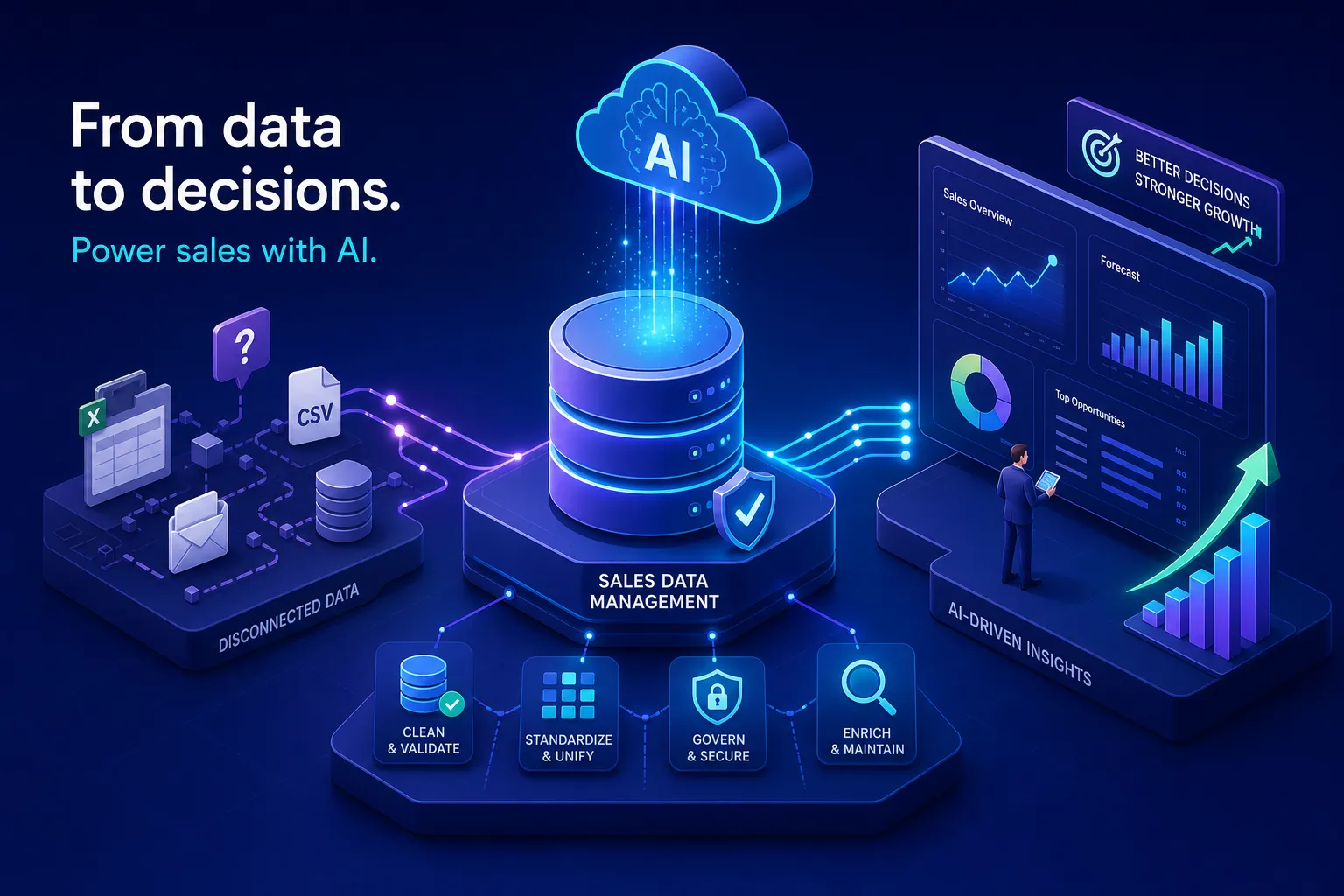
Many sales teams in India are grappling with sales data management in the AI era while running sophisticated AI tools on CRM data that has not been seriously cleaned in years. The dashboards look impressive, the lead scores feel authoritative, and the forecast reads with precision. But underneath, the data is stale, duplicated, and riddled with inconsistent fields. Most AI recommendations built on that shaky foundation reflect the gaps rather than the opportunity.
Sales leaders investing in AI-powered forecasting, lead scoring, and pipeline tools are making the right call. The core challenge is not a technology problem. It is a data quality problem that no AI system can solve on its own. According to Gartner, duplicate rates average 10 to 25% for organisations without active data quality programmes, climbing to 30 to 40% when data flows in from multiple integrated systems without validation controls.
This guide walks through what modern, AI-ready sales data management actually looks like, which problems break AI models before they deliver value, and how to build the governance foundation that makes predictive intelligence reliable. At Growth Aspire, working with revenue teams across mid-sized technology companies in India, we consistently find that poor data quality is a critical gap separating teams that hit quota from those perpetually chasing it.
Why AI has fundamentally changed the rules for data quality
From manual judgment to AI-driven data workflows
Traditional CRMs tolerated gaps because an experienced manager could compensate with judgment. A missing industry field or an inconsistently named account was an annoyance, not a crisis. AI models do not apply judgment to incomplete data. They produce a confidently wrong output instead. Missing fields, stale contact records, and inconsistent naming do not result in a low-confidence score; they result in a high-confidence score built on faulty inputs.
Think of the architecture behind AI-driven sales data management in the AI era as five connected layers: ingestion (pulling data from CRM, email, intent tools, and product usage), storage (structured records plus semantic vectors from call transcripts), a feature layer (pre-computed signals like lead scores and engagement velocity), model operations (training and monitoring), and serving (delivering insights into the sales workflow). Every layer depends on the one before it. Corrupted data at ingestion corrupts every output downstream.
What unified customer data actually means in practice
Most teams believe they have unified data because they have one CRM. They do not. Engagement signals live in email platforms, intent data sits in a separate tool, support tickets are in a helpdesk system, and product usage rarely makes it back to the account record. A genuinely unified account profile consolidates all of these sources into a single, continuously updated view. An incomplete one, common among many mid-sized technology companies in India, means the AI is always working with a partial picture and producing recommendations that reflect it.
The compounding cost of poor data
AI scoring systems trained on unreliable data do not merely reflect bad decisions; they accelerate them. Miscalibrated lead scores send reps after the wrong opportunities. Broken segmentation directs campaign spend at accounts with no buying intent. Forecasts that miss by wide margins quarter after quarter erode trust in the entire revenue operations function, trust that is very difficult to rebuild once it is gone.
Sales data management in the AI era: the quality problems that quietly break models
Duplicates, missing fields, and inconsistent IDs
Duplicate records are a leading cause of data-quality failure, with rates reaching 25% or higher in many enterprise CRMs, according to Salesforce’s State of Sales research. Duplicates split activity across multiple records, making a highly engaged account appear cold and a dormant one appear active. Missing fields create the next layer of failure: AI cannot prioritise what it cannot describe. An account without an industry classification or revenue band will consistently receive an incomplete and therefore unreliable score. Inconsistent naming conventions, “Mumbai” recorded elsewhere as “Bombay,” or “IT” in one record and “Information Technology” in another, prevent the model from grouping similar records for pattern recognition.
Stale data and its damage to signal accuracy
B2B contact data decays at approximately 70% per year due to role changes and restructures. When a rep receives an AI-generated alert to follow up with a decision-maker who left the company six months ago, trust in the AI layer collapses quickly. The alert was technically correct based on what the model knew; the underlying data simply had not kept pace with reality. This is the category of data problem that does the most damage to AI adoption inside revenue teams.
Remediating in the right sequence
Remediation has a correct order, and most teams get it wrong. The first priority is to clean before you configure: deduplicate and archive inactive records before any AI tool goes live. The second is to automate field validation at entry rather than retroactively, because cleaning data after it enters the system is always more expensive. The third is to standardise naming conventions across all integrated platforms before building any model.
Once those foundations are in place, measure data quality as a standing KPI. Track email bounce rates, record completeness scores, and CRM match rates monthly. This is not a one-time project; it is an ongoing discipline that separates teams with reliable AI from those still chasing data fires.
AI-powered enrichment and smarter lead prioritisation
How AI enrichment outperforms manual research
AI enrichment tools solve the research problem at scale. They aggregate intent signals, firmographic data, web activity, and engagement history into richer account profiles automatically, before the rep opens the record. Manual prospect profiling can take tens of minutes per account, and even then delivers a static snapshot that begins going stale the moment it is saved. An enrichment workflow running continuously delivers an updated account view the moment the rep needs it, with no manual effort required. The productivity difference compounds across every rep, every week.
AI-enabled lead scoring: documented ROI for Indian B2B teams
The ROI case for AI-powered lead scoring is well established. Companies implementing it report 138% ROI compared to 78% with traditional methods, a 25% lift in lead-to-deal conversion, and up to 90% scoring accuracy against 30% for manual approaches. Indian B2B enterprise teams specifically have reported 28 to 35% improvement in SQL-to-opportunity conversion after deploying AI qualification tools. For a sales team of 20 to 30 reps, better-calibrated scoring means pipeline prioritisation reflects genuine revenue probability rather than whoever argued most convincingly in the last review meeting.
The key difference from legacy rule-based models is continuous recalibration. Rule-based scoring assigns static weights to criteria like company size or industry, and those weights drift out of alignment as market conditions change. Machine learning models update themselves on closed deal outcomes, which means accuracy improves over time. Teams still running manual or rule-based scoring are, in effect, navigating with an outdated map, one that looked accurate when it was drawn but no longer reflects the territory.
Pipeline visibility and forecasting that revenue teams trust
What genuine pipeline visibility looks like with AI
Pipeline reviews in most organisations are still opinion-based. Managers ask reps to rate their deals, reps are optimistic, and the forecast misses. AI changes the input, not just the output. Real-time deal health scores based on engagement frequency, sentiment from call transcripts, and next-step completion rates replace subjective ratings with observable evidence. Conversation intelligence platforms transcribe calls, extract structured risk signals such as “champion has gone quiet” or “competitor mentioned unprompted,” and update the CRM automatically, removing the manual logging burden from reps entirely.
Deal Intelligence and measurable cycle compression
This is where AI-driven pipeline management translates into measurable commercial outcomes. Sales teams using structured deal intelligence to track engagement patterns, deal risks, and next-best-action recommendations consistently see shorter cycle times and higher win rates. Growth Aspire’s Deal Intelligence platform is designed for revenue teams in India that want these outcomes without assembling a custom data stack from scratch. It surfaces the signals that matter, flags the risks that kill deals, and keeps the CRM current without depending on rep discipline to log every interaction manually.
Forecasting accuracy as a leadership asset
The documented forecasting gains are substantial. Industry analysis points to 20 to 30% improvement in forecast accuracy for teams using AI pipeline management, with some platforms reaching 81% prediction accuracy by combining sentiment analysis with engagement velocity data. This is a leadership issue, not just a sales operations issue. The CFO and CEO depend on these numbers for resource allocation, hiring decisions, and investor communications. A forecast built on AI-driven signals and validated with clean data is a materially different asset from one built on rep optimism.
Building a compliant data governance framework in India
What the DPDP Act 2023 means for AI-driven sales data management
India’s Digital Personal Data Protection Act 2023 is the framework every revenue team deploying AI needs to understand before going live. The Act requires free, specific, informed, and unambiguous consent for every data processing purpose, including AI training and profiling. In practice, this means data collected for account servicing cannot be repurposed for model training without separate, explicit consent. This is not a compliance technicality. It is the legal foundation on which your entire AI data strategy must rest.
Sector-specific obligations and cross-border flows
For companies designated as Significant Data Fiduciaries, the Act requires a Data Protection Impact Assessment before AI processing at scale. In practice, this means completing a formal risk review before any large-scale profiling or scoring goes live. Algorithmic audits to detect bias are also mandatory, meaning models must be tested for discriminatory outputs, not just accuracy. BFSI organisations face additional layers from RBI’s AI lifecycle guidance and SEBI circulars. The MeitY advisory from March 2024 requires intermediaries to notify users clearly when AI outputs may be unreliable and to label all AI-generated content with permanent identifying metadata. On cross-border flows, the DPDP Act mandates data localisation for certain categories of personal data, which means verifying that AI vendor servers are hosted in India or a compliant jurisdiction before onboarding.
Practical governance steps for sales and revenue ops teams
The governance steps that matter most in practice are achievable with the right prioritisation:
- Create a full data inventory before any AI deployment begins
- Train models on anonymised or synthetic data where possible
- Implement sandboxed access controls so data scientists work separately from production records
- Classify AI use cases by risk tier: automated targeting requires human oversight
- Appoint a Data Protection Officer and maintain audit trails sufficient for regulatory review
AI-era sales data management: choosing the right stack and measuring what matters
Four layers every sales leader needs to think about
The right AI sales data stack has four layers: a CRM as the source of truth, an enrichment or data warehouse layer, a revenue intelligence layer, and governance tooling. Effective AI-driven sales data management also requires a fifth consideration: sales data orchestration, the discipline of ensuring clean, validated data flows between each layer without manual intervention or duplication. Enterprise teams at scale (50 or more reps) tend toward Salesforce Agentforce paired with Gong for conversation intelligence. Mid-market teams in India often achieve better agility from HubSpot Breeze combined with a dedicated enrichment layer. The governing principle is fit over brand: the right stack is the one your team will actually use and trust, not the one with the most features on a comparison sheet.
The KPIs that confirm your investment is working
Measurement should begin before implementation so the baseline exists. The KPIs that signal AI data management is paying off are lead-to-deal conversion rate, forecast accuracy (commit versus actual), deal slip rate, CRM record completeness score, time saved per rep per week on manual data entry, and quota attainment. Analysis of teams deploying AI effectively shows 3.7x higher quota attainment and 30%-plus win rate improvements across cohorts. Those numbers do not appear without clean data, structured governance, and a stack calibrated for the team using it.
A vendor selection checklist for Indian enterprises
Before signing with any AI sales data vendor, verify five non-negotiables: data hosting server location (India or a compliant jurisdiction), consent and opt-out mechanisms for data usage, model explainability and bias audit capability, integration depth with your existing CRM, and contractual clarity on data retention and deletion timelines. Each of these has direct regulatory implications under the DPDP Act and the MeitY framework, and each has commercial consequences if it is not addressed before the contract is signed.
The case for getting this right now
AI does not fix broken data. It amplifies it. Teams feeding poor-quality CRM records into sophisticated AI models are not getting better decisions faster; they are getting worse decisions faster, with more confidence attached to them. The teams winning with AI in 2026 are the ones that invested in data hygiene, governance, and unified enrichment first, then layered predictive intelligence on a foundation they could actually trust.
Sound sales data management in the AI era is not a technical project owned by IT. It is a revenue strategy owned by sales leadership, with clear KPIs, an ongoing governance discipline, and a stack aligned to how the team actually works. The payoff is real and measurable: shorter sales cycles and higher win rates. Forecasts become a leadership asset the whole organisation can stand behind, rather than a number that requires a caveat in every board meeting.
If your revenue team is ready to move from intuition-based pipeline reviews to AI-driven deal intelligence grounded in clean, governed data, explore how Growth Aspire’s Deal Intelligence platform supports mid-sized technology sales teams in India that need measurable outcomes without the complexity of building a custom data infrastructure from scratch.