


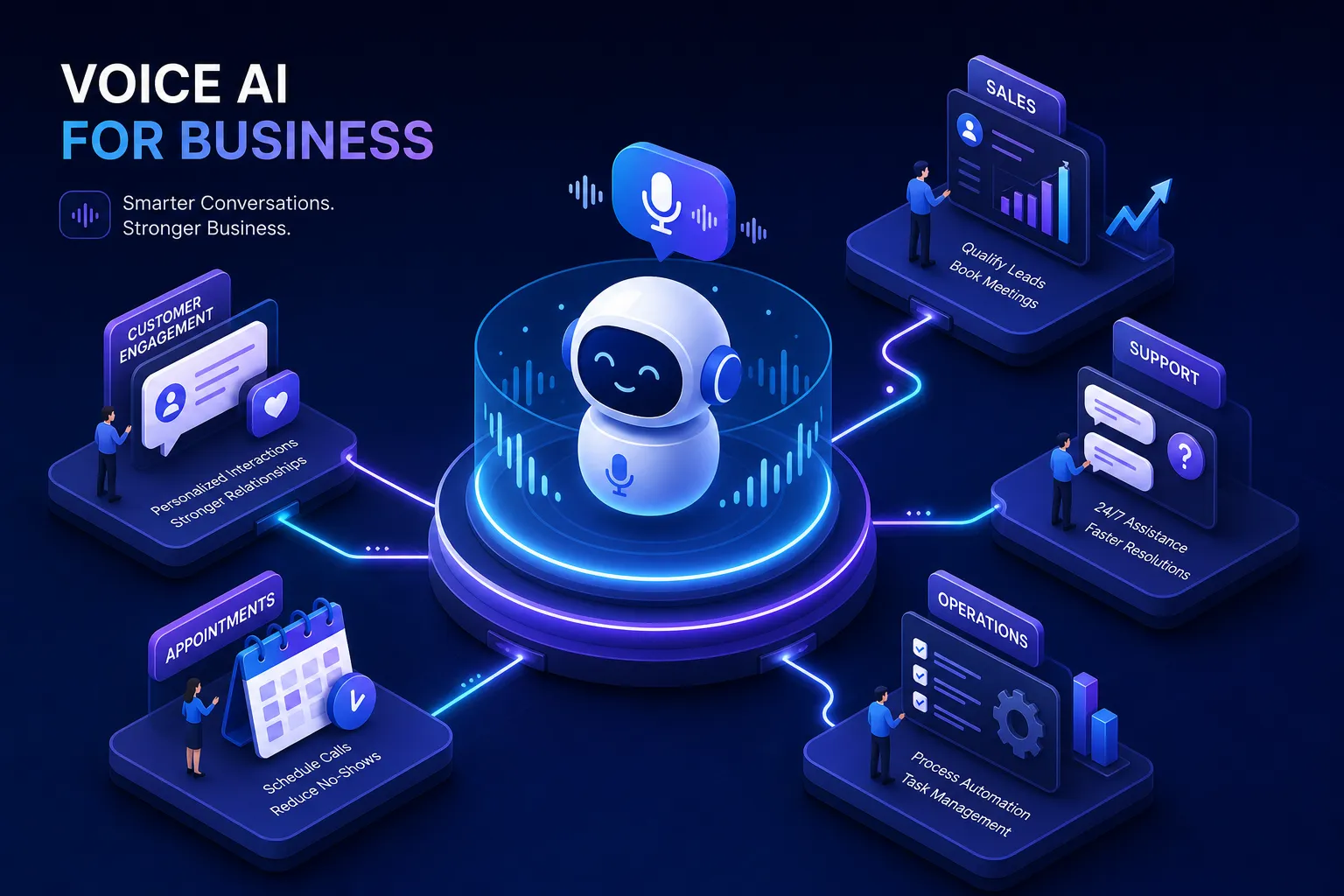
Voice AI agents for business are changing how Indian sales teams handle lead response, and the gap they’re closing is brutal in its simplicity. A prospect fills out a demo request form at 10 PM. By the time your rep calls back the next morning, they have often already contacted competitors during the wait.
Conversational voice AI addresses this directly: qualifying leads at midnight, scheduling demos without a human in the loop, and filing CRM notes the moment a call ends.
This article covers what voice AI agents which we call AI employees actually do inside a sales workflow, which platforms are worth shortlisting for Indian deployments, what it costs to deploy across team sizes, and how to run a 90-day pilot that generates real data. No vendor hype. Just what you need to make a sound decision.
What voice AI agents (AI employees) actually do in a sales workflow
Lead qualification that doesn’t sleep
Voice AI agents handle inbound enquiries around the clock, running structured discovery calls based on pre-set qualification criteria: budget, authority, need, and timeline. The agent asks the right questions, scores the response, and routes high-intent leads directly to a senior rep within seconds, not hours.
The Signpost case study documented a 3x increase in lead capture after deploying automated phone agents for inbound calls. The reason the numbers move so dramatically is well-documented: 85% of callers who don’t reach a business on the first attempt never call back.
What the agent records matters as much as what it says. Every qualification call generates a structured summary: budget range confirmed, decision-maker identified, next step agreed. The rep who picks up the handoff starts with full context, not a blank screen.
Scheduling meetings without the back-and-forth
Conversational voice AI connects directly to calendar tools such as Google Calendar and Outlook, booking meeting slots during the call itself. Multi-turn conversation handling means the agent can navigate availability conflicts, suggest alternatives, and confirm a slot in real time, without sending a single email.
For B2B or even small sales teams focused on pipeline velocity, this matters: same-interaction bookings generally convert better due to speed-to-lead advantages, as research on response-time and conversion rates consistently shows.
The pipeline benefit compounds further when the agent is also timezone aware. For Indian firms with clients across multiple cities or international prospects, the agent handles time differences without rep intervention, keeping the deal moving while the team sleeps.
Post-call summaries and CRM updates
Automated phone agents generate structured call summaries after every conversation, tagging objections, buying signals, and agreed next steps before pushing the data directly into the CRM. This removes the single biggest source of friction in sales data hygiene: manual logging.
For sales managers, the downstream benefit is a reliable coaching dataset, every call documented, every objection tracked, patterns visible at the team level, without asking reps to update fields they will inevitably skip.
Voice AI agents for business that integrate post-call automation at this level effectively turn every conversation into structured intelligence rather than a memory that fades by end of day.
The ROI case: what real deployments show
Cost, conversion, and handle time in numbers
Across documented deployments, headline figures are consistent:
- 40 to 78% cost reduction,
- 15 to 30% conversion uplift, and
- 12 to 35% average handle time (AHT) reduction.
The TSA Group reported a 74% cost reduction after deployment; Etech documented a 34% first-call resolution (FCR) lift.
The cost-per-call economics tell the clearest story:
The median assisted call costs ₹400~₹500~ ($7.50) , while a self-service voice AI interaction costs ₹40 ($.84). For a mid-sized Indian company’s be it B2B sales team running 500 to 2,000 calls per month, that delta compounds quickly into a material budget line.
Conversion uplift is driven less by the AI itself and more by speed. Voice AI agents respond to inbound leads within 15 to 30 seconds of form submission.
Human reps responding hours later are competing with vendors who already completed that first conversation. Conversion lifts of 15 to 30% documented in deployments such as those at Signpost and TSA Group are largely an artefact of response-time consistency, not AI persuasion.
What Indian B2B teams typically see in the first 90 days
The 60 to 90-day payback period is the benchmark most mid-market deployments hit, with ROI ranging from 200 to 500% over the first three to six months.
One metric that rarely appears in ROI calculations but materially affects revenue is after-hours demand recovery. Roughly 30% of unanswered calls come in outside business hours; with AI agents handling those calls, that revenue does not disappear.
Set your baseline KPIs before you launch: cost per qualified lead, call-to-meeting conversion rate, and CRM data completeness. Without a pre-launch baseline, you cannot report results internally, and adoption drops when reps cannot see the impact.
Voice AI agents for business: top platforms worth shortlisting
Developer-first vs. done-for-you: picking the right model
Voice AI platforms fall into three categories. Developer-first infrastructure platforms such as Vapi and Retell AI give technical teams full control over models, prompts, and telephony.
Vapi delivers sub-400ms latency and supports 62 million-plus monthly calls; Retell AI achieves sub-second performance with telephony-native workflows. Enterprise CX suites such as Sierra and PolyAI are built for large-scale contact centres with deep CRM integration and compliance requirements.
Done-for-you solutions such as Voiceflow and Synthflow AI are designed for non-technical teams who need rapid deployment without engineering resources. The selection logic maps directly to your team’s technical capacity. Technical teams build on infrastructure platforms; non-technical teams buy managed solutions.
Platforms with strong Hindi, Hinglish, and regional language support
Vernacular support is a non-negotiable filter for Indian deployments. Gnani AI is ranked first in 8 of 9 Indian languages on the Kathbath Noisy 8kHz benchmark, the most relevant real-world standard for call-centre audio quality.
Sarvam AI’s Bulbul V3 model outperformed ElevenLabs in telephony benchmark categories.
Bolna AI supports Hinglish code-switching and is used by over 1,000 companies.
Awaaz AI reports greater than 95% accuracy with specific tuning for Indian market conditions.
SreenikaAI that GrowthAspire offers is already matching top tier numbers 99% accuracy for Indian markets
For teams selling into Hindi-speaking markets or Tier 2 and Tier 3 cities, vernacular accuracy on noisy telephony audio is the primary technical criterion, not benchmark scores recorded in studio conditions.
A practical shortlist matrix for voice AI agents for business
Evaluate platforms across five criteria before shortlisting:
| Platform | Latency | CRM Integration | Vernacular Support | Outbound Calls | Pricing Transparency |
|---|---|---|---|---|---|
| Vapi | Sub-400ms | API/webhook | Dependent on third-party speech-to-text (STT)/text-to-speech (TTS) models; no built-in vernacular | Yes | High ($0.05/min base) |
| Retell AI | Sub-second | Native + API | Dependent on third-party STT/TTS models; no built-in vernacular | Yes | High (per-minute) |
| Gnani AI | Telephony-optimised | Custom | Best-in-class (Indian) | Yes | Custom enterprise |
| Bolna AI | Good | API/SDK | Strong (Hinglish) | Yes | Moderate |
| Sreenika AI | High containment | Deep native | Best-in-class (Indian) | Yes | Custom enterprise pricing (quote-based) |
What deployment actually costs, by team size
SMB and mid-market pricing realities
Small businesses running 100 to 2,000 minutes per month typically pay between $30 and $500 per month, with per-minute all-in rates ranging from $0.12 to $0.45.
Mid-market teams consuming 5,000 to 10,000 minutes sit in the $350 to $1,200 per month range. The critical distinction is between infrastructure-layer platforms and managed solutions. Infrastructure platforms such as Vapi and Retell AI cost less per minute ($0.05 to $0.15) but require technical setup.
Managed platforms charge $0.25 to $0.50 per minute but deploy in days, not weeks. For a 10-rep sales team running roughly 3,000 minutes per month, a realistic all-in monthly estimate on a managed platform is $450 to $750, inclusive of telephony. (Pricing ranges reflect published vendor plans and analyst estimates as of mid-2026; confirm current rates directly with vendors before budgeting.) For a third-party benchmark on pricing dynamics, see Aircall’s analysis of AI voice agent cost.
Enterprise pricing and the hidden costs nobody mentions
Enterprise deployments range from $3,500 to $20,000 per month, with annual contracts typically starting at $40,000 to $70,000.
The figures vendors quote rarely reflect the full cost. On infrastructure-layer platforms, the per-minute rate shown is only the platform fee; speech-to-text (STT), text-to-speech (TTS), LLM inference (see Growth Aspire’s guide to leveraging ChatGPT for B2B sales), and telephony components each add to the actual cost per minute.
Data localisation requirements for Indian deployments add compliance overhead that does not appear in a pitch deck. Budget separately for integration engineering time, particularly if your CRM requires custom field mapping rather than a certified native connector. A conservative rule: add 20 to 30% to any vendor’s quoted per-minute rate to arrive at a realistic all-in figure.
CRM and sales stack integration: what you need before go-live
Native connectors vs. APIs and webhooks
Four integration mechanisms exist: native connectors, REST APIs, webhooks, and middleware such as Zapier. Native, certified connectors handle field mapping automatically and maintain real-time bidirectional sync, they are the benchmark to aim for. Generic webhooks require custom logic for every data point and break more frequently when CRM schema changes. REST APIs offer precision but demand engineering time to build and maintain. OAuth 2.0 authentication is the standard requirement across all serious platforms; confirm it is supported before signing any contract.
What Salesforce, Freshworks, and Zendesk users need to know
Salesforce users should confirm Open CTI support or native connector availability. Dialpad, Aircall, and CloudTalk offer certified Salesforce connectors that auto-log calls and update records without middleware. Freshworks users should check Kixie and Aircall native integrations for Freshsales and Freshdesk.
Zendesk users should evaluate Sierra AI and Fini connectors for ticket logging and contact synchronisation. (Verify current connector availability with each vendor, as marketplace listings and certification statuses are updated regularly.)
Before signing with any voice AI vendor, confirm four technical requirements: authentication method, field-level mapping capability, real-time sync direction (one-way push is not sufficient), and telephony protocol. SIP trunk support or a confirmed Twilio integration is the minimum standard for production-grade deployments.
A 90-day checklist for voice AI agents for business: pilot to production
Before you launch: defining use cases and success metrics
Select one primary use case to start. Lead qualification for after-hours inbound is the lowest-risk entry point: call volume is measurable, the script is bounded, and the ROI calculation is straightforward. Set your baseline KPIs before a single call goes live: cost per qualified lead, call-to-meeting conversion rate, and CRM data completeness score. Confirm your CRM integration is live and tested with real data, not just connected.
The most common pilot failure is launching without a measurement framework. Reps who cannot see results in the first two weeks disengage, adoption collapses, and the pilot is declared a failure for the wrong reasons.
Weeks 1 to 4: running the pilot and reading the data
A lean pilot requires 200 to 500 calls, one defined script, and one assigned call segment. Route 10 to 20% of your target volume through the AI agent in weeks one and two, then expand to 40 to 60% in weeks three and four as you tune the script. Track seven metrics daily against your human baseline: cost per call, containment rate, FCR, AHT, answer rate, CSAT, and revenue per call.
Week three is typically when the data becomes statistically meaningful enough to make a credible go/no-go call. Don’t make that decision in week one, sample sizes are too small and the agent’s performance improves as prompts are refined against real conversation data. For a practical run-book on pilot expectations, see Callsphere’s AI voice agent pilot program guide.
Training your revenue team to work alongside voice AI agents
Voice AI agents handle repetitive call volume at scale, but reps still own complex conversations, negotiation, and relationship depth. The warm handoffs that voice agents create are only valuable if the rep receiving them knows how to read AI-generated call summaries, interpret flagged objections, and move the conversation forward without requalifying from scratch. This is where human performance becomes the multiplier in your deployment.
Growth Aspire’s AI Employee Solutions are designed for precisely this transition: equipping revenue teams with the skills to work alongside AI-enabled agent tools, interpret AI-generated call data, and convert structured handoffs into closed deals. Without this layer, organisations consistently under-utilise their technology investment, and the ROI numbers they expected never fully materialise.
The decision path from here
Three steps separate you from a working voice AI deployment.
- Shortlist platforms using the comparison criteria in the platform section above, with vernacular support and CRM integration type as your primary filters for Indian B2B contexts.
- Validate your shortlist against the pricing models in the cost section, factoring in hidden infrastructure costs and integration engineering time.
- Then run a 90-day pilot using the phased checklist above, with baseline KPIs set before the first call goes live.
Voice AI agents which are your first AI employees deliver measurable ROI when deployment is paired with revenue team enablement. The technology handles volume and never misses a lead at midnight.
Trained reps handle complex negotiation and relationship-building that leads to the close. If your team is ready to scale both the tool and the human capability alongside it,
Growth Aspire’s offers not just technology but actually helps get new AI employees with voice feature focused on your goals. Explore our AI employee solutions for your sales goals.
Read our Testimonial, Growth Aspire for client outcomes and feedback.