



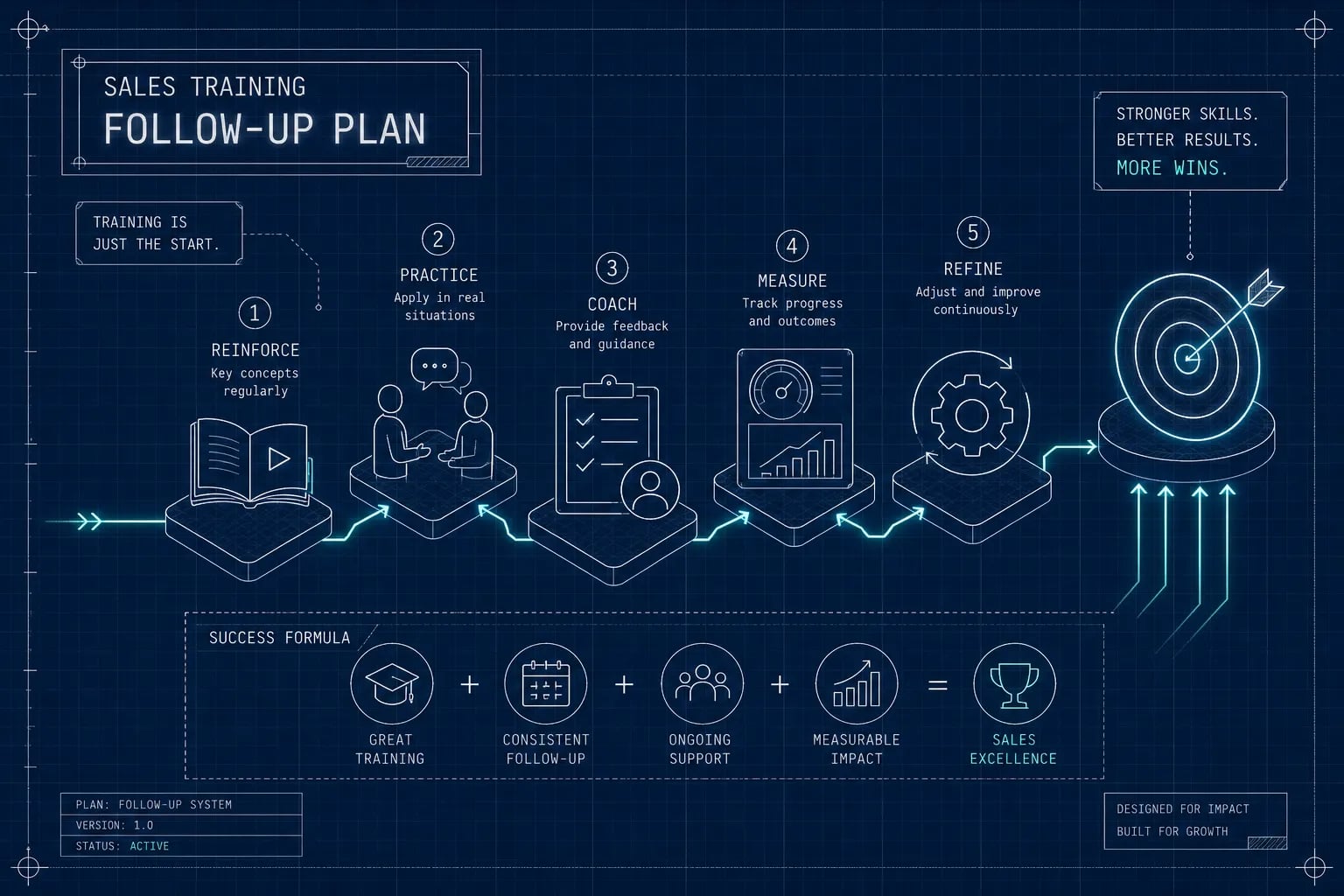
What should a sales training follow-up plan include? The answer begins long before anyone opens a slide deck, and it extends well beyond the final session. Most sales training budgets are not wasted in the room. A large share of that investment is lost in the fortnight that follows, when no reinforcement structure exists to catch what fades. Ebbinghaus’s forgetting curve illustrates the scale of the problem: widely cited training research suggests that, without structured reinforcement, somewhere between 50% and 70% of training content disappears within 24 hours, a figure that varies by context and complexity but consistently points in the same direction. Application-rate data compounds the picture. Immediately after training, research indicates around 62% of reps apply what they have learned; by the twelve-month mark, that figure can drop to as low as 34% (commonly cited in sales performance literature, including work by Sales Performance International). The training happened. The investment was made. The behaviour, however, did not stick.
For mid-sized B2B sales teams in India, this gap between training and lasting performance change is where the real battle is fought. At Growth Aspire, we see it consistently: when teams invest in structured sales training, the reinforcement phase determines whether they see material lift in win rates, in some cases significant, or simply return to old habits within weeks. The workshop is the spark. The follow-up plan is what keeps the fire burning.
A well-designed reinforcement plan is the difference between a good session and a measurable shift in performance. This article gives training leads and heads of sales a practical blueprint for exactly that: the cadence to follow, the activities that work, who owns what, templates you can use immediately, and the KPIs that prove your investment is delivering.
Why sales skills fade so fast without structured reinforcement
Skill decay is not a motivation problem, and it is not a reflection of poor training. It is a predictable cognitive pattern that every sales team faces when there is no deliberate reinforcement plan in place. Understanding why it happens is what makes a follow-up plan credible rather than bureaucratic.
The forgetting curve and what it means for your sales floor
Ebbinghaus’s original experiments, and the body of training research they inspired, suggest that without spaced repetition, the majority of new information, commonly cited in a range of 79% to 90% depending on the study and conditions, disappears within 30 days. The precise figure matters less than the direction: decay is steep and swift. In a B2B sales context, this plays out in a specific and damaging way. A rep attends a workshop on Thursday, returns to their desk on Friday, and immediately faces live calls, pipeline reviews, and quota pressure. There is no moment to practise what was learned, and no structure prompting them to apply it. Within days, the training becomes a memory of a good session rather than a changed behaviour. This is what the sales coaching follow-up checklist and reinforcement cadence are designed to interrupt.
The cost of a one-and-done training event
Consider an illustrative scenario: a 25-rep sales team where trained skills erode within two months because no reinforcement plan was put in place. The team lead has effectively spent the training budget to produce a temporary confidence boost, not a performance shift. The application-rate decline from the post-training high to the twelve-month low is not abstract, it tends to map to weaker pipeline conversion, slower deal velocity, and softer win rates. Heads of sales who approve training investments deserve to see outcomes, not just attendance figures. That only happens when a structured post-training reinforcement plan, a genuine sales training post-course action plan, is built into the programme from the start.
What should a sales training follow-up plan include: essential components
A post-training follow-up plan is not a single check-in email sent three days after the workshop. It is a system with four distinct components working in concert: reinforcement activities, manager accountability, skill application tracking, and measurement. Each one carries weight. Without named ownership, activities drift. Without measurement, the plan loses its business case. Without reinforcement activities, the forgetting curve runs unchallenged. And without manager accountability, nothing above is likely to happen at all.
What should a sales training follow-up plan include in the first 48 hours
The single most important action in the entire reinforcement plan happens within 48 hours of training completion: a one-on-one debrief between each rep and their manager. This conversation should surface three things, what the rep intends to apply first, where they anticipate friction, and what support they need. This is not a performance review. It is a commitment conversation that anchors intention before the urgency of live deals washes it away.
Spaced reinforcement and practice activities
Reinforcement works because of spacing, not volume. Micro-refreshers, call observation, role-play reviews, and short scenario practice distributed across several weeks are far more effective than a single follow-up session. Start with tighter intervals in week one, where touchpoints every two to three days keep the training material active. Then stretch to weekly and eventually monthly check-ins as the skill builds into a habit. Each touchpoint should be short, focused on one specific behaviour, and tied to a real deal or call.
Ownership and accountability structures
Every follow-up plan needs named ownership, not shared responsibility. Someone runs the coaching sessions. Someone tracks application against milestones. Someone escalates when a rep is not progressing. Without this clarity, follow-up becomes optional, and optional follow-up eventually becomes no follow-up at all. Assigning specific responsibilities before training even begins is what separates organisations that see lasting improvement from those that run excellent workshops and wonder why nothing changed.
Mapping a 30-60-90 day reinforcement schedule
The 30-60-90 day framework gives every training lead a structural backbone that is specific enough to follow and flexible enough to adapt to your team’s selling environment. Each phase has a distinct purpose, and the activities should reflect that purpose rather than simply repeating the same check-in across three months.
Days 1, 30: anchoring the skill to live deals
In the first month, the priority is application, not perfection. A training recap email goes out within 24 hours, written by the manager rather than the training team to signal ownership. A debrief conversation happens within 48 hours. Reinforcement touchpoints occur every two to three days in week one, then shift to weekly check-ins. The focus throughout is whether reps are testing the trained behaviour in real calls and pipeline conversations, with manager observation to confirm they are actually doing so and not defaulting to old patterns.
Days 31, 60: consolidating application under pressure
The second month shifts from first-attempt application to consistent execution under pressure. Manager check-ins can taper to biweekly, but they should now be more structured. Call reviews, deal inspections, and observed role-plays replace casual conversations. The question being answered in this phase is whether the behaviour is becoming habitual or whether it remains fragile when the rep faces a difficult prospect, a stalled deal, or a competitor objection. This is where reinforcement plans most often get abandoned, which is exactly why maintaining the cadence here matters most.
Days 61, 90: embedding habits and reviewing early outcomes
The third phase transitions from coaching to measurement. By day 60, evidence of trained skills may begin to appear in pipeline data and win-rate trends, though meaningful signals depend on deal cycle length, sample size, and the metrics being tracked. Monthly check-ins in this phase focus on performance outcomes rather than just skill usage, and the conversations begin to inform whether a refresher programme or additional targeted coaching is needed. This is also the phase where the team lead can start building the business case for continuing to invest: the data now exists to indicate whether the training is producing a return.
Running manager check-ins and a sustainable coaching cadence
The manager is the single most important variable in whether post-training follow-up works. Most reinforcement plans fail not because the content is weak but because frontline managers are not given a structure to run post-training conversations consistently. Without that structure, check-ins either turn into pipeline updates or disappear entirely within three weeks.
What a post-training coaching conversation should cover
An effective check-in has five elements: observed behaviour since the last session, one specific win to reinforce, one gap with a concrete coaching point, a commitment the rep makes before the next meeting, and a confirmed follow-up date. Keeping the conversation to 20 to 30 minutes with a clear agenda transforms it from an ad-hoc chat into a reliable rhythm that managers and reps both prepare for. Brevity and structure are what make this sustainable across a full quarter.
How Growth Aspire structures follow-up coaching for B2B teams
At Growth Aspire, we build the follow-up coaching structure into every training engagement rather than leaving it as an afterthought. For mid-sized B2B sales teams in India, typically in the 20 to 50-rep range, this means assigning specific reinforcement responsibilities to frontline managers. They are given coaching conversation guides they can use immediately, and the engagement includes periodic group calibration sessions to ensure skill adoption is consistent across the entire team. The reinforcement plan is part of the programme, not an optional add-on. That integration is what makes the difference between a well-received workshop and a measurable shift in performance.
KPIs that prove your follow-up plan is working
Training leads are under pressure to justify every rupee spent on capability development. Attendance figures and post-workshop satisfaction scores do not accomplish that. A practical KPI hierarchy gives heads of sales and business leaders something meaningful to review at 30, 60, and 90 days.
Leading indicators: measuring early application and engagement
In the first 30 days, three metrics tell you whether the sales enablement follow-up process is functioning before outcome data is available. Application rate measures the percentage of reps using the trained skill in live selling situations within 30 days. Knowledge retention score compares performance on a 30-day follow-up assessment against the score taken immediately post-training. Manager observation ratings give a direct behavioural signal from the people watching reps on real calls. These leading indicators are your early warning system: if they are low, the outcome metrics will follow.
Lagging outcome metrics: connecting follow-up to revenue impact
By days 60 to 90, the conversation shifts to business results. Conversion rate lift, pipeline velocity improvement, win-rate movement, and time-to-competency for newer reps are the metrics that answer the question every head of sales is actually asking: did this training make my team better at closing? Completion and satisfaction scores are diagnostic, they tell you whether the training was delivered. Behaviour change and business impact tell you whether the training produced a return. A well-structured post-training follow-up plan produces data that speaks both languages.
Templates your team can use this week
A follow-up plan is only as good as the tools that make it easy to execute consistently. Three templates form the practical foundation of any post-training reinforcement system, and each one should be simple enough to use without preparation.
Post-training recap email template
This email goes out within 24 hours of training completion and should be written by the manager, not the training team. The structure is straightforward: a brief acknowledgement of the session, three to five key takeaways expressed in the team’s own language rather than trainer language, links to any supporting resources or job aids, the specific actions the rep is expected to take before the next check-in, and an open invitation to ask questions. Keeping it to a single screen on mobile is a discipline worth enforcing. When this email comes from the manager, it signals that reinforcement is a team priority, not a training department obligation.
Manager coaching check-in template and 1:1 meeting agenda
The coaching check-in template has six fields: observed behaviour since the last session, what went well, one improvement area, a specific coaching point the manager will make, the rep’s commitment before the next meeting, and the confirmed follow-up date. The 1:1 meeting agenda complements this with four agenda items: wins from live application, obstacles the rep encountered, what support the rep needs from the manager, and the next milestone to aim for. Both templates should fit on a single page. Brevity is not laziness here, it is what makes the cadence sustainable across a full quarter without manager fatigue setting in. When managers have a clear structure to follow, they run better coaching conversations, and better conversations produce the behaviour change that justifies the training investment.
The reinforcement phase is where the training investment is won or lost
A sales training workshop is the starting point of the behaviour-change journey, not the destination. Without a deliberate post-training follow-up plan that includes a clear reinforcement schedule, structured manager check-ins, skill application milestones, and meaningful KPIs, the investment fades within weeks. This is not a pessimistic view of training, it is the reality of how cognitive patterns work under the pressure of live selling environments.
So what should a sales training follow-up plan include? A 30-60-90 day cadence, named ownership, manager coaching conversations with a clear structure, leading and lagging KPIs, and practical templates that make the cadence easy to run. Every element in this article is a starting point your team can adapt and begin piloting quickly, none of it requires a lengthy setup before it delivers value.
If you want a training partner who builds the follow-up plan into the programme from day one rather than leaving reinforcement to chance, explore how Growth Aspire’s personalised coaching model helps mid-sized B2B sales teams in India sustain, measure, and continuously build on every skill they acquire. The follow-up plan is where the training investment is either protected or wasted, and building it well is what we do.