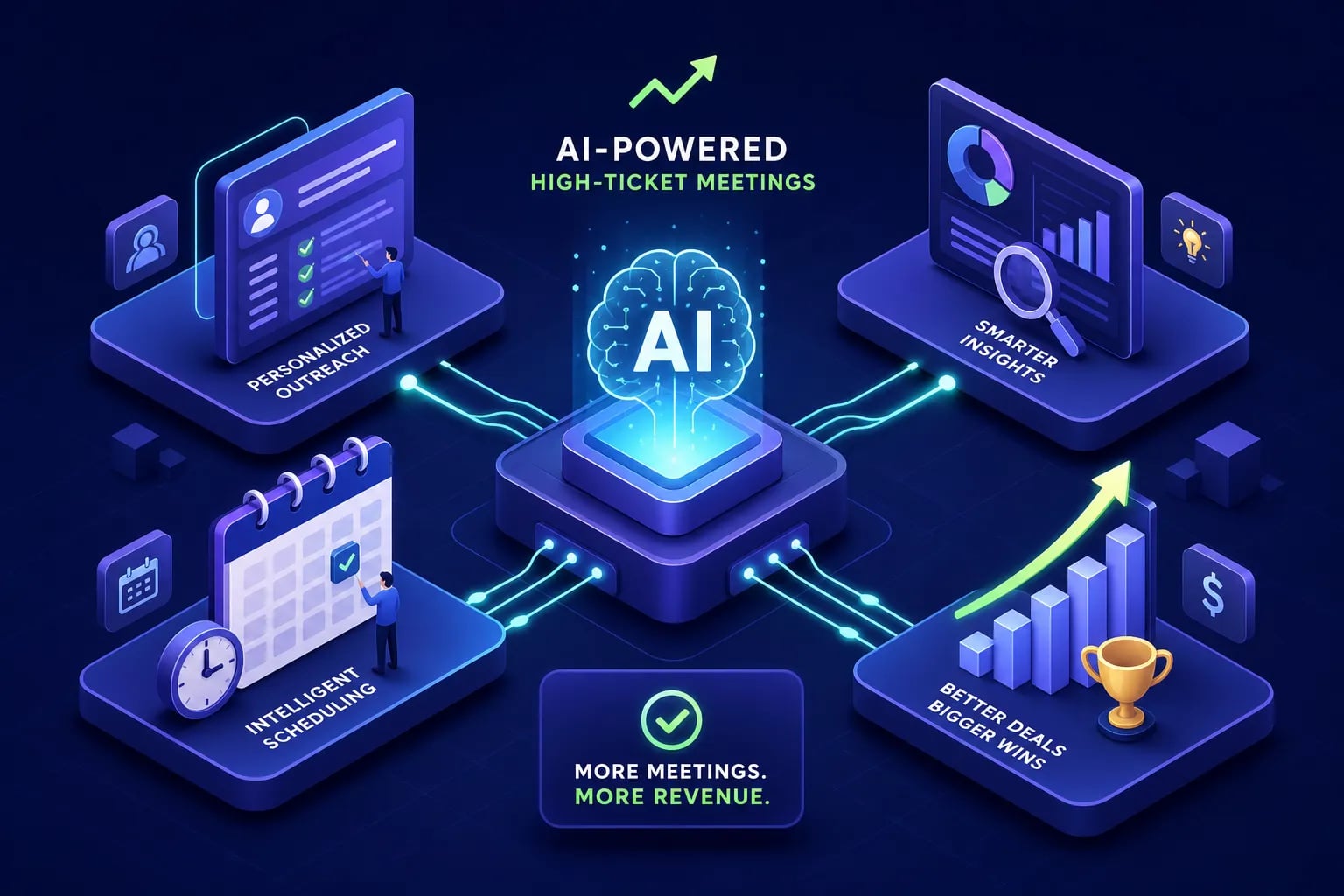
Where AI can help in getting high-ticket meetings is clearest across four stages: account prioritisation using intent signals, AI-assisted personalised outreach to senior buyers, conversational booking and scheduling, and pre-meeting intelligence prep. These four are not equal in impact. Intent data and signal-led personalisation deliver the largest measurable uplift in qualified pipeline; scheduling tools reduce friction but do not create pipeline on their own.
Sales teams in India’s mid-market technology sector consistently run into the same wall: high outreach volume, low conversion to quality meetings, and wasted rep time on accounts that were never ready to buy. The solution is not more activity. It is smarter targeting, driven by AI. At Growth Aspire, we see this pattern consistently across the B2B and enterprise sales teams we work with: AI tools deliver results fastest when reps concentrate effort on the right accounts first, then walk into meetings with the communication skills to convert them.
Key takeaways
- Intent signals prioritise accounts: AI platforms identify which accounts are actively researching your category right now, enabling reps to focus effort where buying cycles are live rather than guessing from a static list.
- Personalisation lifts reply rates: Signal-led, AI-assisted outreach improves email reply rates by 50, 133% in well-run programmes, with meeting-booking rates improving by 20, 40% compared to generic sequencing.
- Scheduling reduces friction: AI meeting schedulers cut time-to-first-meeting from days to minutes and protect show rates for high-ticket opportunities through automated reminders and CRM write-back.
- Metrics beyond bookings: Track qualified meeting rate, show rate, pipeline per AI-booked meeting, and cost per qualified opportunity. Meetings booked alone is a misleading north-star metric.
- Human approval is non-negotiable: AI handles targeting, drafting, and scheduling; a human rep approves every outbound message and manages the conversation once the meeting is secured.
- Skill gap determines conversion: AI gets your team into the room. Executive-level communication and consultative selling determine whether that meeting converts to pipeline.
Where AI Can Help in Getting High-Ticket Meetings: Intent Data and Account Prioritisation
Most outbound teams build their target lists on firmographic fit alone: company size, industry, and revenue range. Intent data adds a behavioural dimension, the signals that indicate an account is actively researching a category right now. An account that fits your ICP on paper but shows no buying activity is an entirely different prospect from one that has spent the past three weeks consuming competitor comparison content, hiring a senior procurement manager, and engaging with relevant industry events.
Intent platforms capture signals including content consumption patterns, competitor website visits, topic cluster engagement, hiring patterns, and trigger events such as funding rounds, leadership changes, or product launches. Processed by AI, these signals generate account scores that tell your rep whether an account is cold, warming, or in an active buying cycle.
First-party vs third-party intent
First-party intent, your own website and content activity, carries higher confidence because the data is unambiguous: a known prospect visited your pricing page three times this week. Third-party intent, tracked across broader publisher networks by platforms such as Bombora, extends your coverage to accounts you have not yet engaged directly. Both layers combined give your team a fuller picture of where buying energy actually sits across your total addressable market.
Tool recommendations for Indian B2B teams
For enterprise and mid-market teams in India, the practical tool landscape using account-based intelligence looks like this:
| Tool | Best fit | Key strength |
|---|---|---|
| ZoomInfo | Enterprise account and contact discovery | Verified decision-maker data, integrated intent signals, account prioritisation |
| 6sense | Enterprise ABM programmes | Predictive buying-stage identification across a defined account list |
| Demandbase | Enterprise ABM and pipeline measurement | Intent, account intelligence, ABM activation, and campaign measurement in one platform |
| Apollo.io | Mid-market, cost-conscious teams | Prospecting, intent, sequencing, and enrichment in a single accessible platform |
| Factors.ai | India-based SaaS and growth teams | Combines first-party website activity with G2, LinkedIn, and external intent signals |
| Clay | Teams needing flexible enrichment | Orchestrates multiple data providers for unusual ICP requirements |
Teams rarely need every platform above; the choice depends on budget, ICP complexity, and whether ABM is already in the motion. A practical stack separates functions rather than relying on a single tool: a contact database, an enrichment layer, and an intent platform. AI-scored account lists then reshape daily outreach planning in a concrete way. Reps direct their highest-effort, most personalised outreach towards accounts showing strong intent signals, use lighter-touch sequencing for warming accounts, and deprioritise cold accounts until the signals shift. This discipline protects rep time and keeps the pipeline filled with conversations that have a genuine chance of converting.
Where AI Helps in Getting High-Ticket Meetings: Personalised Outreach at Scale
The performance data here is specific. AI-driven personalisation improves email reply rates by roughly 50, 133% in well-run B2B programmes. Salesloft’s State of Sales Engagement data puts baseline cold email reply rates at approximately 3, 7%; signal-based personalisation targeting well-filtered audiences can push reply rates towards 15, 25%, though that figure reflects tightly targeted outreach rather than AI alone. Meeting-booking rates improve by 20, 40% in programmes that combine intent-based account selection with signal-led messaging. The gains come from signal quality, not volume.
The signals that earn C-suite replies are specific and verifiable: executive-authored content such as a recent post, interview, or published point of view; company trigger events including expansion, restructuring, funding rounds, or new market entry; new leadership appointments within the target function; and hiring patterns that reveal an active initiative. These contrast sharply with openers that leave senior buyers cold, “I noticed your company does X” and compliments that could apply to any organisation in the sector. Generic personalisation is detectable and dismissed.
The right workflow keeps a human in the decision chain. AI generates a draft based on verified signals and a structured prompt; a human rep reviews, edits, and approves before anything is sent. Fully automated outreach to C-level buyers without human review consistently underperforms because it sacrifices the judgement that makes a message feel specific. The rep’s role shifts from writing from scratch to editing and approving, faster, but still demanding genuine skill and contextual awareness.
A short message that earns replies follows a consistent structure: one verified signal, one business implication tied to an executive outcome such as growth, risk, margin, or speed, one falsifiable hypothesis about their situation, and one low-friction call to action such as “worth sending the one-page summary?” Keep emails under 150 words and LinkedIn messages to two or three sentences with a single clear purpose. AI handles the research and the first draft; the rep ensures it sounds like a credible human with relevant expertise.
Can you automate LinkedIn outreach ethically and still get results?
LinkedIn is where high-ticket B2B deals begin for many Indian sales teams, and also where automation gets misused most visibly. Ethical LinkedIn automation means using AI to identify relevant signals and draft personalised connection requests and follow-up messages, while a human reviews and sends each one within the platform’s rate limits. It does not mean blasting 500 identical connection requests a week or using browser extensions that simulate clicks to bypass LinkedIn’s controls.
A signal-led LinkedIn sequence for high-ticket prospecting follows a deliberate progression. The connection request references one specific thing: a post the prospect wrote, a company announcement, a credible shared context, or a relevant mutual connection. A follow-up three to four days after acceptance offers a sentence of insight relevant to the prospect’s role and current priorities. A second follow-up a week later provides something concrete, a benchmark, a short diagnostic, or a relevant peer pattern. AI identifies the signal and drafts the message; the rep’s voice and judgement keeps it from sounding templated.
LinkedIn is for opening, not closing. Once a prospect responds substantively, the goal shifts to earning a short call or an email exchange. AI can flag the right moment to propose a meeting based on engagement signals, but the transition still requires a human rep who can read the conversation and judge when and how to make the next move.
Where AI Helps in Getting High-Ticket Meetings: Scheduling and Show Rates
Once a prospect agrees in principle to a meeting, friction in the scheduling process kills show rates. Good AI meeting schedulers connect to Google Calendar and Outlook through standard OAuth, read availability across connected calendars, apply buffer rules and time-zone logic, and create meetings with conferencing links automatically. For high-ticket deals, where a qualified prospect agreeing to a meeting represents significant pipeline value, removing the back-and-forth of finding a slot is a meaningful operational gain.
On the CRM side, these tools write booking data back to Salesforce or HubSpot, log the meeting as an activity, trigger follow-up sequences, and route the meeting to the correct rep based on territory, account ownership, or deal stage. For inbound leads, a conversational AI booking assistant can qualify the prospect with a few structured questions and offer available slots in the same interaction, cutting time-to-first-meeting from days to minutes. For outbound, once a prospect replies positively, the AI assistant handles scheduling logistics while the rep stays focused on the conversation rather than the calendar.
Booked meetings that do not happen are wasted pipeline. AI tools send personalised reminders, handle reschedule requests at the right cadence, and deliver pre-meeting context automatically. Track show rate separately from meetings booked. For high-ticket deals, a 15, 20 percentage-point improvement in show rate has a direct and measurable impact on qualified pipeline and revenue attribution.
Which metrics actually prove your AI investment is working?
Optimising for meetings booked alone will inflate calendar volume without improving pipeline quality. The metrics that tell the full story span the conversion chain from first outreach to closed revenue. The core conversion metrics are lead-to-meeting rate, qualified meeting rate (what percentage of held meetings meet the ICP and represent a real opportunity), show rate, and meeting-to-opportunity rate. A high booking rate combined with a low qualified-meeting rate signals that AI is generating activity without generating revenue-relevant conversations. Segment every metric by AI-assisted versus rep-sourced to make the comparison real and actionable.
The ROI formula for a high-ticket meeting programme is straightforward: attributed gross profit plus labour savings, minus total AI costs including software, integrations, oversight, and rework, divided by total AI costs. Pipeline value is a leading indicator only. Closed-won gross profit per AI-assisted meeting is the metric that matters for the final ROI decision. Cost per qualified opportunity serves as a practical mid-funnel metric for programmes where sales cycles are long and revenue attribution takes time.
An executive dashboard for the first quarter of any AI pilot should track ten metrics: lead-to-meeting conversion rate, qualified meeting rate, show rate, meeting-to-opportunity rate, pipeline created, pipeline per AI-booked meeting, closed-won revenue and gross profit, hours saved per rep, cost per qualified opportunity, and net ROI. Review this dashboard at the 30-day mark and again at 60 days to catch underperformance before it compounds, and adjust signal selection or outreach structure before scaling.
AI books the meeting. Your rep still has to win it.
AI tools improve targeting, drafting speed, and scheduling efficiency. They do not teach a rep how to hold a boardroom-level conversation, navigate executive objections, or build credibility in a 30-minute discovery call with a CFO or COO. That skill gap is the most consistent reason AI-generated meetings fail to convert to qualified pipeline, and it is a gap no tool currently closes on its own.
When AI secures a meeting with a senior executive, the rep walks into a conversation where credibility is established in the first five minutes. A rep who defaults to a product demo or a feature walkthrough ends the meeting early and stalls the relationship. Executive-level communication means leading with a business hypothesis, asking diagnostic questions that reveal strategic priorities, and earning the right to continue the conversation rather than pitching. This is a trainable skill, not a personality trait.
Reps trained in influence frameworks, executive discovery, and consultative selling convert AI-sourced meetings at a measurably higher rate. Growth Aspire’s programmes on executive communication, influence, and consultative selling are specifically designed for this gap, equipping B2B and enterprise sales teams across India to perform at the level that high-ticket meetings demand. The AI handles targeting and outreach quality; the rep determines what happens from the moment the meeting begins.
To pilot AI for high-ticket meetings over a 60, 90 day window, work through this checklist in phases:
Prepare
- Define your ICP tier for high-ticket meetings by company size, function, title, and buying signals
- Establish baseline metrics before the pilot starts: reply rate, meeting-booking rate, show rate, and qualified meeting rate
- Select one intent data tool and run a four-week test on a defined account list
Execute
- Choose two to three personalisation signals to test: a trigger event, executive content, or a hiring pattern
- Set up AI-assisted drafting with human approval before any message is sent
- Connect a scheduling tool to your CRM and track show rate separately from bookings
Measure
- Review the dashboard at 30 and 60 days and adjust signal selection or outreach structure before scaling
Start with one signal, one tool, and a clear baseline
Understanding where AI can help in getting high-ticket meetings points to the same answer across high-performing teams: intent-based account prioritisation focuses effort where buying cycles are active, signal-led personalised outreach earns C-level replies, and frictionless scheduling protects show rates. Metrics tracking completes the loop. Without measuring qualified meeting rate, pipeline per meeting, and cost per qualified opportunity, it is impossible to tell whether AI is building the right pipeline or simply adding calendar noise.
The practical starting point is not deploying every tool at once. Choose one intent data source, one personalisation signal to test, and one scheduling integration. Measure the outcome against a pre-pilot baseline and iterate from there. Teams that try to implement everything simultaneously rarely establish clean attribution or learn what is actually working.
Where AI can help in getting high-ticket meetings is only half the story, what your team does inside those meetings is what closes revenue. The technology opens the door; executive-level communication and consultative selling skill determine what happens next. Contact the Growth Aspire team directly and ask for the executive communication and consultative selling programme details for B2B sales teams.
Frequently Asked Questions
How long should we run an AI pilot for high-ticket meetings before deciding if it works?
Run the pilot over a 60 to 90 day window and review progress at 30 and 60 days. I advise catching underperformance early and adjusting signal selection or outreach structure before you scale.
Do I need a human to approve AI-generated outreach every time?
Yes, a human rep must review and approve every outbound message. I state that AI drafts the message but human judgement keeps outreach specific and prevents fully automated C-level outreach from underperforming.
Which single metric should we focus on first to prove AI is adding value?
Start by tracking the qualified meeting rate alongside show rate and pipeline per AI-booked meeting. I recommend qualified meeting rate because meetings booked alone can inflate calendar volume without improving revenue-relevant conversations.
Can we fully automate LinkedIn outreach and still be ethical and effective?
No, fully automated LinkedIn blasts are misuse; ethical LinkedIn automation uses AI to draft personalised messages while a human reviews and sends each one within rate limits. I recommend a deliberate sequence that references a specific verified signal and shifts to a human-led conversation once the prospect responds.