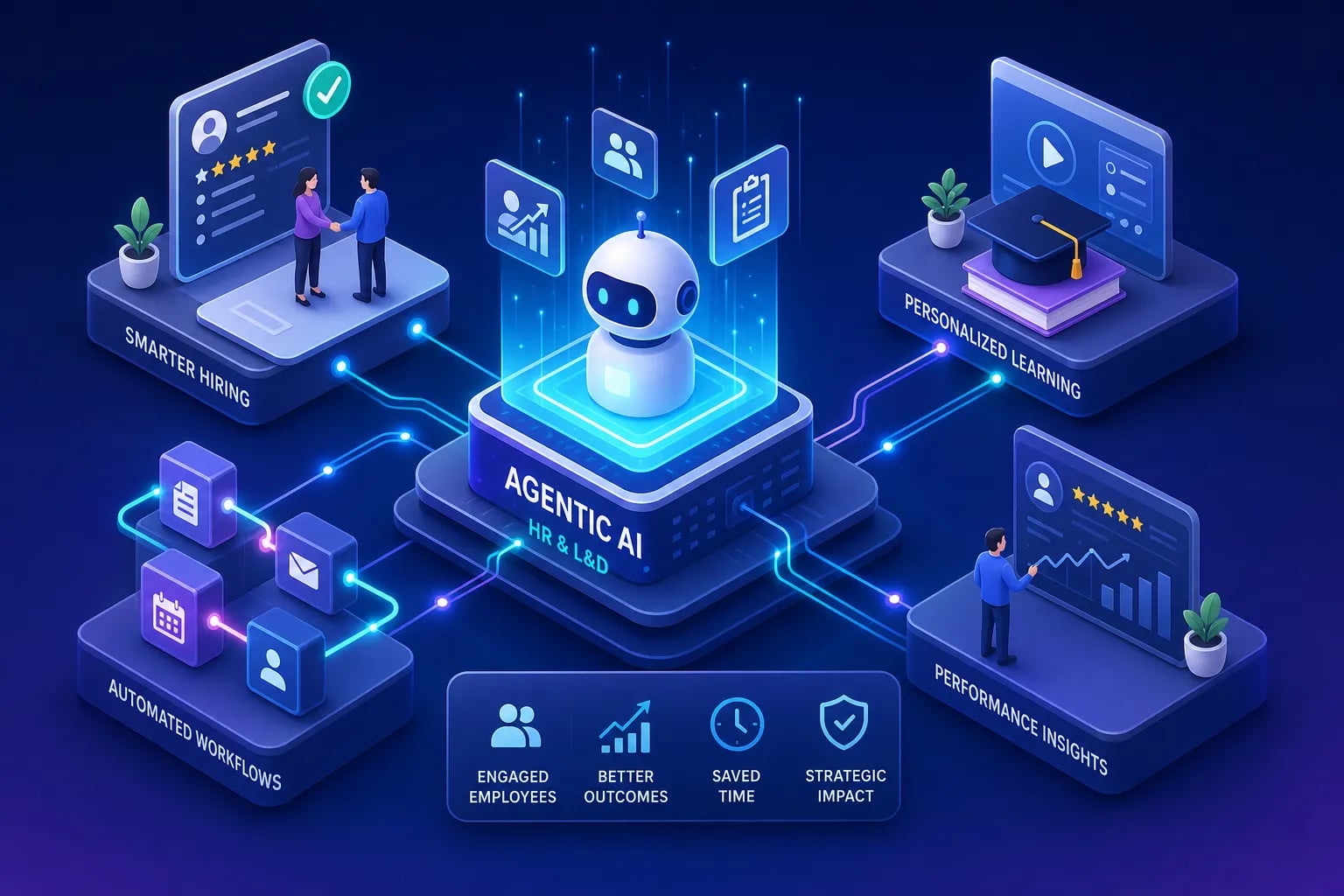
Agentic AI solutions for L&D and HR teams are changing how mid-sized Indian organisations handle onboarding, personalise learning paths, and track skills at scale. The daily reality for most HR business partners and learning leads is still this: manual onboarding checklists, chasing LMS completion data across departments, building learning paths one employee at a time. These are not edge cases. They are the operational baseline for lean teams managing hundreds of employees. Generic AI tools have softened the load in some areas, but they still require a human to type the prompt, interpret the output, and take the next step. That is still a lot of human.
Agentic AI changes that equation fundamentally. These are systems that receive an outcome to pursue, plan the steps required to achieve it, and execute across multiple platforms. They monitor their own progress and adjust when something does not go as expected. At Growth Aspire, one of the most consistent questions we hear from L&D leads and HRBPs working in technology firms is: “How do we use AI to actually do the work, not just assist with it?” This guide answers that directly. You will leave with a clear picture of the use cases worth prioritising, how to evaluate solutions responsibly, how to run a focused pilot, and why the human coaching and methodology layer still determines whether any of this delivers measurable results.
What agentic AI actually is, and why it differs from tools you already use
Most HR and L&D teams have experimented with AI chatbots, co-pilots, or recommendation engines embedded in their LMS or HRIS. These tools are reactive: they respond when prompted, complete one task, and stop. An agentic system is structurally different because it is goal-driven rather than prompt-driven.
A conventional AI assistant waits for a user request and produces a single output. An agentic system receives an objective, plans the steps required to achieve it, selects the right tools, and executes across multiple systems. It then monitors its own progress and adjusts when something changes. In L&D terms, an assistant recommends a course when you ask. An agent detects a skills gap based on assessment data, enrols the learner, schedules follow-up nudges, tracks completion, and flags non-completion to the relevant manager, all without a manual trigger.
Ground this in a scenario any Indian L&D lead will recognise: a new hire joins a mid-sized technology firm in Bengaluru. Instead of HR manually sending welcome emails, assigning LMS modules, chasing pending documents, and logging completion in three separate systems, an agentic workflow coordinates all of it across the HRIS, LMS, and communication platforms with minimal manual intervention. The HR team is alerted only when an exception genuinely requires a human decision. That is the core operational shift.
Agentic AI solutions for L&D and HR teams: key use cases
Not every workflow benefits equally from agentic automation. The strongest return comes from combining several agentic capabilities into one end-to-end process rather than automating isolated tasks that still require manual hand-offs between them.
Automating onboarding admin and new-hire coordination
Onboarding is repetitive, high-volume, and consistently error-prone when managed manually. Agentic AI is particularly well-suited here because the process is structured, the outcomes are measurable, and the data already lives in systems the agent can access. An agent can coordinate task assignments, document collection, system access provisioning, compliance module assignments, and buddy pairing across departments with minimal manual follow-up from HR. For firms onboarding 20 to 50 people a month, this alone represents a material reduction in HR effort per case.
Personalising learning journeys at scale
This is where autonomous AI agents genuinely change what an L&D function can deliver. Instead of a static course catalogue, agents build and continuously adjust learning sequences based on role, performance data, skills assessments, and behavioural signals. Industry estimates suggest that AI-personalised learning paths can produce roughly a 30% reduction in time-to-proficiency compared with static LMS-based programmes, with commonly reported ranges of 20% to 40% depending on baseline design quality. For a team of 500 employees spread across different functions and levels, this level of personalisation is practically impossible to sustain manually at any meaningful depth.
Skill gap detection and continuous development tracking
Agentic systems can monitor completion rates, assessment scores, and behavioural indicators on an ongoing basis, then surface insights to L&D leads and managers without waiting for a quarterly review cycle. Pair this with career-path data from your HRIS and the agent functions as a proactive development planner rather than a passive tracker. L&D moves from a reporting function to a real-time intervention capability, which is precisely what most heads of sales and capability-building teams have been asking for.
Choosing agentic AI solutions for L&D and HR teams: vendor types and realistic costs
The vendor landscape for autonomous learning assistants and AI-driven HR automation is expanding rapidly, and the marketing language is not always useful for shortlisting. Understanding the three broad categories makes the decision considerably cleaner.
The three vendor categories you will encounter
The first category is AI-native LMS and LXP platforms with built-in agentic workflows. These are the fastest to deploy and suit organisations that want a ready-made environment without significant engineering involvement. The second is agentic orchestration platforms that layer across your existing LMS, HRIS, and communication systems, connecting them into a single automated workflow without replacing the tools you already have. The third is custom agent-builder infrastructure, which requires engineering support but offers the most flexibility for organisations with specific integration requirements or unique compliance constraints.
Deployment model is a compliance decision, not a technical preference
For Indian organisations navigating the Digital Personal Data Protection Act (DPDP Act), the deployment model carries real legal weight. SaaS platforms are faster to deploy but require careful data processing agreements with vendors, clear purpose-limitation clauses, and documented security safeguards. Private cloud and on-premises options give more control over employee data residency and access logging, which matters significantly for organisations in regulated sectors or those handling sensitive HR data at scale.
Before shortlisting vendors, your IT, legal, and data teams need to be in the room together, this step belongs at the start of the process, not as a retrofit once build work has begun.
What total cost of ownership actually looks like
Most vendors lead with per-seat or credit-based pricing, but TCO for a mid-sized Indian enterprise pilot typically runs considerably higher than the licence fee alone once integration, governance, change management, and ongoing model usage are factored in. For a focused single-workflow pilot at a firm of 500 to 2,000 employees, realistic TCO benchmarks range from approximately ₹25 lakh to ₹60 lakh over 6 to 12 months. Heavier pilots spanning multiple teams and compliance requirements push toward ₹1.5 crore. Set this expectation with leadership before vendor shortlisting begins. Budget surprises mid-pilot are the most common reason sound pilot programmes get abandoned prematurely.
Running your first pilot without overcomplicating it
The most common failure mode at this stage is scope creep during the design phase. Teams try to automate too many workflows simultaneously, governance gets diffuse, and no single use case is evaluated rigorously enough to support a credible scale decision. A strong pilot is narrow, well-governed, and measured against a documented baseline.
The pilot checklist: from use case selection to scale decision
Follow these seven stages in sequence:
- Select one bounded, high-volume workflow. Onboarding task coordination, learning enrolment and nudging, or HR policy query handling are strong starting points.
- Document the current process in full and capture a two-to-four-week baseline for the metrics that matter: task completion rate, HR effort per case, cycle time, and employee satisfaction.
- Assess data readiness and compliance risk with your IT, data, and legal leads before any build work begins.
- Design the workflow with explicit human-in-the-loop checkpoints for any decision that affects an employee’s pay, performance record, or sensitive personal data.
- Build and test in a controlled environment before going live.
- Run the pilot for four to eight weeks with weekly review sessions.
- Evaluate results against your agreed success threshold and make a clear decision: stop, revise, or scale. Do not let pilots drift indefinitely without a formal evaluation.
Who needs to be in the room
A cross-functional pilot team should include a process owner from L&D or HR, an AI programme manager, an IT and systems lead, a data and analytics lead, a legal and compliance reviewer, and a change management lead. Each role covers a failure mode that projects without that role routinely encounter. A simple onboarding workflow can complete a pilot in six to eight weeks. More complex learning personalisation workflows typically need ten to twelve weeks. Specify this upfront to prevent pressure to rush governance steps during the pilot run.
KPIs that give leadership a clear picture
Define success metrics before the pilot starts, not after the results are in. Core metrics to track include: task completion rate by the agent, time-to-onboard or time-to-proficiency, HR effort saved per case, training completion rate, escalation rate to human reviewers, error or rework rate, and learner satisfaction scores. Indian corporate L&D teams in 2026 are increasingly expected to connect learning metrics to business outcomes, so also track downstream productivity indicators where the workflow data allows it. These give leadership a quantitative basis for the scale decision rather than relying on qualitative impressions alone.
Why the human coaching layer still determines whether any of this works
Agentic AI handles orchestration, personalisation at volume, and administrative accuracy. What it cannot do is replace the quality of the learning methodology running through the content, the coaching conversations that reinforce new behaviours after a session, or the science-backed sequencing that determines whether a skill actually transfers to the job and stays there.
The risk of confusing automation with learning effectiveness
An agent can enrol a thousand learners in a programme and track who clicked through every module. None of that guarantees behaviour change in the field. The failure mode most L&D teams encounter after deploying AI infrastructure is high completion rates paired with no measurable performance uplift. This happens when the methodology behind the learning design is weak, generic, or disconnected from real job context. Automation amplifies whatever is running through the system. If the content and coaching design are sound, the results scale. If they are not, the problems scale instead.
How a methodology partner complements your AI infrastructure
Organisations that invest in AI platforms while also working with a strong methodology partner tend to see meaningfully better outcomes than those that treat the technology as self-sufficient. At Growth Aspire, we layer instructional design grounded in behavioural science, structured coaching cadences, and role-specific application frameworks on top of whatever platform an organisation deploys. The AI handles scale, personalisation, and tracking. The methodology ensures the content and coaching flowing through that infrastructure is rigorous enough to produce outcomes that show up in performance data, not just completion dashboards. The two priorities are not competing; they are the two halves of a complete system.
Where to go from here
Agentic AI solutions for L&D and HR teams represent a genuine operational shift, not simply a productivity add-on. The organisations that will extract the most value over the next 12 to 24 months are those that deploy deliberately: one use case at a time, with proper governance, a documented baseline, and a clear link between automation and the quality of what is being automated.
Start with onboarding or learning administration, prove measurable value with agreed KPIs, and treat vendor selection as a compliance and architecture decision before it becomes a feature comparison. Ensure DPDP Act compliance requirements are built into the pilot design from day one, not retrofitted after deployment. And treat the human coaching and methodology layer as equally important as the technology layer, because that is where the performance uplift actually originates.
If you are evaluating agentic AI solutions for L&D and HR teams and want to ensure the methodology behind your rollout is strong enough to deliver measurable performance outcomes, get in touch with the Growth Aspire team. We work with mid-sized technology firms and enterprise sales teams across India to combine AI-enabled infrastructure with science-backed training design that produces results you can measure and report on with confidence.