



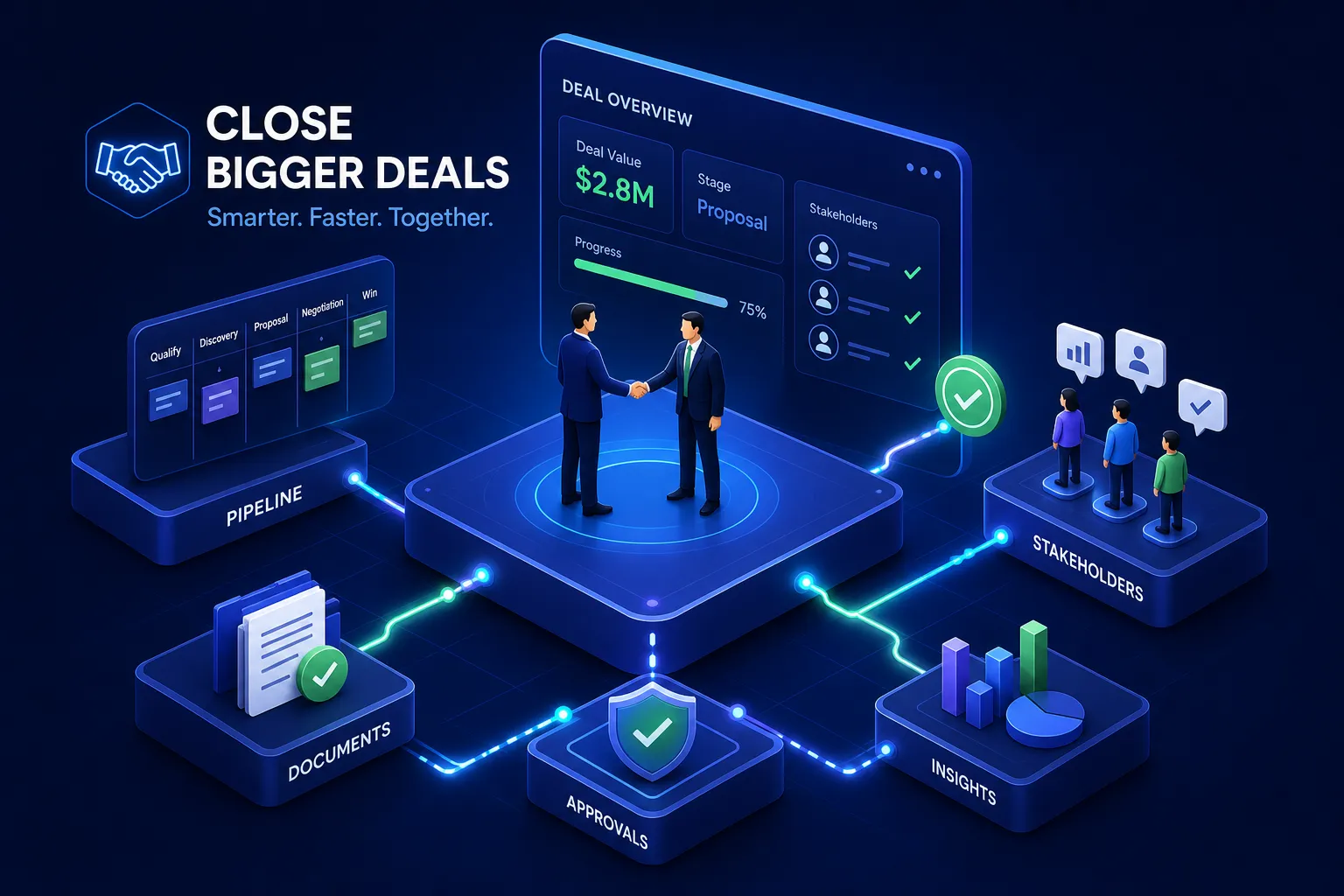
Many mid-sized B2B companies in India lose enterprise deals not because their product is weak, but because their process is ad hoc. A salesperson runs a promising first meeting, logs a vague note in the CRM, and the deal goes dark weeks later with no warning and no clear explanation, often after thirty or more days of zero activity, a threshold that research consistently links to significantly reduced close probability. The deal was never truly managed; it was simply accompanied. Enterprise deal management is the discipline that replaces this guesswork with a repeatable system, one that tracks buyer evidence, maps stakeholder influence, and surfaces risk before it hardens into a loss.
This guide lays out exactly how to build that system. It covers qualification logic, buying committee mapping, stage governance, and the early warning signals that predict a stall weeks before it becomes permanent. Teams familiar with how Growth Aspire’s Deal Intelligence platform works will recognise these principles embedded in its coaching triggers and pipeline analytics. Those starting from scratch will walk away with a practical framework they can deploy in their next deal review.
Why enterprise deals demand a different sales motion entirely
The buying committee problem no one prepares for
Enterprise deals involve five to ten or more stakeholders, each with different priorities, different measures of success, and often competing internal agendas. A strong champion can open doors and advocate internally, but a single contact cannot close an enterprise deal alone. Technical evaluation and procurement or legal review are routinely the two longest phases in the cycle. For most enterprise deals, the full cycle spans six to twelve months, and many sales teams lack processes optimised for either of these phases.
The consequence is predictable: reps lose control of the deal the moment it leaves their champion’s desk. Without relationships across the buying committee, without visibility into the legal redline process, and without a clear business case that survives finance scrutiny, the deal stalls. The CRM still shows it as active, but the buyer has moved on mentally.
Why SMB instincts fail in enterprise accounts
Salespeople trained on fast-cycle SMB deals carry a sprint mindset into enterprise accounts, and it costs them. In SMB, speed and self-serve win. In enterprise, multi-threading and consensus-building win. These are fundamentally different skills operating on fundamentally different timescales, and confusing them produces inaccurate forecasts and missed quarters.
The most damaging habit is timeline compression. A rep who is used to closing deals in three weeks will instinctively push for commitment on an enterprise deal that has only just entered technical evaluation. This pressure signals impatience to the buyer, undermines the champion’s credibility internally, and produces optimistic pipeline calls that Finance stops trusting. The fix is not slowing down; it is switching from velocity-focused selling to evidence-based selling.
Enterprise deal management: qualification criteria that filter out noise
The criteria that separate real enterprise deals from pipeline noise
A structured qualification framework built for the complex sales lifecycle covers four essential areas: budget authority, decision timeline, competitive position, and executive access. The MEDDIC framework, developed at PTC in the 1990s, gives sales teams a systematic way to interrogate each of these areas without relying on intuition. Teams using MEDDIC have documented win rate improvements from 23% to 46%, a result that reflects what happens when you replace guesswork with evidence. For teams evaluating deal management software or enterprise CRM configurations, MEDDIC-aligned qualification fields are a practical baseline to build from.
For mid-sized sellers targeting large Indian enterprises, two elements matter most: procurement readiness and internal champion strength. An account may have genuine interest and an identified pain point, but if there is no active budget cycle and no champion with organisational influence, the deal belongs in a watch list, not an active pipeline. Pipeline credibility is built on honest qualification, not optimistic inclusion.
The bid/no-bid decision and why many teams avoid it
Enterprise deals require a formal bid/no-bid assessment at the point of entry. Specific factors should trigger a no-bid decision: no executive sponsor accessible to the selling team, no defined budget cycle, a competitor already embedded in the account, or no clear timeline on the buyer’s side. Each of these factors, on its own, dramatically reduces the probability of winning. In combination, they make pursuit a waste of six months of capacity.
Teams often report a reluctance to remove deals from the pipeline, the discomfort of saying no to visible pipeline is real. But every unwinnable deal you pursue is a winnable deal you are neglecting. Build the bid/no-bid review into your qualification stage as a non-negotiable step, and give your managers the authority to remove deals that fail it. A short structured review meeting, no more than thirty minutes, with a named decision-maker who holds removal authority, is all this requires.
Mapping the buying committee before your first proposal lands
Understanding the six buyer roles in an enterprise deal
Every enterprise deal involves six core roles, and misjudging which conversations matter most is one of the most common causes of late-stage loss. The Champion advocates internally and opens access to other stakeholders. The Economic Buyer controls the budget and approves final spend. The Technical Buyer evaluates fit, integration, and security. End Users assess daily usability. Procurement manages vendor compliance, commercials, and legal timelines. Legal or Compliance reviews contract risk and data handling obligations.
Most sales teams over-invest in the Champion and under-invest in everyone else. This is a structural vulnerability. Enterprise sales data consistently shows that deals with three or more engaged stakeholders close at significantly higher rates than single-threaded deals, in some studies, the difference is stark: 68% close rate versus 23% for deals that rely on a single contact. The implication is straightforward: your stakeholder map is as important as your solution pitch.
Multi-threading: building relationships beyond your single contact
Multi-threading is a deliberate strategy, not an opportunistic one. The goal is to build parallel, personalised relationships with each stakeholder before the deal reaches procurement, not after. The entry point is almost always your Champion. A direct ask works well: “Who else on your team will be involved in this evaluation? I want to address their specific concerns directly.” This framing makes the Champion’s job easier and gives you a legitimate reason to reach out beyond them.
Relying on one contact is a single point of failure. Deals die in procurement because the relationship map was never built wide enough to survive an internal politics shift, a champion promotion, or a new stakeholder introduced late by the buyer’s legal team. For deals above Rs. 50 lakh in ACV, target at least five engaged contacts across three or more roles before presenting your proposal. Track every contact and their last engagement date in your CRM, whether that is a dedicated enterprise CRM for deals or a configured standard platform, and treat any thread that goes quiet for more than fourteen days as a risk signal.
Stage governance for enterprise deal management
Defining exit criteria for every stage gate
The most damaging CRM habit in enterprise sales is advancing deals based on seller activity rather than buyer evidence. “Had a call” is not a reason to move a deal to Technical Evaluation. “Sent a proposal” is not a reason to move to Negotiation. Each stage in your pipeline must have defined exit criteria based on what the buyer has said or done, not what the seller has attempted.
Concrete exit criteria look like this:
- Discovery: confirmed pain point with a named Economic Buyer
- Technical Evaluation: completed proof-of-concept with documented feedback
- Business Case: an approved internal ROI document that the buyer’s team has presented upward
- Procurement: signed vendor registration and a redline timeline
These are buyer-evidenced gates, and enforcing them is what separates a credible forecast from a wishful one. Across Growth Aspire’s client engagements, revenue operations teams that implement evidence-based stage criteria consistently report stronger forecast accuracy within two quarters of adoption.
Running a deal review that actually produces decisions
A high-quality deal review is a one-to-one coaching session, not a team status update. The manager’s role is to identify recurring blockers and patterns across the pipeline, not to dissect every deal in detail. The rep must present buyer evidence for each stage claim, not just provide a verbal update. The session should close with one or two specific, time-bound actions, each with a clear success criterion.
For late-stage, high-value deals, the deal desk process adds a cross-functional governance layer involving Finance, Legal, and Sales Operations. The deal desk’s job is to accelerate velocity and protect margin, not to create additional approval bureaucracy. Measure it on deal cycle time, discount depth, and SLA compliance. If your deal desk is slowing things down rather than resolving blockers, it needs a structural review. Organisations that also configure CPQ and CLM tooling within this layer report meaningful reductions in procurement friction, particularly where contract redlines and commercial approvals previously created bottlenecks.
Reading the risk signals before a deal goes dark
The stall patterns that predict deal death weeks in advance
Every stage in the enterprise cycle has its own signature stall patterns. In Discovery, the warning signal is no committed follow-up action from the buyer after the first call. In Technical Evaluation, it is a POC dragging beyond the agreed timeline with no explanation. In Procurement, it is a new stakeholder introduced by the buyer’s side without context, or scope expansion requests appearing during negotiation. Each of these signals has a corresponding coaching response, and delayed action on any of them is the primary cause of late-stage losses.
Pipeline analytics from enterprise sales studies indicate that deals with no activity logged for thirty or more days are 80% less likely to close. Deals that slow their stage velocity below the historical average rarely recover. These are not subjective judgements; they are measurable thresholds that a well-configured pipeline and revenue operations platform surfaces automatically. The question is whether your team is looking at these signals or reacting to them only in hindsight.
When to escalate, re-qualify, or walk away
Not every stall is fatal, but every stall demands a clear response. Three distinct responses apply depending on what the data shows.
Escalation is the right move when the deal has stalled because of a relationship gap at the executive level: bring in a senior leader to re-engage the Economic Buyer directly. Re-qualification is warranted when the business case has weakened or the buyer’s priorities have shifted, revisit the original pain points and determine whether the solution still maps to a live urgency. Disqualification applies when two or more disqualifying factors are present simultaneously: exit the deal, document the learnings, and redirect that capacity to winnable opportunities.
The hardest discipline in enterprise selling is walking away from a deal you have invested months in. But capacity spent on an unwinnable deal has a direct cost: it is capacity not spent on the next pipeline that could close. Build the decision framework into your deal review cadence so it operates as a routine process, not a crisis response.
How Growth Aspire’s Deal Intelligence makes enterprise deal management systematic
From spreadsheet gut-feel to coached pipeline visibility
Many mid-sized B2B teams in India track enterprise deals in CRMs that record activity, not buyer intent or deal health. The system logs what the rep did, not what the buyer signalled. This creates a fundamental visibility gap: managers are reviewing a log of seller effort, not a diagnostic of deal risk. Growth Aspire’s Deal Intelligence platform is built to close that gap by surfacing the signals that actually predict outcomes, stakeholder engagement depth, stage-exit failures, and champion responsiveness, within a purpose-built enterprise sales management layer on top of your existing data.
The result is that pipeline reviews shift from status updates to decision-making sessions. When a manager opens a deal in the platform, they see whether the buying committee is engaged at the required depth, whether exit criteria have been met for the current stage, and which risk signals are active. This transforms every review from a conversation about what happened into a conversation about what needs to happen next.
The coaching triggers that embed enterprise selling as a habit
Deal Intelligence operates as a coaching cadence tool, not simply a reporting dashboard. When a deal triggers a risk signal, the platform prompts a specific coaching action tied to the stage. A champion who has gone quiet triggers a multi-threading prompt. A deal that has been in the same stage for twice the historical average triggers a re-qualification prompt. Over time, these triggers build the enterprise deal management muscle across the entire sales team, rather than relying on the individual experience of senior reps.
This is consistent with Growth Aspire’s broader methodology: science-backed sales techniques, interactive workshops that build real skill, and follow-up support that embeds new behaviours rather than letting training fade after the session ends. The platform is the operational layer that keeps the methodology alive in every deal review, every week, across every rep on the team.
Building the discipline that separates consistent closers from the rest
Effective enterprise deal management rests on five disciplines: rigorous qualification, buying committee mapping, evidence-based stage governance, early risk signal recognition, and systematic pipeline visibility. None of these disciplines require a larger team or a longer working day. They require a process that gives every deal the same structured attention, regardless of which rep owns it or how promising it looks at first glance.
For mid-sized companies in India competing for large enterprise accounts, this discipline is the differentiator. Teams operating with a defined qualification framework, a mapped buying committee, and a coached pipeline review cadence consistently outperform those that rely on individual instinct and CRM activity logs. The gap is not talent; it is process.
If your team is ready to pressure-test your current pipeline against these criteria, Deal Intelligence Project | For B2B Founders & Sales Leaders is the place to start. It will Enterprise Deal Leakage Audit, 5 Minutes To Know Deal Success surface the gaps in your active deals and give your managers the coaching prompts to Close enterprise deals faster, with AI DealPilot plus live coaching. Assess your enterprise deal management maturity with Growth Aspire, the team will walk you through exactly what the data surfaces in your active deals and where the highest-leverage interventions lie.