



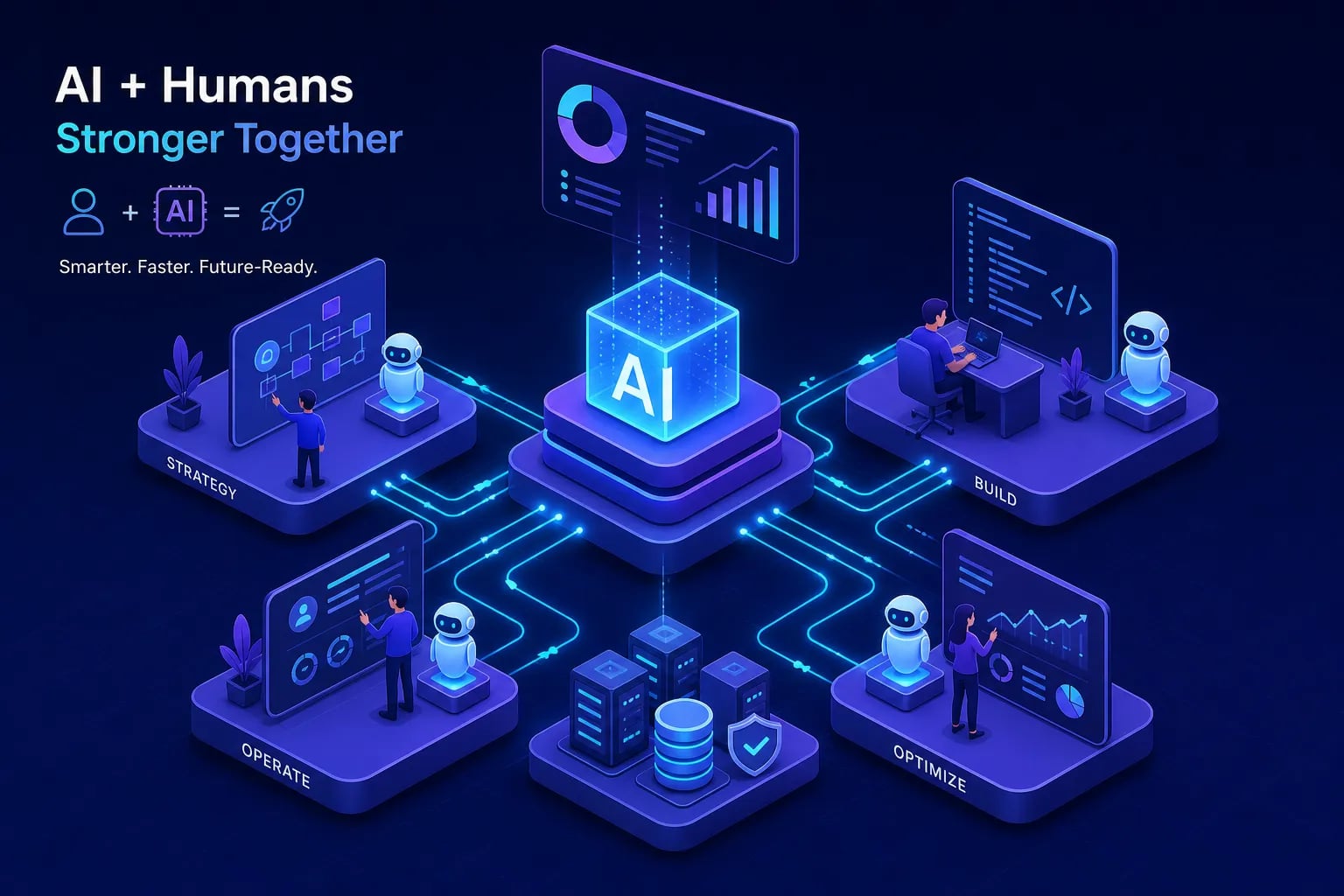
Future organisation design for an AI workforce begins with a structural question, not a software one. In 2026, 88% of organisations are already using AI in at least one core business function. Yet many mid-sized Indian companies are still running a revenue org structure designed for a pre-AI world, a gap that survey data on mid-market adoption consistently surfaces. Sales leaders layer AI tools onto existing team configurations and wonder why the results feel incremental rather than transformational. The answer, in most cases, is structural.
Redesigning your organisation for an AI workforce is not about replacing salespeople. It is about rebuilding the roles, workflows, and accountability layers so that humans and AI each do what they are genuinely better at. That distinction matters enormously. Without it, AI remains a productivity add-on rather than a structural input to how your revenue team actually operates.
At Growth Aspire, we have been guiding Indian mid-sized sales organisations through exactly this kind of redesign challenge, combining deep sales methodology expertise with AI-enabled programmes built specifically for revenue teams. The frameworks in this article reflect what we see working on the ground.
Why the current org structure isn’t built for AI integration
Most org structures were architected around human information processing. For example in b2b sales, Territory reps gather intelligence, managers aggregate it, and directors act on it weeks later. AI disrupts every layer of that chain because it processes pipeline signals, drafts outreach, and scores opportunities in seconds, not cycles. The org structure was never designed to accommodate a team member that never sleeps and never loses a data point.
The World Economic Forum projects 85 million roles displaced globally by end-2026, alongside 97 to 170 million new ones created by 2030. But here is the nuance that most revenue leaders miss: sales and marketing sit firmly in the augmentation zone, not the automation zone. AI supports lead scoring, content generation, prospecting, and pipeline forecasting. It does not replace human relationship management, complex negotiation, or strategic account planning. That reframe is critical. The question is not whether to rearchitect your org structure for AI, but when, and how deliberately you approach it.
The current pressure on revenue teams is real. In 2026, 78% of mid-market B2B sales organisations report using AI tools or running pilots. Yet only 37% of sales professionals use AI as part of their daily workflow. That gap between adoption and integration is where most organisations lose value, and it is a structural problem before it is a skills problem.
Future organisation design for an AI workforce: how roles actually evolve
A clear task-ownership split is the foundation of any AI-ready org design. AI should own data enrichment, outreach sequencing, pipeline health alerts, meeting summaries, and forecast modelling. Humans must own stakeholder trust-building, complex negotiation, multi-buyer consensus creation, and strategic account planning. This is not about shrinking headcount. It is about restructuring what each person on your team actually focuses on each day.
In 2026, hybrid role archetypes are taking shape across mature revenue teams. The most relevant for Indian mid-sized B2B organisations is the AI-Literate Account Executive, someone who uses AI co-pilots for deal intelligence and real-time context but leads every customer interaction personally. Alongside this role, Revenue Intelligence Analysts are emerging to interpret AI outputs and translate pipeline signals into strategy, while Sales Enablement Leads maintain the human capability layer that AI cannot replicate: coaching behaviours, building judgement, and embedding new workflows into daily practice. Each of these represents a reskilling path, not a redundancy notice.
Organisations that have moved ahead on this reconfiguration are reporting measurable outcomes. WPP consolidated its job architecture for the AI era and reported capacity gains of up to 25%. Johnson Controls reduced HR service delivery costs by 30 to 40% through AI self-service redesign. The common thread is not the technology itself. These organisations committed to a deliberate overhaul of how roles and workflows were structured around AI, rather than hoping the tools would sort it out on their own.
Human-AI collaboration models that actually work in revenue teams
The augmentation model is the most common entry point for mid-sized organisations, and it requires the least structural change. In this model, the human leads every customer interaction, but AI feeds them real-time context: deal risk scores, sentiment signals from previous conversations, competitive intelligence, and next-best-action prompts. The salesperson remains the decision-maker, but their cognitive load drops significantly. Collaborative intelligence research across enterprise AI deployments shows this model delivers the fastest adoption because it fits naturally into existing selling behaviours, rather than demanding a wholesale change in how reps work.
In more mature deployments, organisations move to what is often called the review-gate model. Here, AI handles end-to-end tasks such as outreach, follow-up scheduling, and initial qualification, and humans review outputs at defined checkpoints before action is taken. This is the human-in-the-loop pattern, and it requires explicit accountability design. Who reviews the outputs? What specifically do they check for? What triggers an escalation to senior review? Without answers to those questions, errors propagate at machine speed. Design the gate before you open the automation.
For B2B teams operating in complex, multi-stakeholder environments, a common profile among Indian mid-sized companies, the augmented SDR model is proving particularly effective. AI continuously surfaces buying signals, compiles account research, and drafts personalised outreach, while the human rep decides when and how to engage. Relationship quality and local market knowledge still determine the outcome; AI simply ensures the rep walks into every conversation better prepared.
A practical 6, 12 month roadmap for future-ready organisation design with an AI workforce
Phase 1 (months 1, 3): Diagnose, map, and pilot with precision
Start with a current-state assessment. Identify which revenue workflows are fragmented, where data quality is weak, and which teams have the highest tolerance for change. Select two or three specific pilot use cases rather than attempting an org-wide rollout. Strong candidates for Indian mid-sized B2B teams include AI-assisted outreach sequencing, pipeline health dashboards, and deal intelligence reporting.
In this phase, also begin mapping roles against the task-ownership split described earlier. Some organisations use digital-twin organisation tools such as Mavim or BusinessOptix to simulate the impact of role changes across processes, headcount, and capability requirements before a single job description changes. It is a low-risk way to stress-test your redesign assumptions before committing to structural decisions.
Phase 2 (months 4, 12): Scale, codify, and govern
Once pilots show measurable results, codify the workflows that worked and extend them to adjacent teams. Revisit your org chart with fresh eyes. Which roles have genuinely changed in scope? Which titles are now redundant? Where do you need net-new capability, such as a Revenue Intelligence Analyst or an AI Operations lead? Build your escalation and governance model in parallel with scaling, not after. Scale without governance creates speed without accountability, and in revenue functions, that is a direct pipeline risk.
Track these KPIs across both phases to assess whether your structural decisions are delivering:
- Pipeline velocity, are deals moving faster through the funnel?
- Win rate changes, is the quality of pipeline improving alongside volume?
- Quota attainment per rep, is the redesign translating into individual performance?
- AI tool adoption rates, are sellers integrating AI into their daily workflow?
- Average time saved per seller per week, is cognitive load actually decreasing?
These metrics tell you whether the structural redesign is delivering, not just whether the tools are being used.
Change management, reskilling, and where the real work happens
Most AI rollouts stall not because the technology does not work, but because the humans using it were not prepared. Sales professionals who have not been trained to interpret AI outputs, challenge its recommendations, or use it to accelerate their own performance tend to either over-trust the system or ignore it entirely. Reskilling for an AI-enabled workforce means building AI literacy alongside selling skills, not as a separate initiative delivered in a different quarter.
Hands-on, workflow-integrated training consistently outperforms conceptual AI literacy programmes in measurable performance outcomes. Programmes that teach practical AI use in prospecting, outreach, CRM management, and proposal creation are the ones most clearly tied to improvements in time saved, pipeline creation, and conversion rates. An Accenture analysis of structured AI-enabled selling programmes found 12% higher quota attainment among trained workers compared to untrained peers. The structure and the coaching cadence matter as much as the content.
This is where our work at Growth Aspire becomes directly relevant. Our AI Enabled Solutions for Revenue Teams are built specifically to help Indian mid-sized companies redesign how their sales professionals operate alongside AI tools. The programmes combine structured skill-building in deal intelligence, pipeline management, and coaching cadences with the practical change management support that makes adoption stick. For heads of sales navigating an organisational overhaul, this kind of structured, India-contextual support shortens the transition and protects quota attainment during the shift.
Governance, accountability, and measuring whether the redesign is working
Every AI-integrated org design needs clear decision rights. Who owns the model outputs? Who reviews AI-generated pipeline forecasts? Who is accountable when an AI recommendation contributes to a lost deal? Effective AI governance frameworks for revenue teams follow the same principles established in recognised standards such as the NIST AI Risk Management Framework: document what AI may and may not decide autonomously, assign a qualified human reviewer for high-stakes actions, and build an incident escalation path that does not rely on informal judgement.
In practice, your accountability structure should include an executive sponsor for overall ownership, a programme lead for day-to-day coordination, a sales or revenue operations owner for the workflow use cases, and a legal or compliance reviewer for any AI tool touching compensation, territory, or performance decisions. This is not a compliance exercise for its own sake. It is what keeps your redesign trustworthy, for your team and for your customers.
Alongside operational KPIs, monitor cultural metrics through quarterly pulse checks. Track team confidence with AI tools, willingness to challenge AI recommendations, and whether individual sellers feel the redesign has improved or complicated their working day. A future-ready revenue team only works if the humans inside it are progressing, not just the algorithms. Governance is the mechanism that ensures both move forward together.
Building a future-ready revenue team starts with structure
Future organisation design for an AI workforce is a structural project, not a software project. The companies building genuinely future-ready revenue teams are the ones treating role evolution, human-AI collaboration models, reskilling, and governance as a coordinated programme, one integrated effort, not a series of disconnected technology deployments. For mid-sized Indian companies, the window to get ahead of this curve is now, while the structural decisions are still yours to shape rather than react to.
Here is the real test: when your best account executive opens their laptop tomorrow morning, does the organisation they work within make them sharper, or does it simply ask them to do the same job with more tabs open? That is the question that future organisation design with an AI workforce is built to answer. Use the roadmap and frameworks in this article as a starting point for your 6 to 12 month journey. Assess your current state, select targeted pilots, codify what works, and build governance in parallel with scaling. If you want structured support for the reskilling and AI-enablement side of that journey, our programmes at Growth Aspire are built to help you move from planning to measurable performance improvement, without losing momentum mid-transformation. Reach out to our team to discuss where your redesign stands and what a structured next step looks like for your organisation.