



Many mid-sized B2B sales teams in India report a persistent structural gap: leadership expects more pipeline, but headcount stays flat. Reps typically spend between eight and fourteen hours per week on CRM updates, follow-up sequencing, and research tasks that have nothing to do with closing, time measured consistently across sales productivity studies. A coordinated network of AI sales agents, what practitioners now call a multi agent sales system, is the architecture that addresses this mismatch directly. At Growth Aspire, we observe this pattern regularly in our work with Indian B2B teams, and the shift from single-tool AI automation to a properly coordinated agent system often correlates with larger gains in pipeline velocity than incremental tool upgrades ever deliver.
This article covers the four things you need to understand before deploying one of these systems: how the architecture actually works, which agents own which part of your funnel, what the measured revenue outcomes look like in real deployments, and how to roll it out without disrupting the sales team you already have.
What a multi agent sales system actually is
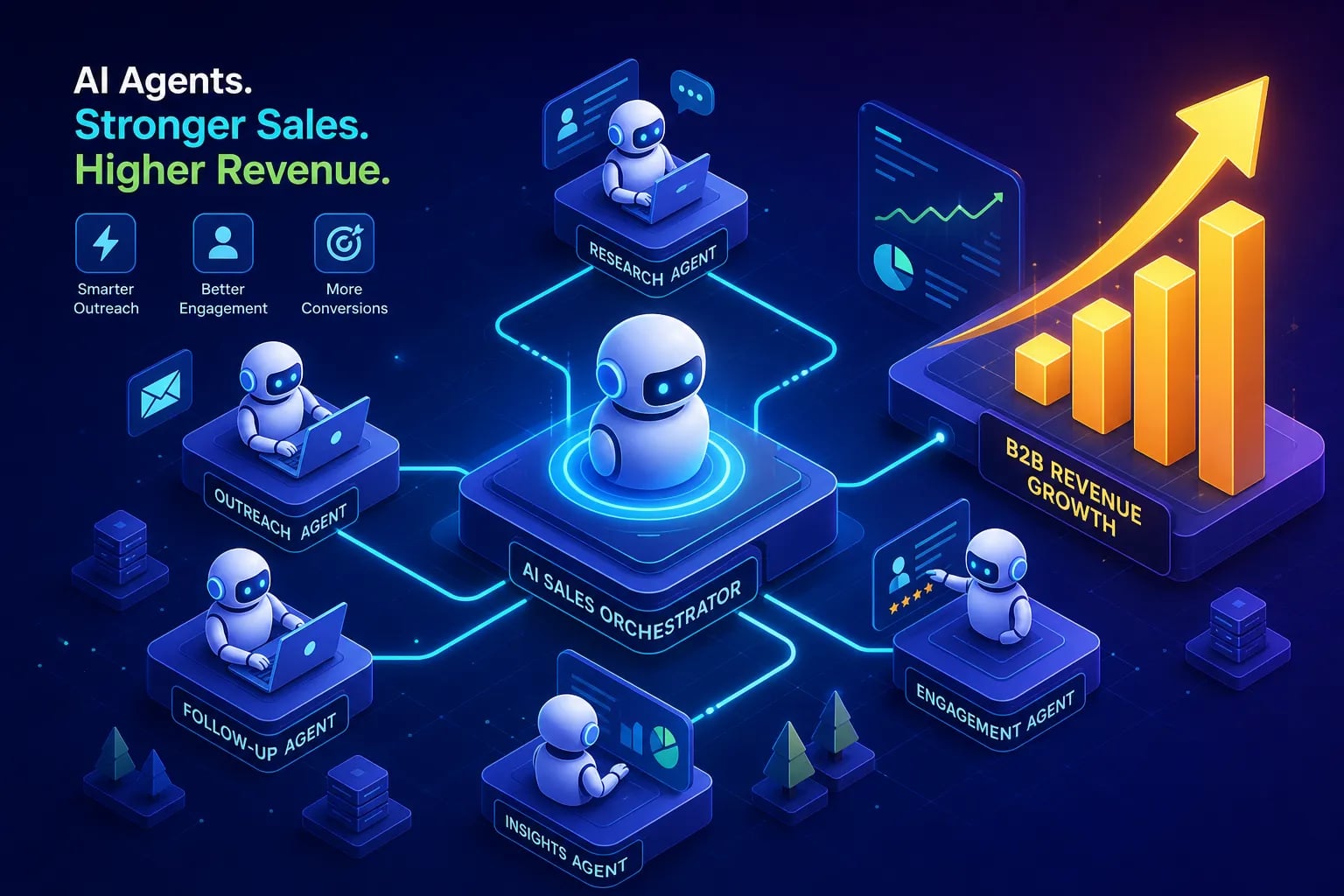
The simplest way to describe this architecture is a network of specialised AI sales agents, each responsible for one discrete sales function, coordinated by an orchestrator that decides what happens next. This is categorically different from a standalone AI tool like an email assistant or a lead-scoring widget. A single tool waits for a human to trigger it; a coordinated agent network, what some practitioners call a MAS for sales, routes work independently based on rules, real-time data signals, and the outputs of other agents in the system.
The difference between a single AI tool and a coordinated agent network
An AI email assistant generates a draft when you ask it to. A lead-scoring model produces a score when CRM data is pushed to it. These tools are useful in isolation, but they have no awareness of each other and no ability to act on their own outputs. In a networked agent architecture, the output of one agent becomes the input of the next. The qualification agent’s score triggers the outreach agent’s first-touch message, which then feeds the follow-up agent’s sequencing logic. The key distinction is autonomy combined with coordination: the system moves deals forward without waiting for a rep to initiate each step. A useful benchmark here is speed-to-first-response, autonomous sales agents operating in coordinated architectures consistently engage qualified leads faster than human-initiated processes allow.
The four layers every coordinated agent system needs
Regardless of the platform you choose, a functional multi-agent architecture has four components:
- An orchestrator that routes work, sequences steps, and manages handoffs between agents. Think of it as the team lead who assigns tasks and tracks progress, the hub-and-spoke coordinator that keeps the whole system coherent.
- Specialist agents, each focused on one job: prospecting, qualification, outreach, deal intelligence, or CRM maintenance. Keeping roles narrow is what allows each agent to execute with consistency.
- A shared memory layer so every agent sees the same deal history, stakeholder context, and prior interactions. Without this, agents act on incomplete information and contradict each other.
- An integration layer that connects the system to your CRM, email, calendar, and enrichment tools so sales automation agents can act in the systems your team already uses.
Visit Multi-Agentic-System discover various AI agents or workforce that can be deployed in the b2b sales system
Why B2B sales specifically benefits from this model
B2B sales cycles involve multiple stakeholders, parallel tracks of activity, and long timelines where things stall between touchpoints. A single rep managing several active opportunities will inevitably drop something when attention shifts to a high-priority close. An agent-based architecture mirrors the complexity of B2B selling: agents work different tracks simultaneously, so a stalled follow-up in one deal does not go unaddressed simply because the rep is on a call with another prospect.
How each AI agent owns a different stage of your funnel
The operational value of a multi agent sales system becomes clear when you map specific agents to the stages of your pipeline. Each agent owns a narrow function and executes it with a consistency that no rep, however disciplined, can match across dozens of simultaneous opportunities.
Prospecting and qualification agents working in parallel
The prospecting agent surfaces ICP-matched accounts from enrichment databases and intent data signals continuously, not just when a rep has time to research. Simultaneously, the qualification agent scores inbound leads against your fit criteria and routes them based on score thresholds. Because these two agents run in parallel rather than in sequence, pipeline coverage can grow without immediate headcount increases in most deployments. The qualified lead reaches your rep already researched and scored; the rep’s first conversation is substantive rather than exploratory.
Outreach and follow-up agents: consistency at scale
The outreach agent drafts personalised first-touch messages using account context, past interactions, and buying signals from the enrichment layer. The follow-up agent monitors reply status and sends sequenced messages at optimal intervals without rep intervention. Together, these two agents eliminate the most common cause of lost deals in any manual process: the follow-up that never happened because the rep was focused elsewhere. A 2026 deployment benchmark reported that teams using AI sales agents alongside human reps saw a 41% increase in pipeline generation, driven largely by this consistency in outreach coverage. (Source: 2026 Agentic Sales Deployment Benchmark, cite directly when referencing this figure.)
Deal intelligence and CRM agents closing the feedback loop
The deal intelligence agent monitors open opportunities for risk signals: stalled conversations, missed touchpoints, and stakeholder changes that indicate a deal is drifting. When a risk signal crosses a threshold, it flags or escalates to the rep or sales manager automatically. The CRM maintenance agent keeps contact records, activity logs, and opportunity stages current without requiring reps to manually log every interaction. Real deployments have reported up to 73% reduction in manual data entry through this agent combination, though results vary by deployment scope, which means sales leaders get accurate forecasting data in real time rather than from whatever the rep last remembered to update.
The revenue numbers B2B teams are already measuring
The business case for a multi agent sales system is no longer theoretical. Companies that have deployed coordinated agent systems since 2024 are reporting specific, measurable outcomes across pipeline, conversion, and cycle time.
What recent deployments have actually measured
The 11x Alice 2.0 multi-agent SDR system sourced nearly 2 million leads, sent approximately 3 million messages, and generated roughly 21,000 replies at a reply rate comparable to human SDR performance (11x.ai, Alice 2.0 deployment report, verify link before publishing). A B2B pipeline automation case study from 2025 reported 28% revenue growth, 52% faster deal cycles, and 89% lead-scoring accuracy from an agent-based prospecting and qualification workflow (vendor-reported results; review methodology and sample caveats before citing). The Questex deployment of AI sales agents delivered $1.056 million in revenue within 90 days, with inbound conversion rates lifting from 30% to 37% (Questex case study, add source link). A 2026 benchmark across agentic sales teams reported inbound conversion improving from 11.3% to 19.8% and qualified opportunity volume increasing by 144% among leading deployments (2026 Agentic Sales Benchmark, add publisher citation and note cohort definition).
What is actually driving the lift: speed, coverage, or both
The common factor across high-performing deployments is not that AI agents are smarter than reps. It is that autonomous sales agents are faster and more consistent at the repetitive tasks that fall through the cracks in every manual process. Speed means the qualified lead hears from you before a competitor does. Consistency means no follow-up is ever skipped because an agent is never distracted, never in back-to-back meetings, and never managing too many deals to remember the third touchpoint on an account from six weeks ago.
Rolling out a multi agent sales system without disrupting your team
The implementation question is where most teams hesitate, understandably. Deploying a multi-agent architecture into an active sales stack carries real disruption risk if done without structure. Every deployment case study reviewed points to one principle: start narrow, prove the workflow, then expand.
Start with one workflow, not the whole funnel
Teams that attempt to automate the entire sales funnel at once create data chaos, rep confusion, and governance gaps simultaneously. Teams that start with a single, high-value workflow, inbound qualification, follow-up sequencing, or CRM writeback, build confidence and clean data before adding complexity. The right starting workflow is the one where dropped balls cost you the most. For many Indian mid-market B2B teams, that tends to be follow-up sequencing, because the volume of prospects who never hear from a rep again after the first touch is both significant and immediately measurable.
The six-phase rollout that keeps reps in control
A reliable rollout follows six phases:
- Discovery and workflow selection: Map the current process, identify the highest-friction manual tasks, and define success KPIs before building anything.
- Architecture and agent boundary design: Assign one primary role per agent, eliminate overlapping responsibilities, and specify what each agent passes to the next.
- Sandbox build with CRM integration: Connect only the systems required for the first workflow and instrument monitoring from the start.
- Unit testing and handoff testing: Validate each agent independently, then test every agent-to-agent handoff under realistic load.
- Parallel pilot with human approval on key actions: Run the system alongside the existing manual process, let reps review outputs before they go live, and use this phase to build trust rather than bypass it.
- Controlled scale-up: Add the next workflow only after the pilot is stable and the data is clean.
Multi agent sales system platform choices for Salesforce, Dynamics, and Zoho environments
The right platform depends on your existing stack. Salesforce Agentforce is the native choice for Salesforce CRM environments, with agent orchestration built into the CRM layer. Microsoft Copilot Studio and Azure AI Foundry Agent Service are the natural fit for Dynamics 365 stacks, integrating across the Microsoft 365 and Power Platform ecosystem. For teams running Zoho CRM, or those who need cross-platform orchestration across multiple systems, workflow orchestration tools like n8n offer the broad SaaS connectivity that CRM-native platforms do not. Choose based on where your data already lives, not on which platform has the loudest marketing presence in 2026.
Data governance and compliance every Indian B2B team must address
India’s Digital Personal Data Protection Act 2023 creates specific obligations that apply the moment personal data moves between AI agents. This is not a future consideration; it is a baseline requirement for any deployment that handles customer data today.
What the DPDP Act means for your agent deployment
The DPDP Act requires purpose limitation, data minimisation, and security safeguards for all processing of personal data. That obligation follows the data even when it moves between AI agents rather than between humans. Legally, the organisation deploying the system remains the data fiduciary and retains full accountability; operationally, each agent in your system that accesses customer data should be treated and governed as a processor or sub-processor. Consent-aware memory architecture, per-agent data minimisation, and PII redaction before inter-agent transfers are not optional safeguards, they are baseline requirements under the Act. If your system is classified as a Significant Data Fiduciary, you will also need a named Data Protection Officer, periodic audits, and Data Protection Impact Assessments before going live.
Practical security controls to enforce before you go live
Assign a unique identity and scoped permissions to each agent rather than shared credentials across the system. Require structured, authenticated handoffs between agents and encrypt all inter-agent communication. Implement immutable audit logs that record which agent acted, on what data, and why; this traceability is as important for internal governance as it is for regulatory compliance. Set human approval gates for high-risk actions such as external messaging, CRM writes, and deal escalations until the system has demonstrated reliability. These controls also give your team a complete, auditable trace of every agent decision if a deployment issue arises.
How Growth Aspire helps mid-sized Indian companies adopt this architecture
The technical deployment of a coordinated multi agent sales system is only half the challenge. The other half is getting your sales team to trust it, work with it, and build their process around it rather than revert to the old manual workflows. Mid-sized Indian B2B teams consistently face a gap between a system that works in a sandbox and one that reps actually use in the field. That gap is not a technology problem; it is a behaviour change problem, and no platform vendor resolves it for you.
Growth Aspire’s AI Agentic Solutions are designed for mid-market implementation. They combine system design and CRM integration with rep onboarding, coaching, and adoption support, the elements that determine whether a deployment drives measurable pipeline velocity or sits unused after the first month. For Indian B2B teams navigating DPDP compliance obligations, existing CRM setups, and sales teams that are not yet familiar with agentic workflows, a guided implementation approach removes the disruption risk that stops most organisations from moving forward at all.
The bottom line on multi agent sales system architecture
A coordinated network of AI sales agents works because it handles parallel tracks simultaneously rather than sequentially. Prospecting, qualification, outreach, follow-up, deal intelligence, and CRM maintenance all run in parallel, something no rep or manager can replicate manually across a full pipeline. The result is faster cycles, higher conversion, and forecasting data that is actually accurate.
The implementation principle that holds across every successful deployment is consistent: start narrow, prove one workflow completely, then expand. Teams that try to automate everything at once create chaos; teams that start with the workflow where dropped balls hurt them most build the confidence and clean data that make the next stage reliable.
If you are evaluating whether a multi agent sales system is the right move for your team, or if you are ready to move from evaluation to implementation, Growth Aspire’s AI Agentic Solutions offer a structured path from architecture design to rep adoption. Review the programme details and see how Indian B2B teams are deploying this model to accelerate pipeline without adding headcount.
Frequently asked questions about multi agent sales systems
How does a multi agent sales system differ from a single AI sales tool?
A single AI tool responds when a human triggers it and has no awareness of other tools in your stack. A multi agent sales system connects multiple specialist agents, prospecting, qualification, outreach, follow-up, deal intelligence, under a shared orchestrator. Agents act on each other’s outputs automatically, moving deals forward without waiting for rep input at every step.
What ROI benchmarks should Indian B2B teams expect?
Published deployment data from 2025 and 2026 shows a wide range: pipeline generation increases of 41%, inbound conversion improvements from roughly 11% to nearly 20%, deal cycle acceleration of up to 52%, and reductions in manual data entry of up to 73% in some cases. Results vary significantly by deployment scope, starting workflow, and how well rep adoption is managed. Treat these as directional benchmarks rather than guaranteed outcomes.
Is a multi agent sales system compliant with India’s DPDP Act?
Compliance is achievable but requires deliberate design. The organisation deploying the system remains the data fiduciary under DPDP. Each agent accessing personal data must be governed operationally as a processor, with purpose limitation, data minimisation, PII redaction on inter-agent transfers, and immutable audit logs. Significant Data Fiduciaries face additional requirements including a Data Protection Officer and impact assessments.
Which CRM platforms support multi agent sales system deployment?
Salesforce environments are best served by Salesforce Agentforce. Microsoft Dynamics 365 teams can use Copilot Studio or Azure AI Foundry Agent Service. For Zoho CRM or cross-platform requirements, orchestration tools such as n8n provide the connectivity that CRM-native platforms typically cannot.
How long does a phased rollout typically take?
A six-phase rollout, from discovery through controlled scale-up, typically spans eight to sixteen weeks for the first workflow, depending on CRM complexity and integration scope. Teams that compress this timeline by skipping testing or parallel-pilot phases consistently report higher disruption rates and lower adoption.