



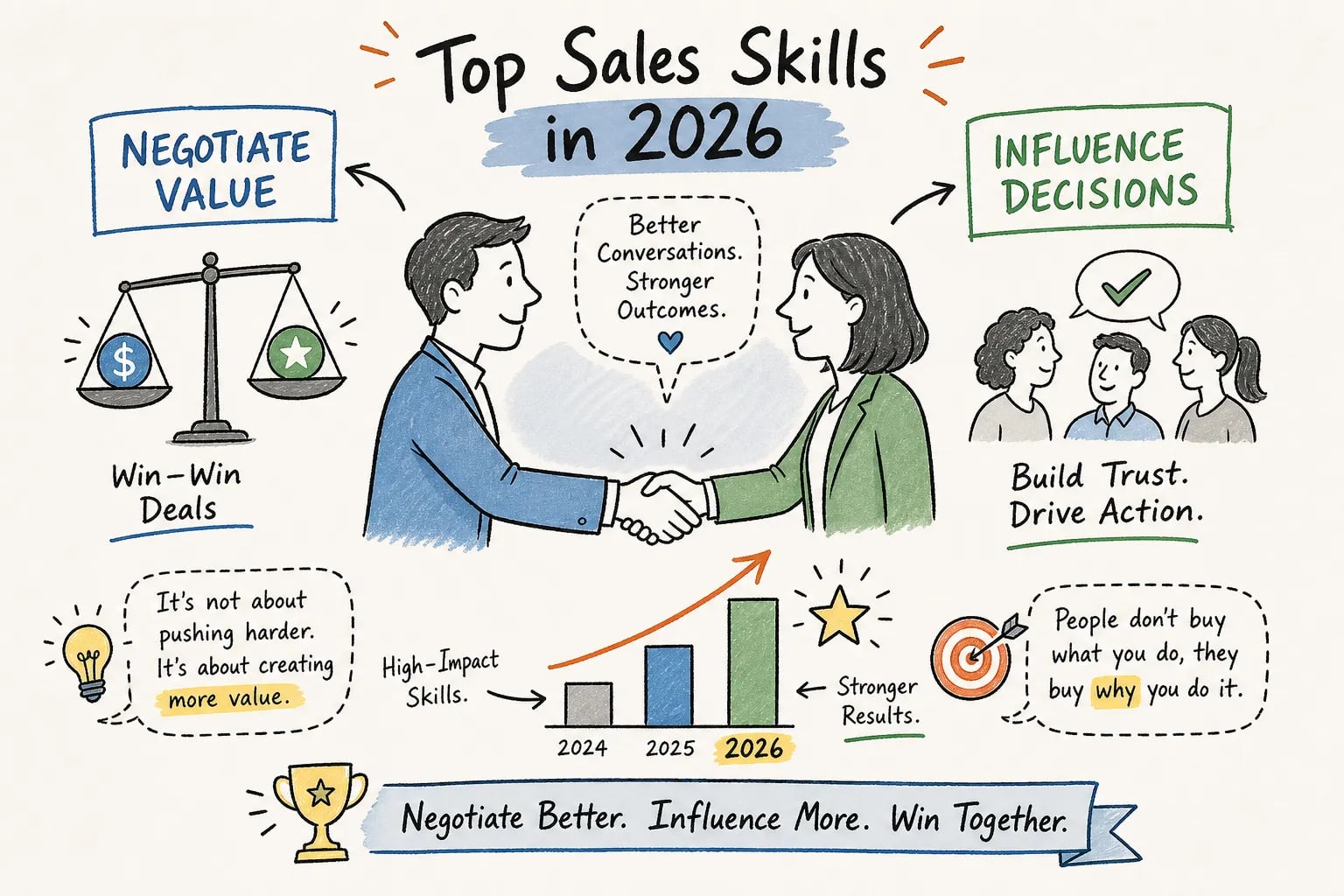
Sales leaders across India keep asking the same question: why are their teams losing deals they should be winning? The pipeline looks healthy, the product is competitive, and the team knows the solution inside out. Yet deals stall, discount requests escalate, and late-stage opportunities collapse with no clear explanation. Growth Aspire has been tracking this pattern across its client base, observing late-stage loss trends across mid-sized technology firms and enterprise sales teams in India, and the answer points consistently to the same two gaps: negotiation and influence.
These are not soft skills at the edges of a competency framework. In complex, multi-stakeholder B2B deals, negotiation and influence sit at the centre of every commercial conversation that matters. Procurement behaviour reinforces it, and the economic environment makes it more urgent by the quarter. Recent indicators from Forrester, GoConsensus, and HG Insights show that B2B buyers in India are more informed, more cautious, and more deliberate than they have been in years. Teams that cannot negotiate value and guide decisions through ethical persuasion are steadily losing ground to those that can.
This article unpacks why negotiation and influence are the top-rated sales skills of 2026, what the research shows about their commercial impact, and what sales leaders can do about the gap right now.
Why negotiation and influence are top-rated skills: the forces reshaping B2B sales
Buyer sophistication is outpacing seller preparation
Buyers in 2026 arrive at negotiations with more information, more options, and considerably less patience for generic pitches. Forrester’s 2026 State of Business Buying found that buyers now complete 70 to 80 per cent of their research before making first contact with a sales representative. This is not incremental change; it is a structural shift in what the sales conversation is actually for.
When buyers arrive this well-prepared, product knowledge stops being a differentiator. The seller’s advantage no longer lies in what they know about the product; it lies in their ability to negotiate value, reframe objections, and guide a conversation toward commitment without losing the relationship in the process. That is a fundamentally different skill set from the one most sales training programmes have historically prioritised.
Economic pressure and longer deal cycles are raising the stakes
Macro-economic headwinds across 2025 and 2026 have made procurement teams more cautious, approval chains longer, and deal cycles more complex. The GoConsensus 2026 B2B Buyer Behaviour Report found that 77 per cent of B2B buyers described their most recent purchase as highly complex or difficult. In India’s mid-market technology segment, multi-stakeholder deals involving three or more decision-makers have become the norm rather than the exception. Average deal cycles across comparable B2B segments are estimated to have extended from roughly 30 to 90 days in 2023 to 60 to 120 days by 2026, based on available benchmarks, though actual figures will vary by sub-sector and deal size.
Every additional stakeholder in a deal is another negotiation. Every additional approval layer is another influence challenge. Teams that lack structured bargaining and persuasion skills are watching deals stall or collapse at late stages, often without understanding why. The problem is rarely the product. It is almost always the conversation around value, risk, and commitment.
What the research actually shows about negotiation as a performance driver
Compensation, win rates, and deal value: the hard numbers
The evidence for negotiation training’s impact on commercial outcomes is more robust than most sales leaders realise. A large-scale NBER field experiment found that a targeted negotiation intervention increased total compensation gains by an average of 13.9 per cent, with an estimated $7,377 in additional annual compensation for those who negotiated versus those who did not. A related study summarised in Annual Reviews reports a 2.2 per cent increase in reported salaries for trained negotiators versus control groups. These are not marginal gains; they are the kind of numbers that make a measurable difference to a sales team’s revenue output at scale.
In sales-specific contexts, studies tracking pre- and post-training performance report measurable improvements in win rates, average deal size, and margin protection. Research on Nokia’s sales teams, for example, documented shorter deal cycles and reduced discounting after structured negotiation training. These are precisely the metrics that heads of sales and revenue teams can trace directly to commercial negotiation competence, making the return-on-investment case straightforward rather than speculative.
The career compounding effect of negotiation mastery
An MIT and Negotiation Journal survey of trained negotiators found that 30 per cent attributed direct pay or promotion outcomes to their negotiation skills, and over 80 per cent reported using negotiation techniques actively in their day-to-day work.
For individual sales professionals, that data points to something beyond the single deal. Sellers who consistently protect value and navigate complex multi-stakeholder deals build a professional reputation that generates more qualified opportunities over time. That reputation is itself a commercial asset, one that compounds across a career in ways a single product certification never will.
Why negotiation and influence are becoming top-rated skills: the persuasion layer
Ethical persuasion is not a soft add-on
Negotiation and influence work together, and understanding why influence and persuasion techniques are becoming top-rated skills requires separating them from pressure tactics. Ethical persuasion draws on behavioural science: understanding how buyers process risk, how anchoring affects perceived value, and how reciprocity and trust accelerate commitment. Behavioural science research confirms that anchors carry greater weight when buyers have less prior knowledge of a product category, because they have fewer internal benchmarks against which to evaluate an offer. Framing has been shown in controlled studies to have a significant effect on a buyer’s willingness to commit, simply by presenting the same outcome as a gain rather than a cost.
Sellers who rely purely on discounting or persistence are using the bluntest tools available. Those who understand influence and persuasion techniques can shape the conversation well before formal negotiation begins, which shortens cycles and raises win rates at the same time. Reciprocity functions in complex sales when the seller provides genuine value before asking for commitment, creating the conditions for a more open and honest negotiation. These are not manipulation tactics; they are communication skills grounded in how buyers actually make decisions under uncertainty, a distinction that behavioural researchers draw clearly around intent, sincerity, and the conditions under which reciprocity strengthens versus weakens.
How framing changes outcomes before a single number is discussed
Decision-making research consistently shows that buyers respond more to how an offer is framed than to the raw terms themselves. Skilled sellers use this knowledge to present options in ways that make the preferred outcome feel like the buyer’s own conclusion. This is communication architecture, and it is the layer of skill that separates competent negotiators from elite ones in complex, multi-stakeholder deals. When a senior procurement lead arrives at a buying decision feeling that they guided the process, rather than being sold to, the relationship is stronger, the close is faster, and the terms are less likely to be unpicked post-signature.
The skill gap most B2B sales teams in India aren’t addressing
Why product knowledge alone is no longer enough
The most common pattern in underperforming B2B sales teams is an over-investment in product training and an under-investment in negotiation and influence. Sales professionals can articulate features fluently but struggle the moment a procurement lead pushes back on price or a deal stalls because a key stakeholder is unconvinced. These are negotiation problems, not product problems. Deals lost at late stages are rarely lost on product fit, a pattern Growth Aspire observes consistently across its client engagements. HG Insights’ 2026 B2B Buying Disconnect Report reinforces the point: 47 per cent of buyers reported lower trust in online resources than the prior year, which means the burden of building credibility and guiding decisions has shifted further onto the seller’s ability to communicate and negotiate effectively in real conversations.
What top-performing negotiators do differently and consistently
High performers do not improvise under pressure; they prepare systematically. They define their BATNA before entering any negotiation, ask more open-ended questions than they make statements, and trade across issues rather than conceding on price alone. Practitioner case studies and structured research on negotiation outcomes support five consistent behaviours:
- Thorough preparation: knowing your walk-away point, the other side’s likely priorities, and the objective data that supports your position
- Active listening and open-ended questioning: surfacing real interests and hidden constraints that create workable deals
- Building rapport early: making counterparties more willing to share information and trade value
- Win-win issue trading: adding issues to the discussion and trading concessions across priorities rather than fighting over a single variable like price
- Strategic concession planning: making small, deliberate concessions rather than large, emotional discounts
These behaviours are not innate. They are trained and reinforced over time through structured practice and feedback, which is precisely what most one-off sales workshops fail to deliver because they lack follow-up and real-scenario application.
Building negotiation and influence as a team-wide capability
Science-based development versus traditional training
The difference between a sales team that negotiates well and one that does not is rarely individual talent; it is the quality of the system behind them. Growth Aspire’s Ethical Persuasion Workshop is designed specifically for this challenge. Built for B2B sales teams in India’s mid-market and enterprise segments, it combines behavioural science principles with real-world deal scenarios, giving participants a structured framework for influence and negotiation they can apply in live deals from the outset. The workshop uses deliberate practice across simulated deal contexts, not passive instruction, so new behaviours embed beyond the training room rather than fading within a fortnight.
The follow-up structure matters as much as the workshop itself. A personalised coaching cadence after the initial session ensures that participants are applying what they have learned in live deals, not just recalling it in theory. This is the element that most generic training providers skip, and it is the element that determines whether negotiation improvement shows up in your quarterly numbers or stays confined to a feedback form.
Measuring improvement with the right KPIs
Negotiation skill development is only meaningful if it moves the metrics that matter. The most reliable indicators of improvement are win rate on competitive deals, average deal value, discount rate and concession frequency, sales cycle length, and client retention at the twelve-month mark. Tracking these before and after structured training gives sales leaders a clear return-on-investment picture and a baseline for ongoing coaching. The Harvard Program on Negotiation recommends monitoring performance before, during, and after several key negotiations rather than relying on a single post-training assessment, an approach that applies equally well to B2B sales teams operating in India’s complex technology and enterprise segments.
Why negotiation and influence now determine deal outcomes in India’s B2B market
In 2026, negotiation and influence are not trending skills awaiting mainstream adoption. They are the reason deals close or collapse in complex B2B environments right now. Buyers are more sophisticated, deal cycles are longer, procurement scrutiny is heavier, and every stakeholder added to a buying group is another influence challenge that an underprepared seller will handle poorly. A growing body of evidence, from NBER field experiments to Nokia’s sales team case study to the MIT and Negotiation Journal survey, shows consistent positive effects on compensation, win rates, and margin protection for teams trained systematically in negotiation and ethical persuasion.
The next step is straightforward:
- Identify where your team is losing deals on influence and negotiation rather than product fit
- Review your late-stage loss data and ask honestly whether the problem is what you are selling or how the conversation is being conducted
- Invest in science-backed training that uses real scenarios, behavioural reinforcement, and structured follow-up, not a single workshop that fades within weeks of delivery
- Measure the right KPIs before and after so the improvement is visible and defensible to the business
Negotiation and influence are the top-rated sales skills separating teams that win complex deals at full value from those that discount their way to a marginal close. If you want to understand how Growth Aspire can accelerate that development for your team, contact Growth Aspire directly to review the framework and the measurable outcomes your team can expect.